

Astrodevice Tilt Corrector for 90mm Diameter ZWO Pro Cameras & Celestron RASA 8 Telescope
Availability: Item has been discontinued by the manufacturer
Contiguous US Customers:
All items we sell ship for free within the Contiguous US. Shipping will be via the cheapest shipping method which will vary depending on the items in your order. During checkout, you may also be shown other optional faster shipping choices.
US Customers in Hawaii and Alaska:
Free shipping applies to almost all products. A few large telescopes and mounts are excluded from this free shipping offer. For these items, please contact us to obtain a shipping quote before you check out using the online shopping cart.
International Customers:
Free shipping does not apply to international orders. During check-out, you will be presented with several shipping choices and costs. However, the export of some items may be restricted outside the US due to size or manufacturer restrictions.
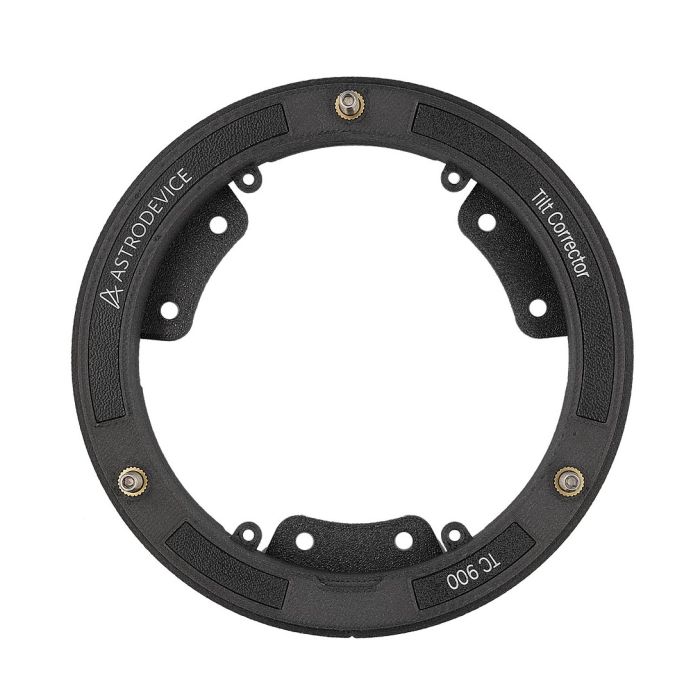
Tilt Corrector is a device used to conveniently correct the tilt of ZWO ASI cameras. It also allows you to correct the tilt created outside the camera, in the rest of the optical train, in telescopes with this type of cameras.
Please note that this is a 3d printed plastic part.
Astrodevice Tilt Corrector is a device used to make minimal changes in the position of an astrophotographic camera. With the help of this accessory, it is possible to both change the angle of tilt of the sensor and precisely adjust its position along the optical axis (backfocus).
The device is designed to work with cooled 90mm ZWO ASI cameras:
- ZWO ASI 2400 MC Pro
- ZWO ASI 2600 MM/MC Pro
- ZWO ASI 6200 MM/MC Pro
and any telescope: refractor or reflector.
The kit also includes an additional set of screws for attaching the camera’s original black tilt plate.
The base of the product are 3D printed elements made of PET-G CF filament (polyethylene terephthalate glycol-modified reinforced with carbon fiber).
The challenge
Like any Astrodevice design, the Tilt Corrector is also a solution to a specific problem. In this case, it’s a matter of proper alignment of the sensor in the image train. The thing is that the camera sensor must be set in a plane perfectly perpendicular to the optical axis of the telescope, in addition, at a precise distance from the front of the tube. Any deviation from the ideal state can lead to optical distortion, which usually manifests itself in deformed star shapes in the corners of the frame. The larger the sensor, the greater the scale of the problem. Likewise – the faster the optics, the more severe the problem also becomes. It is for this reason that users of fast telescopes such as the Celestron RASA often face the very difficult tilt problem.
Modern cooled astrophotographic cameras often have a tilt adjustment mechanism. For example, some ZWO ASI cameras have a distinctive black plate with screws on the front that allows you to enter the tilt of the camera. Unfortunately, the original method of adjustment may seem inconvenient to many people. To change the tilt angle, you have to first loosen the mounting screws, then fine-tune the adjustment screws and then tighten the mounting screws again. All of this must be done from the front of the camera, which is very inconvenient and often requires physically removing the camera and then reattaching it after adjustment. This whole process is not only uncomfortable, but also subject to a great deal of uncertainty, as each tightening of the screws, removal and reassembly introduces independent, unwanted misalignments. In the case of some telescopes, e.g., the RASA 8, the camera must be taken off for adjustment because when it is put on the telescope, there is no physical access to its front.
The Solution
In an effort to solve the problem described above, Astrodevice constructed a device that meets the following objectives:
- allows adjustment accessible from the rear of the camera,
- has zero optical length,
- allows the camera to be used the same as without it,
- can be used with any telescope and with any accessories (e.g. any filter drawer, any adapters, any filter adapter),
- adjustment is very easy.
Out of all these ideas came the Tilt Corrector, an accessory for ZWO cameras to easily adjust tilt.
- The device has the form of a ring. It is attached to the camera using the original mounting screws supplied with the camera itself. It comes with three tilt adjustment screws available from the rear of the camera. There is no need to loosen, tighten or remove the camera to change the settings. Tilt adjustment is available all the time while the camera is mounted on the telescope, so even adjustment with live view is possible.
- Tilt Corrector allows you to use the original tilt plate. First, the Tilt Corrector is mounted to the camera from which the original tilt plate was taken off, and in a second step the tilt plate is screwed to the front of the Tilt Corrector. In this way, the camera again has the original tilt plate on the front, but now the tilt adjustment is done through the Tilt Corrector.
- With the ability to use the original tilt plate, the camera can be used as it has always been – attaching the same adapters, connectors and devices to it as without the Tilt Corrector. The presence of the Tilt Corrector in this sense is transparent. The camera with or without the Tilt Corrector can be used the same way, the same accessories can be attached to it.
- Thus, the whole set can be used not only with any accessories1 but also with any telescope.
- Tilt Corrector can also be used with Astrodevice filter drawers2. Thanks to special clamps, it can also be used with FD 900 M87 filter drawer instead of the original tilt plate. Of course it can be also used with Astrodevice RSF R8 single filter adapter.
There is also another very important, in fact, almost revolutionary feature: Tilt Corrector allows you to transfer the correct tilt settings to the original tilt plate and Astrodevice filter drawers.
So you can:
- Put the Tilt Corrector on the camera
- Set the correct tilt, e.g. in live view
- Take the camera off the telescope
- Copy the settings to the original black tilt plate, filter
- drawer or camera adapter Astrodevice
- Take off the Tilt Corrector and use the camera with the correct tilt setting
Of course, you can also use the camera with the Tilt Corrector always on – you have complete freedom here. This is possible even with cameras mounted on the front of the telescope. Tilt Corrector is as narrow as possible. Even with RASA 8, the Tilt Corrector obscures only 7% more light compared to the default setup with the camera alone. But – as already said – if for some reason this is too much for you – you will be able to take it off after making the right settings.
1 In continuous operation, that is, when the Tilt Corrector is put on the camera, any accessories can be screwed to the black original tilt plate using the original M42 thread in the front. However, due to the geometry of the drawer, the first 5 mm of the optical path behind the tilt plate has limited freedom. An accessory screwed directly to the black tilt plate must not be larger than 70 mm in diameter for the first 5 mm, nor must it contain side-extending moving parts in this area. If, for example, you want to use a filter drawer from another manufacturer, while using the Tilt Corrector, you must first screw in a spacer ring with a height greater than 5 mm into the black tilt plate, and only then screw the drawer to it. Please refer to the Users Manual for details.
2 When you combine the Tilt Corrector with Astrodevice filter drawer, the role of the device is to set the correct tilt in the drawer through the aforementioned feature of being able to copy the correct settings. When working with the Tilt Corrector having FD 900 M87 filter drawer attached, that is, when setting the tilt, you cannot use the slide-out filter sliders. Only the front filter should be used. To take full advantage of the filter drawer’s features, after setting the proper tilt with the Tilt Corrector, remove it and mount the drawer directly on the camera.
Results
With the help of the Tilt Corrector, unwanted sensor tilt can be effectively minimized or completely eliminated. The following photos show the results of an experiment conducted using the Tilt Corrector with the original tilt plate and the Astrodevice RSF R8 filter adapter attached. The set used a ZWO ASI 2600 MM Pro camera and a Celestron RASA 8 telescope.
The first image shows the initial state of the set-up fraught with severe distortion due to improper mounting of the accessories.
The second image shows the same section of sky after the adjustment made with the Tilt Corrector.
Beneath each of the images you can see the star field analysis performed with CCD Inspector. As you can see, the result obtained after the correction shows zero tilt and virtually complete elimination of distortion.

Adjustment resolution
Although the adjustment screws allow continuous movement, once making a micro-adjustments, we are usually able to do it in jumps, with only some accuracy. By making a movement with our hand, we first break the frictional resistance, the screw is set in motion, and even if we want to stop this movement immediately, the signal controlling our nerves arrives to our brain with some delay. Also, taking into account the flexibility of our fingers, we are not usually able to make a smaller movement than a certain limiting minimum. Experience with Tilt Corrector indicates that such a minimum rotation is roughly 5 degrees.
The device is equipped with adjustment screws with a thread pitch of 0.7 mm. The adjustment screws are located 51 mm from the optical axis. This means that when you turn the adjustment screw 5 degrees, you move the corner of the APS-C sensor by about 0.003 mm and therefore you’re able to correct about 0.01 degree of the sensor tilt.
| Product Banner Type | discontinued |
|---|---|
| Free Shipping Graphic | Free US Shipping |
| Hide Found a better Shipped Price on Frontend? | No |

Tilt Corrector is a device used to conveniently correct the tilt of ZWO ASI cameras. It also allows you to correct the tilt created outside the camera, in the rest of the optical train, in telescopes with this type of cameras.
Please note that this is a 3d printed plastic part.
Astrodevice Tilt Corrector is a device used to make minimal changes in the position of an astrophotographic camera. With the help of this accessory, it is possible to both change the angle of tilt of the sensor and precisely adjust its position along the optical axis (backfocus).
The device is designed to work with cooled 90mm ZWO ASI cameras:
- ZWO ASI 2400 MC Pro
- ZWO ASI 2600 MM/MC Pro
- ZWO ASI 6200 MM/MC Pro
and any telescope: refractor or reflector.
The kit also includes an additional set of screws for attaching the camera’s original black tilt plate.
The base of the product are 3D printed elements made of PET-G CF filament (polyethylene terephthalate glycol-modified reinforced with carbon fiber).
The challenge
Like any Astrodevice design, the Tilt Corrector is also a solution to a specific problem. In this case, it’s a matter of proper alignment of the sensor in the image train. The thing is that the camera sensor must be set in a plane perfectly perpendicular to the optical axis of the telescope, in addition, at a precise distance from the front of the tube. Any deviation from the ideal state can lead to optical distortion, which usually manifests itself in deformed star shapes in the corners of the frame. The larger the sensor, the greater the scale of the problem. Likewise – the faster the optics, the more severe the problem also becomes. It is for this reason that users of fast telescopes such as the Celestron RASA often face the very difficult tilt problem.
Modern cooled astrophotographic cameras often have a tilt adjustment mechanism. For example, some ZWO ASI cameras have a distinctive black plate with screws on the front that allows you to enter the tilt of the camera. Unfortunately, the original method of adjustment may seem inconvenient to many people. To change the tilt angle, you have to first loosen the mounting screws, then fine-tune the adjustment screws and then tighten the mounting screws again. All of this must be done from the front of the camera, which is very inconvenient and often requires physically removing the camera and then reattaching it after adjustment. This whole process is not only uncomfortable, but also subject to a great deal of uncertainty, as each tightening of the screws, removal and reassembly introduces independent, unwanted misalignments. In the case of some telescopes, e.g., the RASA 8, the camera must be taken off for adjustment because when it is put on the telescope, there is no physical access to its front.
The Solution
In an effort to solve the problem described above, Astrodevice constructed a device that meets the following objectives:
- allows adjustment accessible from the rear of the camera,
- has zero optical length,
- allows the camera to be used the same as without it,
- can be used with any telescope and with any accessories (e.g. any filter drawer, any adapters, any filter adapter),
- adjustment is very easy.
Out of all these ideas came the Tilt Corrector, an accessory for ZWO cameras to easily adjust tilt.
- The device has the form of a ring. It is attached to the camera using the original mounting screws supplied with the camera itself. It comes with three tilt adjustment screws available from the rear of the camera. There is no need to loosen, tighten or remove the camera to change the settings. Tilt adjustment is available all the time while the camera is mounted on the telescope, so even adjustment with live view is possible.
- Tilt Corrector allows you to use the original tilt plate. First, the Tilt Corrector is mounted to the camera from which the original tilt plate was taken off, and in a second step the tilt plate is screwed to the front of the Tilt Corrector. In this way, the camera again has the original tilt plate on the front, but now the tilt adjustment is done through the Tilt Corrector.
- With the ability to use the original tilt plate, the camera can be used as it has always been – attaching the same adapters, connectors and devices to it as without the Tilt Corrector. The presence of the Tilt Corrector in this sense is transparent. The camera with or without the Tilt Corrector can be used the same way, the same accessories can be attached to it.
- Thus, the whole set can be used not only with any accessories1 but also with any telescope.
- Tilt Corrector can also be used with Astrodevice filter drawers2. Thanks to special clamps, it can also be used with FD 900 M87 filter drawer instead of the original tilt plate. Of course it can be also used with Astrodevice RSF R8 single filter adapter.
There is also another very important, in fact, almost revolutionary feature: Tilt Corrector allows you to transfer the correct tilt settings to the original tilt plate and Astrodevice filter drawers.
So you can:
- Put the Tilt Corrector on the camera
- Set the correct tilt, e.g. in live view
- Take the camera off the telescope
- Copy the settings to the original black tilt plate, filter
- drawer or camera adapter Astrodevice
- Take off the Tilt Corrector and use the camera with the correct tilt setting
Of course, you can also use the camera with the Tilt Corrector always on – you have complete freedom here. This is possible even with cameras mounted on the front of the telescope. Tilt Corrector is as narrow as possible. Even with RASA 8, the Tilt Corrector obscures only 7% more light compared to the default setup with the camera alone. But – as already said – if for some reason this is too much for you – you will be able to take it off after making the right settings.
1 In continuous operation, that is, when the Tilt Corrector is put on the camera, any accessories can be screwed to the black original tilt plate using the original M42 thread in the front. However, due to the geometry of the drawer, the first 5 mm of the optical path behind the tilt plate has limited freedom. An accessory screwed directly to the black tilt plate must not be larger than 70 mm in diameter for the first 5 mm, nor must it contain side-extending moving parts in this area. If, for example, you want to use a filter drawer from another manufacturer, while using the Tilt Corrector, you must first screw in a spacer ring with a height greater than 5 mm into the black tilt plate, and only then screw the drawer to it. Please refer to the Users Manual for details.
2 When you combine the Tilt Corrector with Astrodevice filter drawer, the role of the device is to set the correct tilt in the drawer through the aforementioned feature of being able to copy the correct settings. When working with the Tilt Corrector having FD 900 M87 filter drawer attached, that is, when setting the tilt, you cannot use the slide-out filter sliders. Only the front filter should be used. To take full advantage of the filter drawer’s features, after setting the proper tilt with the Tilt Corrector, remove it and mount the drawer directly on the camera.
Results
With the help of the Tilt Corrector, unwanted sensor tilt can be effectively minimized or completely eliminated. The following photos show the results of an experiment conducted using the Tilt Corrector with the original tilt plate and the Astrodevice RSF R8 filter adapter attached. The set used a ZWO ASI 2600 MM Pro camera and a Celestron RASA 8 telescope.
The first image shows the initial state of the set-up fraught with severe distortion due to improper mounting of the accessories.
The second image shows the same section of sky after the adjustment made with the Tilt Corrector.
Beneath each of the images you can see the star field analysis performed with CCD Inspector. As you can see, the result obtained after the correction shows zero tilt and virtually complete elimination of distortion.
Adjustment resolution
Although the adjustment screws allow continuous movement, once making a micro-adjustments, we are usually able to do it in jumps, with only some accuracy. By making a movement with our hand, we first break the frictional resistance, the screw is set in motion, and even if we want to stop this movement immediately, the signal controlling our nerves arrives to our brain with some delay. Also, taking into account the flexibility of our fingers, we are not usually able to make a smaller movement than a certain limiting minimum. Experience with Tilt Corrector indicates that such a minimum rotation is roughly 5 degrees.
The device is equipped with adjustment screws with a thread pitch of 0.7 mm. The adjustment screws are located 51 mm from the optical axis. This means that when you turn the adjustment screw 5 degrees, you move the corner of the APS-C sensor by about 0.003 mm and therefore you’re able to correct about 0.01 degree of the sensor tilt.
| Product Banner Type | discontinued |
|---|---|
| Free Shipping Graphic | Free US Shipping |
| Hide Found a better Shipped Price on Frontend? | No |