

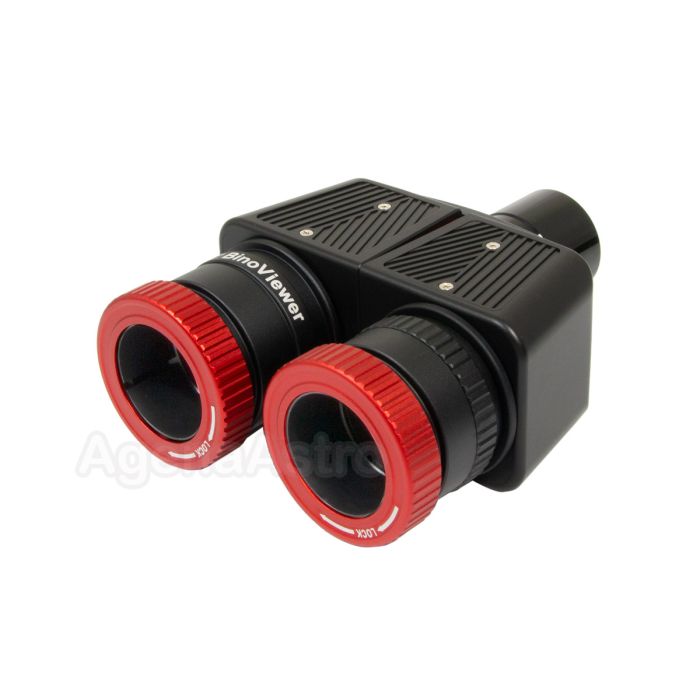
Long Perng 1.25" Erect Image Divergent Binoviewer with Zero Optical Length
Availability: Item has been discontinued by Agena and we no longer carry this item
Contiguous US Customers:
All items we sell ship for free within the Contiguous US. Shipping will be via the cheapest shipping method which will vary depending on the items in your order. During checkout, you may also be shown other optional faster shipping choices.
US Customers in Hawaii and Alaska:
Free shipping applies to almost all products. A few large telescopes and mounts are excluded from this free shipping offer. For these items, please contact us to obtain a shipping quote before you check out using the online shopping cart.
International Customers:
Free shipping does not apply to international orders. During check-out, you will be presented with several shipping choices and costs. However, the export of some items may be restricted outside the US due to size or manufacturer restrictions.
- Innovative erect-image 1.25” binoviewer for terrestrial and astronomical observations
- Zero optical path length means no additional back focus requirement or focuser in-travel
- No Barlow lens or glass path corrector required with any telescope type
- Linear housing makes it easy to adjust to a range of interpupiliary distances
- Works with Newtonians, refractors, and compound telescopes such as Schmidt-Cassegrain and Maksutov-Cassegrains
Parfocal with Any Telescope – No Additional Focuser In-Travel Required
Based on an innovative optical design, the Long Perng Erect Image Linear Binoviewers deliver superior optical performance and a comfortable viewing experience. Unlike other binoviewers, they are parfocal and add no extra optical path length, which means no extra focuser ‘in travel’ is needed when using them in your telescope. They work with virtually any telescope type, even Newtonians and fast refractors that often have restricted back focus capabilities. And they operate without the need for a Barlow lens or glass path corrector, which means you can enjoy low-power and relatively wide-field binoviewing with 1.25” eyepieces.
Linear Housing and Innovative Optical Design
Nearly all commercial binoviewers use prisms to split the light path in two, but these Long Perng binoviewers use a knife-edge beam-splitting mirror with a >99% reflective dielectric coating to reduce aberrations and field curvature and improve contrast compared to traditional binoviewers. The device also uses seven lenses in five groups in each optical path which introduces minimal false color and preserves image sharpness. This design also helps ensure matched images for each eye to minimize eye strain while observing.
Rather than a “folding” housing typical of most binos, the Long Perng binoviewer features a sliding “linear” housing to let you easily match the eyepiece spacing to an interpupillary distance (IPD) between 58mm and 74mm. This design makes it less prone to miscollimation while adjusting the IPD. The housing also uses an engraved scale to help you repeatably set it to the right IPD position.
This binoviewer also includes 1.25” eyepiece holders that are self-centering with twist-tightened collars. The right eyepiece holder has a helical diopter adjustment to help ensure both eyepieces come to focus.
The attractive CNC-machined anodized housing is designed to make it easy to handle without slippage, even when wearing gloves. While compact in size with dimensions of 127mm x 105mm x 50mm, the device packs some heft and weighs in at about 1.57 lbs (716g) without eyepieces, so users must use diagonals and focusers that can support it. The 1.25” barrel of the binoviewer is threaded for M28.6x0.6 filters such as those sold by Orion – in most cases, they should be compatible with standard 1.25” filter threads from other manufacturers but this cannot be guaranteed. The barrel also includes a taper to reduce the chance of the binoviewer slipping from the diagonal or focuser.
Low and High Magnification Visual Observing
These Long Perng binoviewers work with nearly any pair of matched 1.25” eyepieces. However, the field stop of these binoviewers is about 17mm, smaller than the 22mm of many traditional small binoviewers. That means wide-field eyepieces with a field stop greater than about 17mm will experience some vignetting. As a rule of thumb, vignetting occurs in eyepieces for which the focal length multiplied by the apparent field of view (AFOV) is greater than 1,000. For example, a pair of 20mm Plossl eyepieces with a 50-degree AFOV will work fine with these binoviewers (50x20=1000). But a pair of 24mm eyepieces with a 68-degree AFOV (24x68=1632) will experience substantial vignetting.
While these binoviewers do not need a Barlow or glass path corrector, they can be used with Barlows or Powermates for high-magnification observations. The manufacturer suggests a pair of medium focal-length eyepieces and a Barlow will deliver a better viewing experience than very short focal length eyepieces without a Barlow.
Erect Image Viewing
When used 'straight though' with any telescope without a diagonal, these Long Perng binoviewers deliver an erect image, an ideal feature for terrestrial observations.
When used in a refractor or Schmidt-Cassegrain or Maksutov-Cassegrain with a star diagonal or many types of 'correct image' diagonals, the binoviewers delivers an inverted image which is not a problem for astronomical viewing. For terrestrial viewing where image orientation is critical, the binoviewer must be used with an erecting pentaprism diagonal to render an erect image.
In the Box
- Long Perng 1.25" Erect Image Divergent Binoviewer
- Waterproof plastic carrying case with room for eyepieces and a diagonal
(NOTE: Eyepieces and diagonals are not included)
| Product Banner Type | discontinued |
|---|---|
| Free Shipping Graphic | Free US Shipping |
| Hide Found a better Shipped Price on Frontend? | No |
- Innovative erect-image 1.25” binoviewer for terrestrial and astronomical observations
- Zero optical path length means no additional back focus requirement or focuser in-travel
- No Barlow lens or glass path corrector required with any telescope type
- Linear housing makes it easy to adjust to a range of interpupiliary distances
- Works with Newtonians, refractors, and compound telescopes such as Schmidt-Cassegrain and Maksutov-Cassegrains
Parfocal with Any Telescope – No Additional Focuser In-Travel Required
Based on an innovative optical design, the Long Perng Erect Image Linear Binoviewers deliver superior optical performance and a comfortable viewing experience. Unlike other binoviewers, they are parfocal and add no extra optical path length, which means no extra focuser ‘in travel’ is needed when using them in your telescope. They work with virtually any telescope type, even Newtonians and fast refractors that often have restricted back focus capabilities. And they operate without the need for a Barlow lens or glass path corrector, which means you can enjoy low-power and relatively wide-field binoviewing with 1.25” eyepieces.
Linear Housing and Innovative Optical Design
Nearly all commercial binoviewers use prisms to split the light path in two, but these Long Perng binoviewers use a knife-edge beam-splitting mirror with a >99% reflective dielectric coating to reduce aberrations and field curvature and improve contrast compared to traditional binoviewers. The device also uses seven lenses in five groups in each optical path which introduces minimal false color and preserves image sharpness. This design also helps ensure matched images for each eye to minimize eye strain while observing.
Rather than a “folding” housing typical of most binos, the Long Perng binoviewer features a sliding “linear” housing to let you easily match the eyepiece spacing to an interpupillary distance (IPD) between 58mm and 74mm. This design makes it less prone to miscollimation while adjusting the IPD. The housing also uses an engraved scale to help you repeatably set it to the right IPD position.
This binoviewer also includes 1.25” eyepiece holders that are self-centering with twist-tightened collars. The right eyepiece holder has a helical diopter adjustment to help ensure both eyepieces come to focus.
The attractive CNC-machined anodized housing is designed to make it easy to handle without slippage, even when wearing gloves. While compact in size with dimensions of 127mm x 105mm x 50mm, the device packs some heft and weighs in at about 1.57 lbs (716g) without eyepieces, so users must use diagonals and focusers that can support it. The 1.25” barrel of the binoviewer is threaded for M28.6x0.6 filters such as those sold by Orion – in most cases, they should be compatible with standard 1.25” filter threads from other manufacturers but this cannot be guaranteed. The barrel also includes a taper to reduce the chance of the binoviewer slipping from the diagonal or focuser.
Low and High Magnification Visual Observing
These Long Perng binoviewers work with nearly any pair of matched 1.25” eyepieces. However, the field stop of these binoviewers is about 17mm, smaller than the 22mm of many traditional small binoviewers. That means wide-field eyepieces with a field stop greater than about 17mm will experience some vignetting. As a rule of thumb, vignetting occurs in eyepieces for which the focal length multiplied by the apparent field of view (AFOV) is greater than 1,000. For example, a pair of 20mm Plossl eyepieces with a 50-degree AFOV will work fine with these binoviewers (50x20=1000). But a pair of 24mm eyepieces with a 68-degree AFOV (24x68=1632) will experience substantial vignetting.
While these binoviewers do not need a Barlow or glass path corrector, they can be used with Barlows or Powermates for high-magnification observations. The manufacturer suggests a pair of medium focal-length eyepieces and a Barlow will deliver a better viewing experience than very short focal length eyepieces without a Barlow.
Erect Image Viewing
When used 'straight though' with any telescope without a diagonal, these Long Perng binoviewers deliver an erect image, an ideal feature for terrestrial observations.
When used in a refractor or Schmidt-Cassegrain or Maksutov-Cassegrain with a star diagonal or many types of 'correct image' diagonals, the binoviewers delivers an inverted image which is not a problem for astronomical viewing. For terrestrial viewing where image orientation is critical, the binoviewer must be used with an erecting pentaprism diagonal to render an erect image.
In the Box
- Long Perng 1.25" Erect Image Divergent Binoviewer
- Waterproof plastic carrying case with room for eyepieces and a diagonal
(NOTE: Eyepieces and diagonals are not included)
| Product Banner Type | discontinued |
|---|---|
| Free Shipping Graphic | Free US Shipping |
| Hide Found a better Shipped Price on Frontend? | No |