

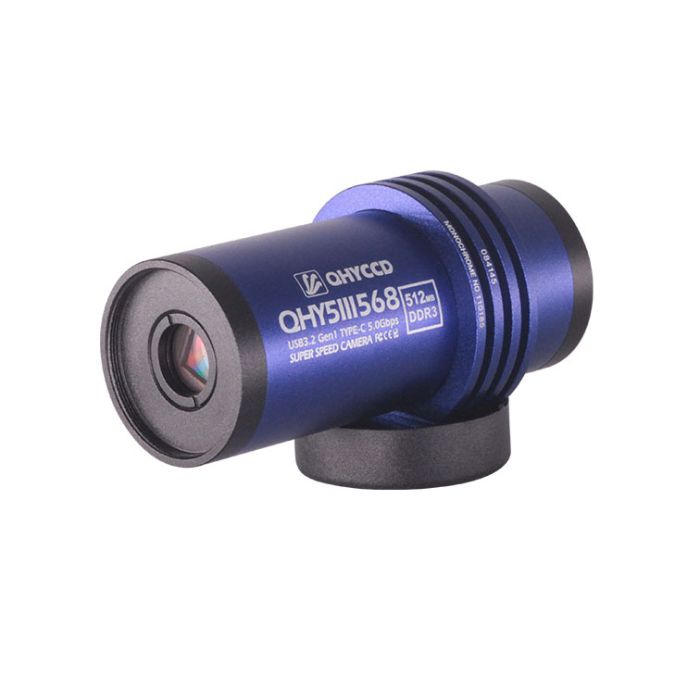
QHY 5-III 568M Mono Astronomy Camera with USB 3.2
Availability: Item has been discontinued by the manufacturer
Contiguous US Customers:
All items we sell ship for free within the Contiguous US. Shipping will be via the cheapest shipping method which will vary depending on the items in your order. During checkout, you may also be shown other optional faster shipping choices.
US Customers in Hawaii and Alaska:
Free shipping applies to almost all products. A few large telescopes and mounts are excluded from this free shipping offer. For these items, please contact us to obtain a shipping quote before you check out using the online shopping cart.
International Customers:
Free shipping does not apply to international orders. During check-out, you will be presented with several shipping choices and costs. However, the export of some items may be restricted outside the US due to size or manufacturer restrictions.
The QHY5III568M is a back-illuminated planetary & guiding camera built on the latest Series 5III v2 framework It utilizes a global shutter and supports true hardware 2x2 binning. Its high-speed design can output up to 500 FPS at select ROI.
QHY5III568M Features
Sensor
The QHY5III568M uses a 5.1-megapixel Sony IMX568 Pregius S CMOS sensor with 2472 x 2064 pixels at 2.74um. Pregius is Sony's trademark name for its global shutter pixel technology for active pixel CMOS image sensors that combine the low-noise performance of CCD with the high-speed and high-precision performance of global shutters. The newly developed Pregius S technology adopts a back-illuminated structure to simultaneously realize a smaller image sensor and a faster frame rate, while still maintaining the high imaging performance of Pregius.
Back-Illumination
One benefit of the back-illuminated CMOS structure is improved sensitivity. On Pregius S, Sony newly developed an original photodiode structure and light-shielding structure that were optimized for the back-illuminated structure. These greatly improved the sensitivity and saturation properties while also suppressing the noise generation. By utilizing these properties, it is also possible to maintain the image quality while achieving the miniaturization of pixels, which makes a more compact image sensor possible.
True Hardware Binning
Unlike Most CMOS cameras, the QHY5III568M camera supports charge-domain binning (FD Binning), which is true hardware pixel binning similar to CCD cameras. In the past, most CMOS cameras used digital binning, which relied on algorithms for binning after the readout process. The disadvantage of this binning method (using 2*2 binning as an example) is that while the signal is amplified by 4 times, it also introduces twice the amount of noise, resulting in only a doubling of the signal-to-noise ratio, and the frame rate is not improved. In contrast, hardware binning does not increase the noise, resulting in a direct 4-fold improvement in the signal-to-noise ratio. Moreover, the frame rate is significantly increased without reducing the field of view by selecting a smaller region of interest (ROI) on the sensor.
Global Shutter
Both the mono and color versions of the QHY5iII568M have a global shutter. Unlike the rolling shutter technology used in most CMOS cameras, a global shutter begins and ends the exposure for all pixels in the array at the same time, guaranteeing uniform exposure over the entire image. In the Pregius global shutter design, the pixel comprises a photodiode with the excellent low-noise property of CCD and a memory section. The light simultaneously sensed by each photodiode of all pixels is converted to digital signal and transferred to their respective memory sections before being processed. By processing the simultaneous digital signals all at once, the resulting image has no distortion. This type of shutter is ideal for high precision applications and is superior to the rolling shutter when imaging moving objects.
High Frame Rates
High-speed signal processing and high image quality are additional advantages of the sensor design in the QHY5III568M. The key to the high speed of CMOS image sensors with Pregius technology is the parallel processing. CMOS image sensors are equipped with A/D conversion circuits, which transform the analog signal from the pixel to a digital signal. An array of several thousands of these circuits arranged horizontally realizes the high-speed processing by operating simultaneously. In the A/D conversion circuit, the analog circuit that causes noise has been changed to a different configuration so that it automatically suppresses noise. In this way, the technology both realizes the high speed and low noise in one image sensor.
New QHY5III v2 Series Features
QHYCCD's latest planetary cameras and guiders are built around a new framework supporting a variety of sensors in the same small camera mechanical configuration. These features common to the new cameras, including the QHY5III568M are highlighted below:
512MB DDR3
The latest 5III (v.2) series of planetary and guiding cameras are all equipped with a 512MB DDR3 image buffer that can effectively reduce the pressure on computer transmission, a great help for planetary photography that often requires writing a large amount of data in a short period of time. Some deep-sky astrophotography cameras on the market today only have 256MB, for example. In comparison, the 512MB DDR3 memory of the new 5III (V. 2) series of cameras represents a significant upgrade.
New Front-end Design with Better Compatibility
QHY5III (v. 2) series cameras adopt a new front-end design with better compatibility and flexibility. The back focal length of the camera is only 8mm, which means you can easily use a v2 series camera with your OAG. The standard front end adapter has 1.25-inch threads so you can add a common 1.25- inch filter. The front adapter window can also easily be switched. One of the advantages of changeable front window glass is you can add a filter even you’re using lens. You can also add a 1.25-inch CS adapter to connect a CS lens, or a second CS-to-C adapter ring for a C-mount lens. The CS and C adapters are standard accessories. QHY also offers an optional 1.25-inch filter wheel adapter available for connecting your mono planetary camera to a QHYCFW3-S filter wheel.
USB 3.2 Gen1 Type C Interface
The new QHY5III (v.2) series cameras all use the USB3.2 Gen1 Type-C interface. Compared to the USB3.0 Type-B interface used in the previous generation, the Type-C interface has a longer life and is more flexible. Tips: It is recommended to use the official standard Type-C data cable of QHYCCD. As the market is flooded with a large number of poor-quality Type-C cables, casual use may lead to the camera malfunctioning. If you use your own spare cable, please make sure it is a high-quality cable.
Universal Guiding Interface
The custom guiding cable port of previous generations of planetary cameras and guiders has been replaced in the QHY5III (Ver.2) series with a more universal ST-4 compatible guiding port and commonly available cable with RJ11 style connectors. Now, even if the guiding cable is lost or damaged, you will be able to easily get a replacement locally at a low cost. Indicator LED The new QHY5III (v.2) series of cameras is equipped with an LED status indicator at the back of the camera. If the camera experiences an abnormal status, the multi-colored indicator light will help to determine the situation with different colors signifying different conditions. During normal operation this indicator light is off, so there is no worry about stray light contaminating the image.
Specifications
- Model: QHY5III568M
- CMOS Sensor: Sony IMX568
- Pixel Size: 2.74um x 2.74um
- Effective Pixel Area: 2472 x 2064
- Effective Pixels: 5.1 Megapixel
- Fullwell Full Resolution: 8.8ke- / 2X2 FD Binning: 9.7ke-
- Readout Noise Full Resolution: 1.5-2.3e- / 2X2 FD Binning: 1.6-2.7e-
- AD Sample Depth :12-bit (output as 16-bit and 8-bit)
- Built-in Image Buffer: 512MB DDR3 Memory
- Full Resolution Frame Rate: 2472 x 2064: 64.9 FPS @ 8-bits; 34.5 FPS @ 16-bits
- ROI Frame Rate:
- 1920x1080: 115.6FPS @ 8-bits; 62.1FPS @16-bits
- 800x600: 187.2FPS @ 8-bits; 100.5FPS @ 16-bits
- 480x480: 221.2FPS @ 8-bits; 118.5FPS @ 16-bits
- 2X2 FD Binning
- 1236x1032: 304FPS @ 8-bits; 152FPS @ 16-bits
- 800x600: 439.6FPS @ 8-bits; 221.9FPS @ 16-bits
- 480x480: 519.6FPS @ 8-bits; 262.8FPS @ 16-bits
- Exposure Time Range: 11us-900sec
- Shutter Type: Global Shutter
- Computer Interface: USB3.2 Gen1 Type-C
- Guide Port: ST-4
- Telescope Interface: 1.25-inch threded plus CS-mount and C-mount adapters
- Front end: 5III568M AR Coated; 5III568C AR w/IR-Cut Filter
- Back Focal Length: 17mm(with adapter); 8±0.5mm without adapter
- Chip package size: 6.7mm*5.6mm Type1/1.8
- Debayer: RGGB
- Weight: 80g
| Product Banner Type | discontinued |
|---|---|
| Free Shipping Graphic | Free US Shipping |
| Hide Found a better Shipped Price on Frontend? | No |
- 1x Camera body
- 1x USB3.0 Type C Cable
- 1x Guiding Cable
- 1x Filter Coated Front Window
- 1x CS to X Mount Adapter
- 1x 1.25 inch to CS Mount Adapter
- 1x Focus Lock Ring and Thumb Screw
- 1x Driver Download Instructions Card
The QHY5III568M is a back-illuminated planetary & guiding camera built on the latest Series 5III v2 framework It utilizes a global shutter and supports true hardware 2x2 binning. Its high-speed design can output up to 500 FPS at select ROI.
QHY5III568M Features
Sensor
The QHY5III568M uses a 5.1-megapixel Sony IMX568 Pregius S CMOS sensor with 2472 x 2064 pixels at 2.74um. Pregius is Sony's trademark name for its global shutter pixel technology for active pixel CMOS image sensors that combine the low-noise performance of CCD with the high-speed and high-precision performance of global shutters. The newly developed Pregius S technology adopts a back-illuminated structure to simultaneously realize a smaller image sensor and a faster frame rate, while still maintaining the high imaging performance of Pregius.
Back-Illumination
One benefit of the back-illuminated CMOS structure is improved sensitivity. On Pregius S, Sony newly developed an original photodiode structure and light-shielding structure that were optimized for the back-illuminated structure. These greatly improved the sensitivity and saturation properties while also suppressing the noise generation. By utilizing these properties, it is also possible to maintain the image quality while achieving the miniaturization of pixels, which makes a more compact image sensor possible.
True Hardware Binning
Unlike Most CMOS cameras, the QHY5III568M camera supports charge-domain binning (FD Binning), which is true hardware pixel binning similar to CCD cameras. In the past, most CMOS cameras used digital binning, which relied on algorithms for binning after the readout process. The disadvantage of this binning method (using 2*2 binning as an example) is that while the signal is amplified by 4 times, it also introduces twice the amount of noise, resulting in only a doubling of the signal-to-noise ratio, and the frame rate is not improved. In contrast, hardware binning does not increase the noise, resulting in a direct 4-fold improvement in the signal-to-noise ratio. Moreover, the frame rate is significantly increased without reducing the field of view by selecting a smaller region of interest (ROI) on the sensor.
Global Shutter
Both the mono and color versions of the QHY5iII568M have a global shutter. Unlike the rolling shutter technology used in most CMOS cameras, a global shutter begins and ends the exposure for all pixels in the array at the same time, guaranteeing uniform exposure over the entire image. In the Pregius global shutter design, the pixel comprises a photodiode with the excellent low-noise property of CCD and a memory section. The light simultaneously sensed by each photodiode of all pixels is converted to digital signal and transferred to their respective memory sections before being processed. By processing the simultaneous digital signals all at once, the resulting image has no distortion. This type of shutter is ideal for high precision applications and is superior to the rolling shutter when imaging moving objects.
High Frame Rates
High-speed signal processing and high image quality are additional advantages of the sensor design in the QHY5III568M. The key to the high speed of CMOS image sensors with Pregius technology is the parallel processing. CMOS image sensors are equipped with A/D conversion circuits, which transform the analog signal from the pixel to a digital signal. An array of several thousands of these circuits arranged horizontally realizes the high-speed processing by operating simultaneously. In the A/D conversion circuit, the analog circuit that causes noise has been changed to a different configuration so that it automatically suppresses noise. In this way, the technology both realizes the high speed and low noise in one image sensor.
New QHY5III v2 Series Features
QHYCCD's latest planetary cameras and guiders are built around a new framework supporting a variety of sensors in the same small camera mechanical configuration. These features common to the new cameras, including the QHY5III568M are highlighted below:
512MB DDR3
The latest 5III (v.2) series of planetary and guiding cameras are all equipped with a 512MB DDR3 image buffer that can effectively reduce the pressure on computer transmission, a great help for planetary photography that often requires writing a large amount of data in a short period of time. Some deep-sky astrophotography cameras on the market today only have 256MB, for example. In comparison, the 512MB DDR3 memory of the new 5III (V. 2) series of cameras represents a significant upgrade.
New Front-end Design with Better Compatibility
QHY5III (v. 2) series cameras adopt a new front-end design with better compatibility and flexibility. The back focal length of the camera is only 8mm, which means you can easily use a v2 series camera with your OAG. The standard front end adapter has 1.25-inch threads so you can add a common 1.25- inch filter. The front adapter window can also easily be switched. One of the advantages of changeable front window glass is you can add a filter even you’re using lens. You can also add a 1.25-inch CS adapter to connect a CS lens, or a second CS-to-C adapter ring for a C-mount lens. The CS and C adapters are standard accessories. QHY also offers an optional 1.25-inch filter wheel adapter available for connecting your mono planetary camera to a QHYCFW3-S filter wheel.
USB 3.2 Gen1 Type C Interface
The new QHY5III (v.2) series cameras all use the USB3.2 Gen1 Type-C interface. Compared to the USB3.0 Type-B interface used in the previous generation, the Type-C interface has a longer life and is more flexible. Tips: It is recommended to use the official standard Type-C data cable of QHYCCD. As the market is flooded with a large number of poor-quality Type-C cables, casual use may lead to the camera malfunctioning. If you use your own spare cable, please make sure it is a high-quality cable.
Universal Guiding Interface
The custom guiding cable port of previous generations of planetary cameras and guiders has been replaced in the QHY5III (Ver.2) series with a more universal ST-4 compatible guiding port and commonly available cable with RJ11 style connectors. Now, even if the guiding cable is lost or damaged, you will be able to easily get a replacement locally at a low cost. Indicator LED The new QHY5III (v.2) series of cameras is equipped with an LED status indicator at the back of the camera. If the camera experiences an abnormal status, the multi-colored indicator light will help to determine the situation with different colors signifying different conditions. During normal operation this indicator light is off, so there is no worry about stray light contaminating the image.
Specifications
- Model: QHY5III568M
- CMOS Sensor: Sony IMX568
- Pixel Size: 2.74um x 2.74um
- Effective Pixel Area: 2472 x 2064
- Effective Pixels: 5.1 Megapixel
- Fullwell Full Resolution: 8.8ke- / 2X2 FD Binning: 9.7ke-
- Readout Noise Full Resolution: 1.5-2.3e- / 2X2 FD Binning: 1.6-2.7e-
- AD Sample Depth :12-bit (output as 16-bit and 8-bit)
- Built-in Image Buffer: 512MB DDR3 Memory
- Full Resolution Frame Rate: 2472 x 2064: 64.9 FPS @ 8-bits; 34.5 FPS @ 16-bits
- ROI Frame Rate:
- 1920x1080: 115.6FPS @ 8-bits; 62.1FPS @16-bits
- 800x600: 187.2FPS @ 8-bits; 100.5FPS @ 16-bits
- 480x480: 221.2FPS @ 8-bits; 118.5FPS @ 16-bits
- 2X2 FD Binning
- 1236x1032: 304FPS @ 8-bits; 152FPS @ 16-bits
- 800x600: 439.6FPS @ 8-bits; 221.9FPS @ 16-bits
- 480x480: 519.6FPS @ 8-bits; 262.8FPS @ 16-bits
- Exposure Time Range: 11us-900sec
- Shutter Type: Global Shutter
- Computer Interface: USB3.2 Gen1 Type-C
- Guide Port: ST-4
- Telescope Interface: 1.25-inch threded plus CS-mount and C-mount adapters
- Front end: 5III568M AR Coated; 5III568C AR w/IR-Cut Filter
- Back Focal Length: 17mm(with adapter); 8±0.5mm without adapter
- Chip package size: 6.7mm*5.6mm Type1/1.8
- Debayer: RGGB
- Weight: 80g
| Product Banner Type | discontinued |
|---|---|
| Free Shipping Graphic | Free US Shipping |
| Hide Found a better Shipped Price on Frontend? | No |
- 1x Camera body
- 1x USB3.0 Type C Cable
- 1x Guiding Cable
- 1x Filter Coated Front Window
- 1x CS to X Mount Adapter
- 1x 1.25 inch to CS Mount Adapter
- 1x Focus Lock Ring and Thumb Screw
- 1x Driver Download Instructions Card