

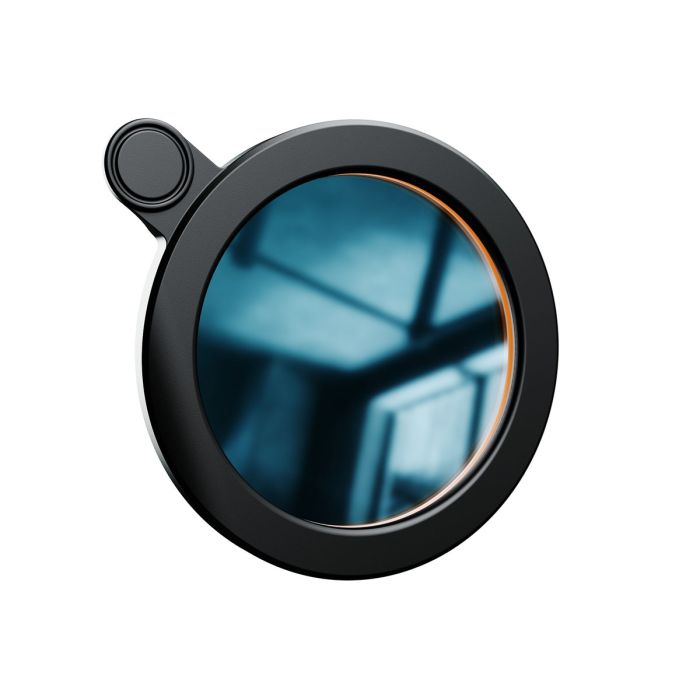
Vaonis Dual Band H-a (12nm) and O-III (12nm) Filter for Vespera
Ships by Next Business Day
Contiguous US Customers:
All items we sell ship for free within the Contiguous US. Shipping will be via the cheapest shipping method which will vary depending on the items in your order. During checkout, you may also be shown other optional faster shipping choices.
US Customers in Hawaii and Alaska:
Free shipping applies to almost all products. A few large telescopes and mounts are excluded from this free shipping offer. For these items, please contact us to obtain a shipping quote before you check out using the online shopping cart.
International Customers:
Free shipping does not apply to international orders. During check-out, you will be presented with several shipping choices and costs. However, the export of some items may be restricted outside the US due to size or manufacturer restrictions.
The Vespera Dual Band Filter is a dual narrowband interference filter that will significantly improve your photo quality whether you are viewing from an urban or natural environment.
By selecting very precisely the wavelengths of Hydrogen Alpha (H-alpha) and Oxygen III (O-III), found mainly in nebulae, the filter will increase the contrast between the Stellar object and the sky background. Thus, its use makes it possible to obtain a higher-quality image, with sharper stars and finer details.
- Significantly improves photo quality
- Ideal for nebula photography
- Increases the contrast between the sky background and the stellar object
- Refines stars and details
Keep only the essential
The Dual Band filter has been designed to allow only two particular wavelengths to pass through to the Vespera sensor:
- O-III
- H-alpha
Due to the filtered wavelengths, it is particularly effective for photographing nebulae in emission (e.g.: Orion nebula M42, Heart nebula IC 1805 …), dark nebulae endowed with hydrogen (e.g.: Horsehead or Elephant’s Trunk nebula…), planetary nebulae (e.g.: Owl nebula M97, Dumbbell nebula M27…), supernova remnants (e.g.: Veil nebula, Crab Nebula M1…).
For globular clusters (e.g.: Hercules cluster M13, cluster M92…), the selectivity of the Dual Band filter will help you to obtain sharper stars.
A filter specifically studied for Vespera
The optical quality of the Dual Band filter has been specifically studied by our engineers to offer use at full aperture, without any impact on the optical diameter of the instrument. The lens ring is equipped with an electronic micro-card that allows Vespera to detect the Dual Band filter and adapt its observation and image processing parameters.
Transmission curve
The filter features 12nm of bandwidth in each wavelength (O-III = 500.7nm, H-alpha = 656.3nm).
Instructions for use
Designed specifically for Vespera, the filter fits easily and discreetly into the optical arm. Remove the standard Vespera lens ring and insert the Dual Band filter until you hear a click. To verify that the Dual Band filter is properly positioned, connect Vespera to your mobile device and launch the Singularity app. In the Space Center and then the Instrument screen, the word “Dual” is shown.
- The use of the Dual Band filter is incompatible with the observation of galaxies, due to the rejection of a good part of the spectrum which attenuates the signal of the galaxies.
- The filter is of little interest for the observations of the Moon, individual stars, and planets.
- The Dual Band filter is ineffective against LED lighting.
Directions for use:
- Do not expose the filter to direct sunlight.
- Store the filter in its box after each use to avoid dust build-up.
- If you notice any streaks or dust, gently clean the filter with an optical wipe, microfiber cloth, feather duster or air blower.
- Do not attempt to open the lens ring that contains the filter.
Specifications
- Weight: 0.1 kg
- Colors: Black (exterior)
- Net weight: 17 g (0.6 oz)
- Net Dimensions: Thickness: 0.6 cm (0.24 in), Width: 7.80 cm (3.07 in)
- Materials: Glass, Plastic
- Package Weight: 60 g (2.12 oz)
| Free Shipping Graphic | Free US Shipping |
|---|---|
| Hide Found a better Shipped Price on Frontend? | No |
The Vespera Dual Band Filter is a dual narrowband interference filter that will significantly improve your photo quality whether you are viewing from an urban or natural environment.
By selecting very precisely the wavelengths of Hydrogen Alpha (H-alpha) and Oxygen III (O-III), found mainly in nebulae, the filter will increase the contrast between the Stellar object and the sky background. Thus, its use makes it possible to obtain a higher-quality image, with sharper stars and finer details.
- Significantly improves photo quality
- Ideal for nebula photography
- Increases the contrast between the sky background and the stellar object
- Refines stars and details
Keep only the essential
The Dual Band filter has been designed to allow only two particular wavelengths to pass through to the Vespera sensor:
- O-III
- H-alpha
Due to the filtered wavelengths, it is particularly effective for photographing nebulae in emission (e.g.: Orion nebula M42, Heart nebula IC 1805 …), dark nebulae endowed with hydrogen (e.g.: Horsehead or Elephant’s Trunk nebula…), planetary nebulae (e.g.: Owl nebula M97, Dumbbell nebula M27…), supernova remnants (e.g.: Veil nebula, Crab Nebula M1…).
For globular clusters (e.g.: Hercules cluster M13, cluster M92…), the selectivity of the Dual Band filter will help you to obtain sharper stars.
A filter specifically studied for Vespera
The optical quality of the Dual Band filter has been specifically studied by our engineers to offer use at full aperture, without any impact on the optical diameter of the instrument. The lens ring is equipped with an electronic micro-card that allows Vespera to detect the Dual Band filter and adapt its observation and image processing parameters.
Transmission curve
The filter features 12nm of bandwidth in each wavelength (O-III = 500.7nm, H-alpha = 656.3nm).
Instructions for use
Designed specifically for Vespera, the filter fits easily and discreetly into the optical arm. Remove the standard Vespera lens ring and insert the Dual Band filter until you hear a click. To verify that the Dual Band filter is properly positioned, connect Vespera to your mobile device and launch the Singularity app. In the Space Center and then the Instrument screen, the word “Dual” is shown.
- The use of the Dual Band filter is incompatible with the observation of galaxies, due to the rejection of a good part of the spectrum which attenuates the signal of the galaxies.
- The filter is of little interest for the observations of the Moon, individual stars, and planets.
- The Dual Band filter is ineffective against LED lighting.
Directions for use:
- Do not expose the filter to direct sunlight.
- Store the filter in its box after each use to avoid dust build-up.
- If you notice any streaks or dust, gently clean the filter with an optical wipe, microfiber cloth, feather duster or air blower.
- Do not attempt to open the lens ring that contains the filter.
Specifications
- Weight: 0.1 kg
- Colors: Black (exterior)
- Net weight: 17 g (0.6 oz)
- Net Dimensions: Thickness: 0.6 cm (0.24 in), Width: 7.80 cm (3.07 in)
- Materials: Glass, Plastic
- Package Weight: 60 g (2.12 oz)
| Free Shipping Graphic | Free US Shipping |
|---|---|
| Hide Found a better Shipped Price on Frontend? | No |

Vaonis Dual Band H-a (12nm) and O-III (12nm) Filter for Vespera # AC022