

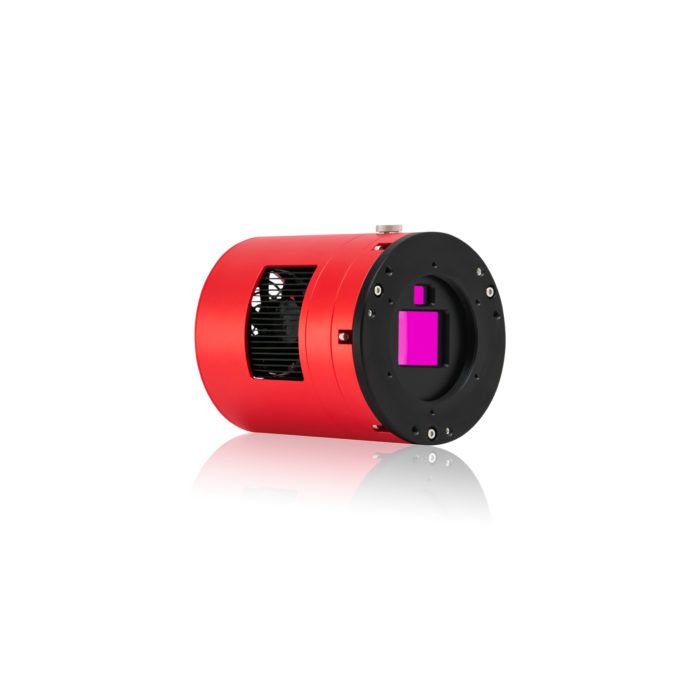
ZWO ASI2600MC Duo APS-C Cooled Color Astronomy Camera with Built-In Guide Sensor
Ships by Next Business Day
Contiguous US Customers:
All items we sell ship for free within the Contiguous US. Shipping will be via the cheapest shipping method which will vary depending on the items in your order. During checkout, you may also be shown other optional faster shipping choices.
US Customers in Hawaii and Alaska:
Free shipping applies to almost all products. A few large telescopes and mounts are excluded from this free shipping offer. For these items, please contact us to obtain a shipping quote before you check out using the online shopping cart.
International Customers:
Free shipping does not apply to international orders. During check-out, you will be presented with several shipping choices and costs. However, the export of some items may be restricted outside the US due to size or manufacturer restrictions.
ASI2600 Duo: Dual Imaging and Guiding Solution for Deep Space Astrophotography
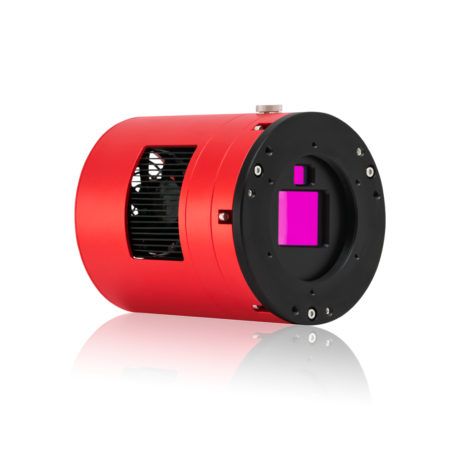
The original ASI2600MC-Pro changed the game when considering what was possible with a color camera. The sensitivity, lack of amp glow, and all the other features that came with the ASI2600MC had never been available at that price. With the ASI2600MC Duo, you get the same amazing IMX571 high-resolution color sensor found in the original model. Except now it has a built-in auto-guiding sensor! Gone are the days of fiddling with an OAG or balancing a finder scope. With the ASI2600MC Duo, if your main camera can focus, then so can your guide camera!
The ZWO ASI2600MC-Duo uses the same 16-bit ADC for an impressive dynamic range of 14 stops. This means the 2600MC-Duo can capture faint details in both the dark shadows and bright highlights of your favorite targets. The 3.76µm pixels also provide an ideal pixel scale for a wide variety of imaging telescopes. This means fewer issues with sampling, better stars, and sharper deep-sky details.
The IMX571 color sensor in the ZWO ASI2600MC-Duo boasts the same 80% quantum efficiency (QE) as the original 2600MC-Pro. This remains an impressive figure as compared to previous generations of astronomy cameras, but where the ASI2600MC-Duo stands out is with a full well capacity of 73ke! This is 23ke larger than the original, and it means the stars won't become over-saturated or lose their detail in longer exposures. And of course, amp glow continues to be a thing of the past with this camera (even with dark frames).
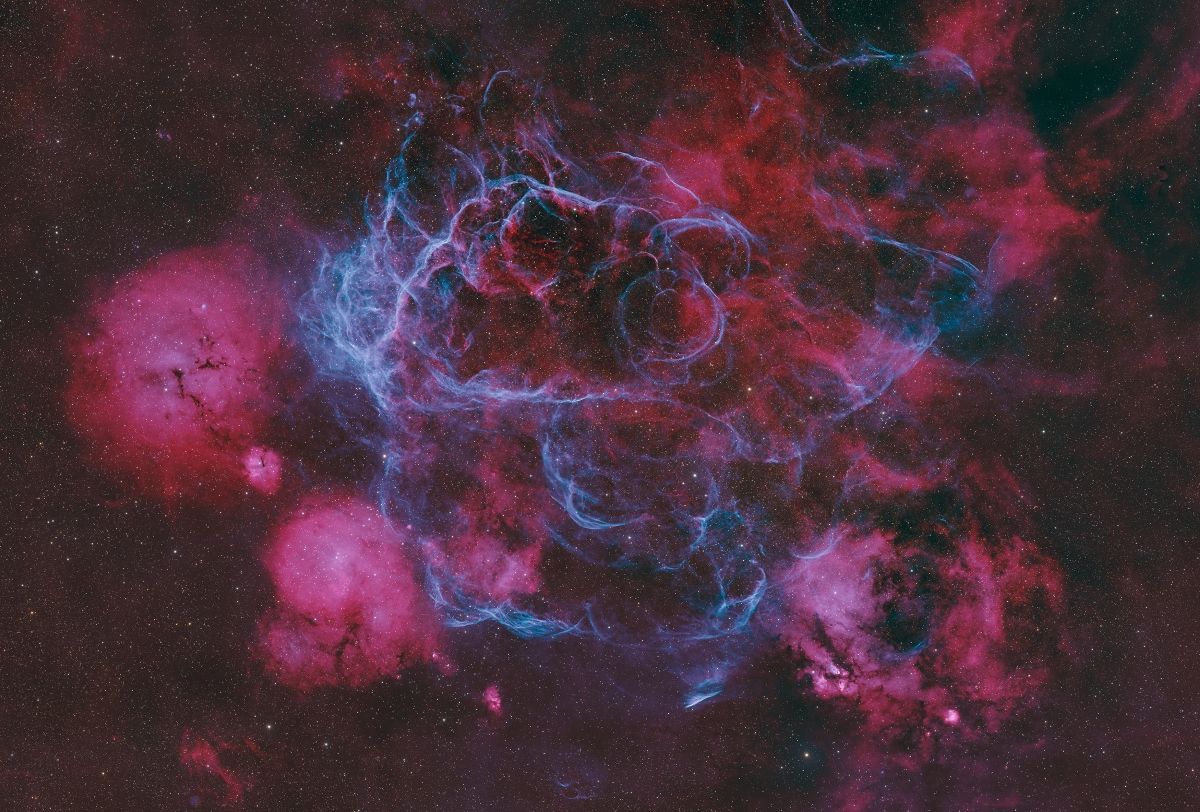
Vela Supernova Remnant - Taken by Astrobin.com user Malcolm Park, using a ZWO ASI2600MC-DUO and a Rokinon 135mm f/2.0 ED UMC lens.
Key Features of the ASI2600MC Duo
- 26 Megapixel Full-Frame Sensor: Delivers exceptional detail for capturing deep-sky objects with precision.
- True 16-bit ADC: Provides up to 14 stops of high dynamic range, ensuring excellent contrast and detail in both bright and dark areas.
- 80% Peak Quantum Efficiency: Greater sensitivity means more light capture, resulting in clearer and more detailed images.
- 73ke- Full Well Capacity: Helps capture bright stars without them looking bloated or overexposed, even during long exposures.
- Ultra-Low Readout Noise (1.0e - 3.3e): Enhances image clarity and dynamic range.
- Zero Amp-Glow: Ensures clean images without the camera adding unwanted light from its electronics, even during extended exposures, reducing post-processing hassle..
- Seamless Compatibility with ZWO Accessories: Integrates with accessories like the ZWO CAA Camera Angle Adjuster Electronic Rotator or the ZWO 7-Position Electronic Filter Wheel for 2" Filters (EFW).
The ZWO ASI2600MC Duo: A simple solution for long-exposure astrophotography!
Integrated Guide Camera for Seamless Imaging and Guiding
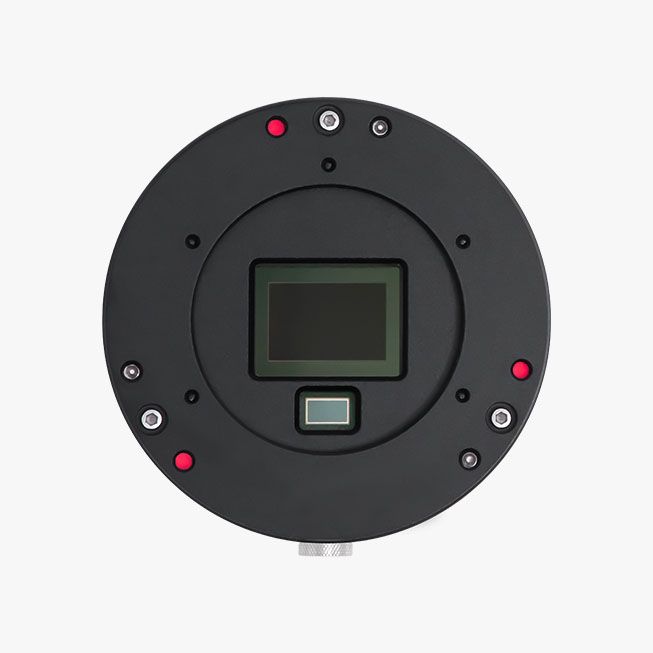
The highlight of the ASI 2600 Duo is the camera sensor above the main IMX571 imaging sensor. This secondary sensor is dedicated to auto-guiding, and integrating it in the camera body offers several significant benefits. The first and most noticeable is improved performance. By including the guide sensor within the main camera, you’ll no longer need to deal with mechanical issues like balance or flexure, or worry about finding the focal plane. Plus, removing the need to use an off-axis guider frees up 16.5 millimeters of space in your imaging train! Having this free space means you can use other accessories like the ZWO Camera Angle Adjuster (CAA) or a filter drawer.
When the ASI2600MC Duo was first announced, many people questioned its ability to pick up guide stars. This concern is because of the guide sensor's position behind any filters. Since many filters significantly reduce the amount of incoming light, it was unclear whether the guide camera’s sensor could find enough stars. This has since been thoroughly tested, and the results are clear: the guide camera sensor has no issue picking up guide stars.
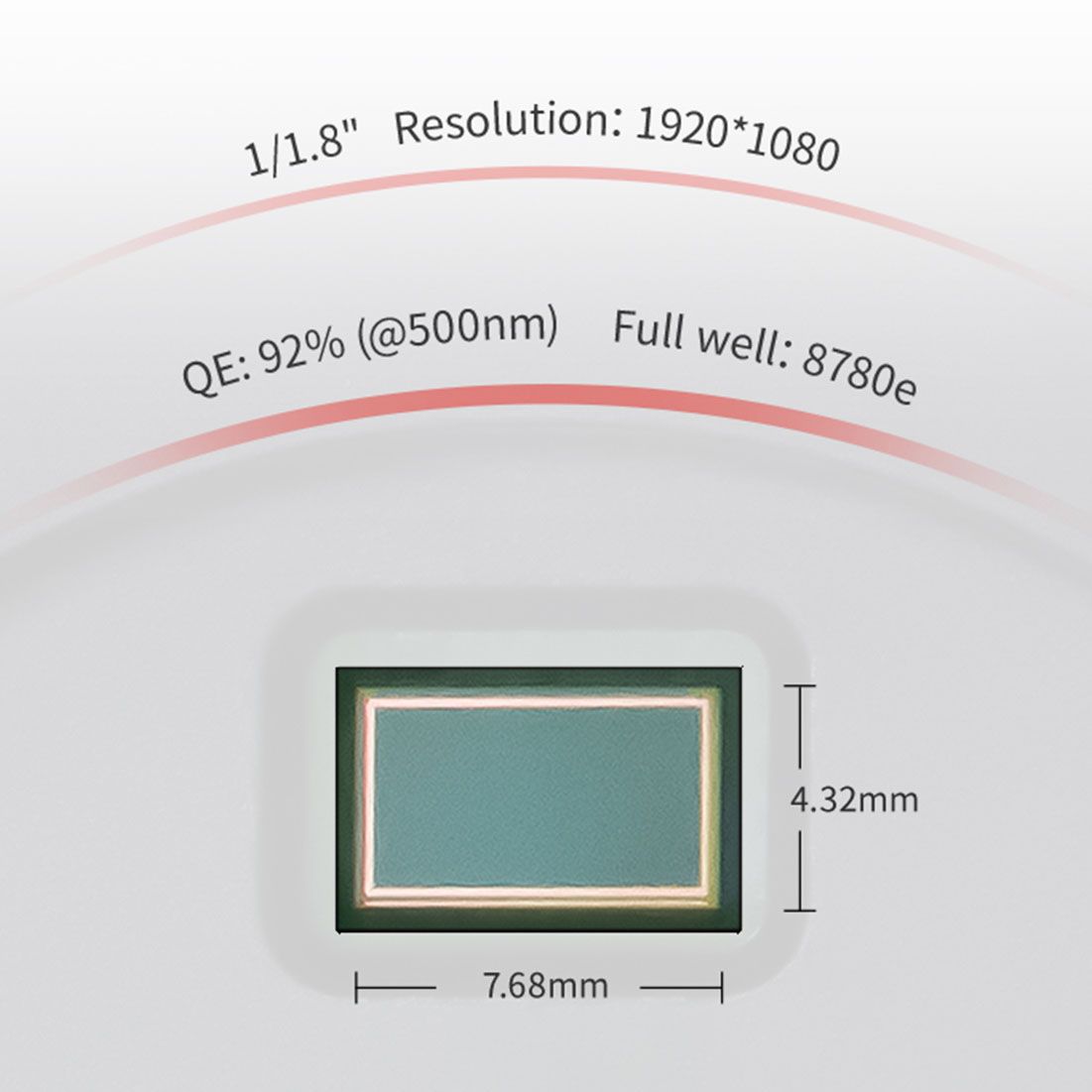
The guide camera sensor is the same found in the ASI220MM Mini, which is itself a highly-sensitive guide camera. The sensor is 7.7x4.3 millimeters and has a resolution of 1920x1080 pixels. Autoguiding software uses the centroid of a star to accurately guide. This means that pinpoint stars are not required for good guiding. So, even if stars appear elongated on telescopes with smaller image circles, users report that 2600MC Duo guiding works great.
Cutting-Edge Technical Specifications
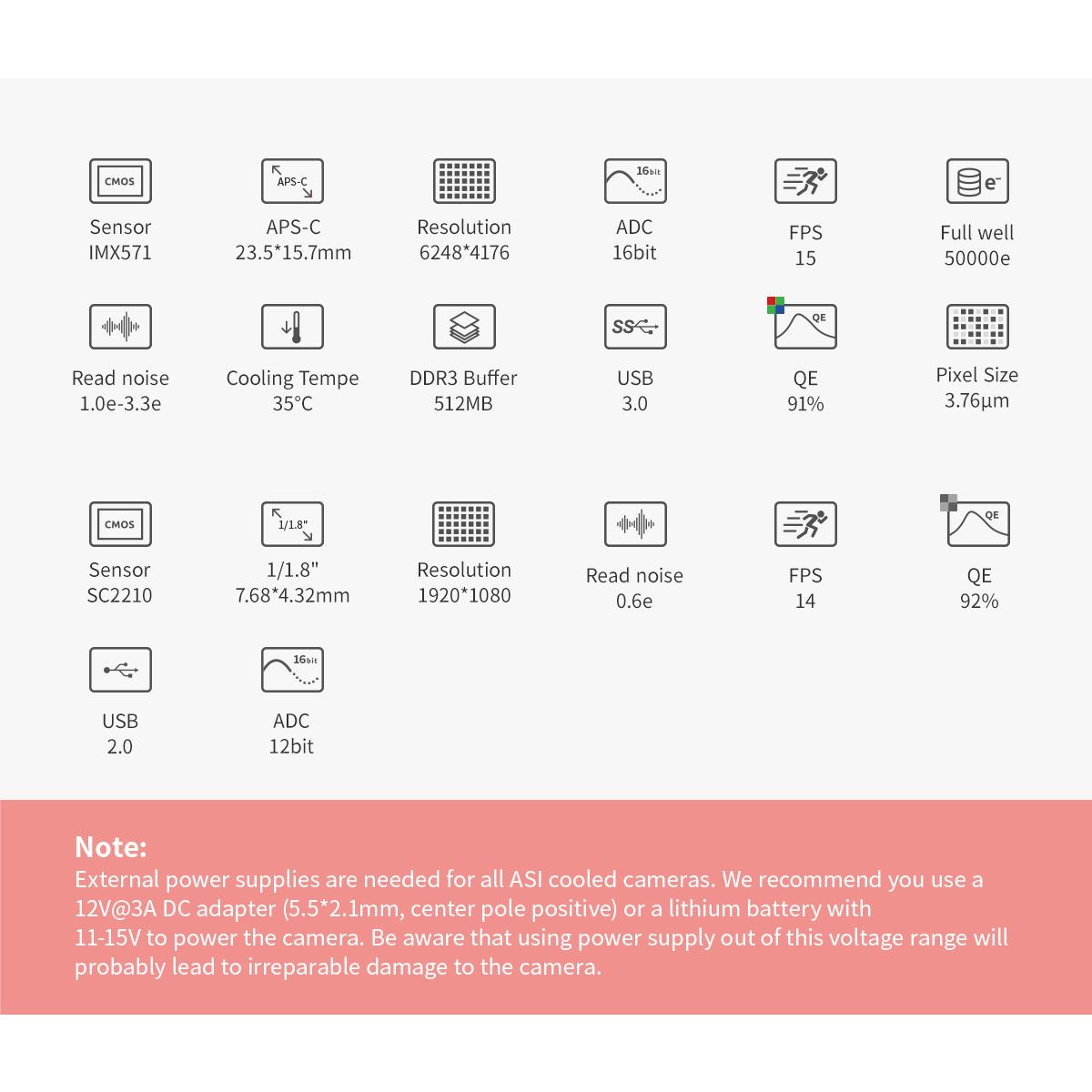
The ASI2600MC Duo has some of the best technical capabilities of any cooled astronomy camera on the market. The 80% QE means that 80% of the photons hitting your sensor are recorded as data. This is essential when imaging deep space objects, especially faint objects like galaxies and planetary nebulae. The ASI2600MC-Duo also has a 16-bit analog-to-digital converter (ADC). This allows for a very wide dynamic range, which complements its 73,000e full well capacity.
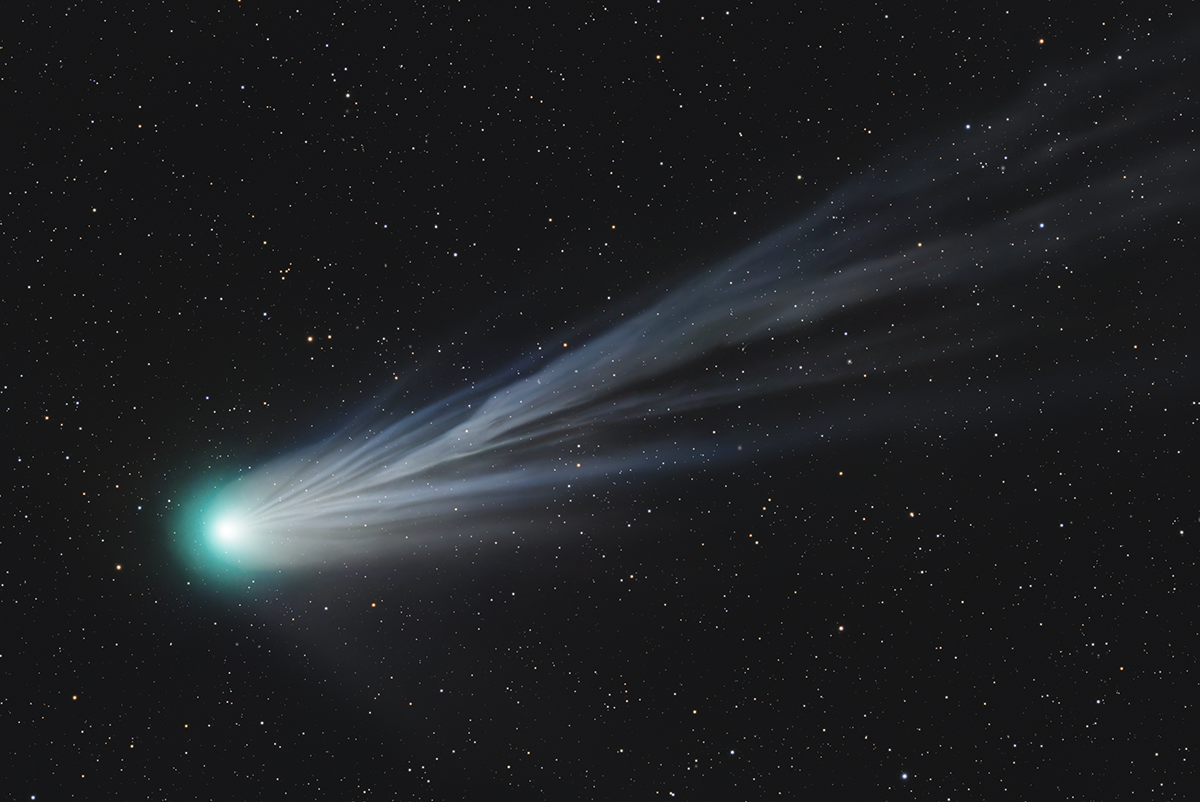
Comet 12P/Pons-Brooks - Taken by Astrobin.com user James Peirce, using a ZWO ASI2600MC-DUO, Sky-Watcher Esprit 120ED, and ZWO-AM5 Mount. For more information on this incredible image, please see James' full description, available here - https://mypetstars.com/astrophotography/Comet-12P-Pons-Brooks
Reviews for the ZWO ASI2600MC Duo:
Agena Astro affiliate Peter Zelinka breaks down the specs and features of the ZWO ASI2600MC Duo.
Agena Astro affiliate Nico Carver (@NebulaPhotos) does a full test and review of the ZWO ASI2600MC Duo.
Dive Deeper into the ASI2600 Duo’s Full Capability
Dual Gain Structure
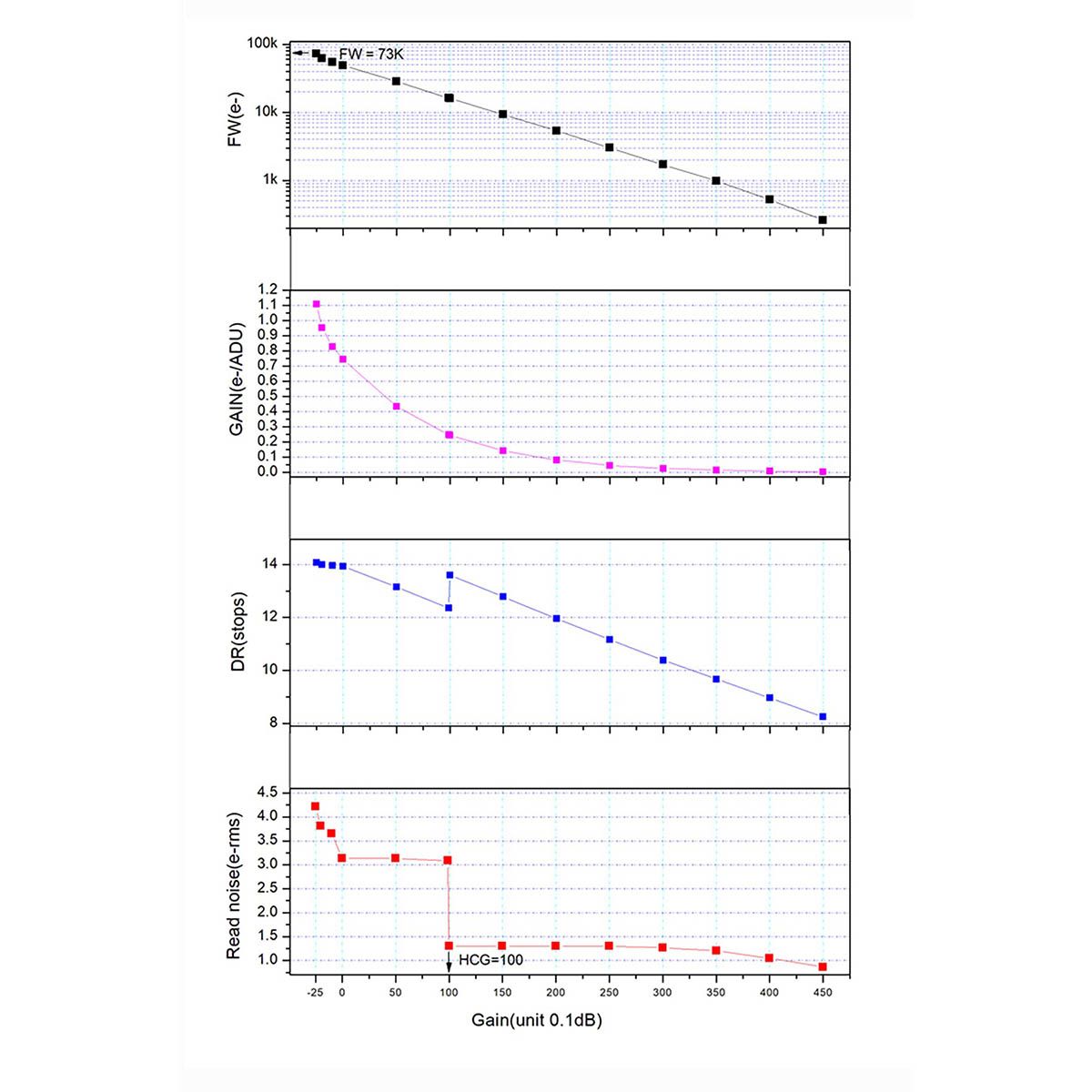
A key advancement of the IMX571 over previous generations of camera sensors is the dual gain structure. By setting the gain to 100, you can immediately reduce read noise and boost dynamic range. The sensitivity also increases, allowing you to capture finer details with minimal noise.
ZWO recommends using gain 100 for most applications, the main exception is for very bright deep-space objects or when using short exposures that might benefit from different settings.
Modern Backside-Illuminated Sensor (BSI) For Improved Sensitivity
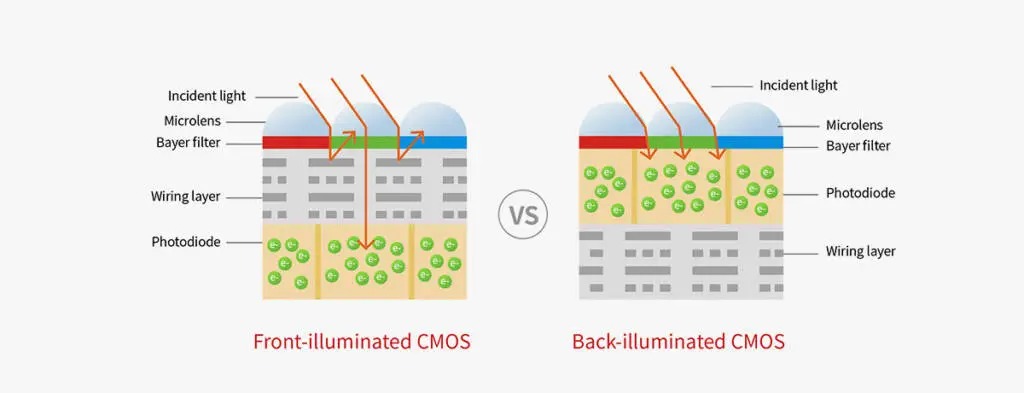
Sony's backside-illumination (BSI) sensor technology was designed to enhance sensitivity while reducing noise. This is because conventional sensors place their electronics on top of the silicon layer that the light must penetrate. This blocks some of the incoming light from reaching the photodiodes. BSI technology inverts this arrangement, positioning these electronics behind the silicon layer. This approach creates an unobstructed path for photons to reach the light-sensitive areas!
This BSI advancement is especially valuable in high-resolution sensors like the IMX571, along with ZWO's larger full-frame models (ASI6200MM, ASI6200MC, and ASI2400MC). This is because BSI sensors can download images much faster, particularly when handling the expanded file sizes produced by 16-bit sensors. And thanks to this low-noise CMOS architecture, the images have so little noise that traditional calibration frames become almost unnecessary!

Native 16-bit ADC Improves Dynamic Range
The ZWO ASI2600MC-Duo distinguishes itself with an advanced 16-bit analog-to-digital converter (ADC). While some older CCD cameras claim 16-bit capability, this modern CMOS sensor provides a genuine 14-stop dynamic range. Improved dynamic range yields image quality with superior contrast and improved tonal gradations. And this is particularly true when used with narrowband filters. From the faintest details of a nebula to the brilliant stars at its center, the ASI2600MC-Duo handles them with ease! And all in one single exposure!
Reduced Noise with Two-stage TEC Cooling
The ASI2600MC-Duo features a powerful two-stage TEC cooling system to reduce thermal noise during long exposures. It can reduce the sensor temperature by a whopping 63°F (35°C) below ambient conditions!
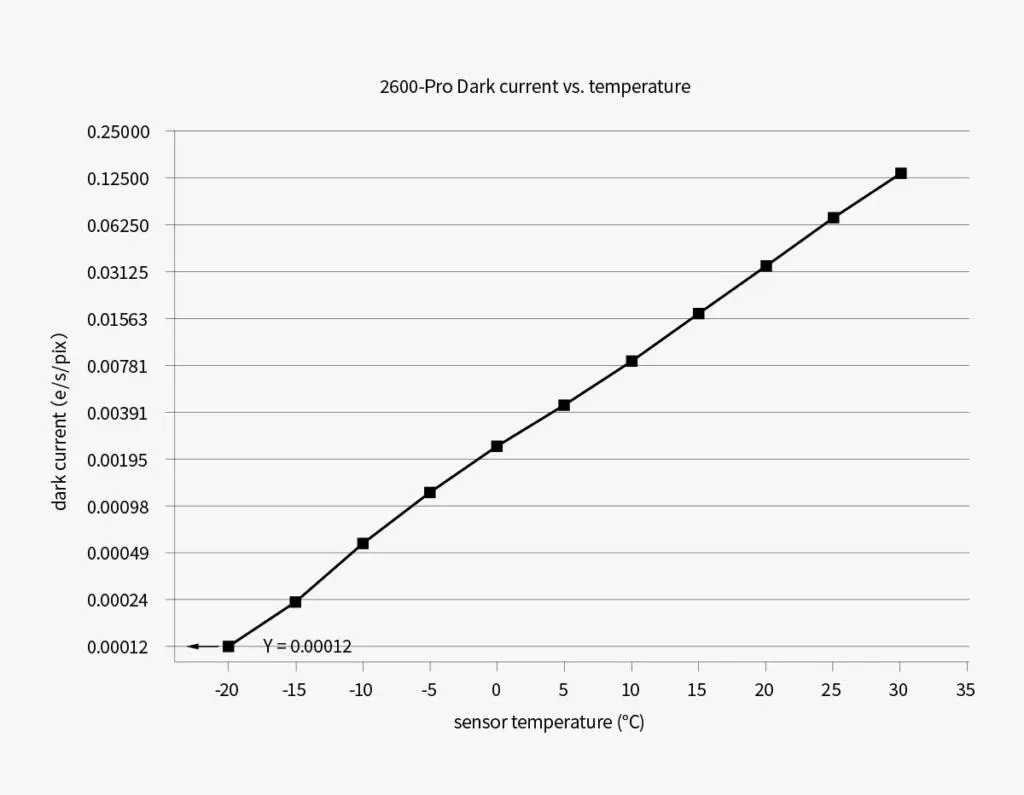
This impressive system works alongside ZWO's innovative dark current suppression technology to provide industry-leading noise management. At 32°F (0°C), the camera produces an exceptionally low 0.0022 electrons of dark current noise per second per pixel. This means during a 5-minute (300s) exposure, the accumulated dark current noise (0.7e) remains below the camera's basic readout noise. When cooled further to -4°F (-20°C), dark current becomes virtually nonexistent at 0.00012e/s/px, making it inconsequential to final image quality.
*Please note: the camera’s TEC cooler requires a 12V external power supply (not included).
High-Speed Data Transfer with USB 3.0
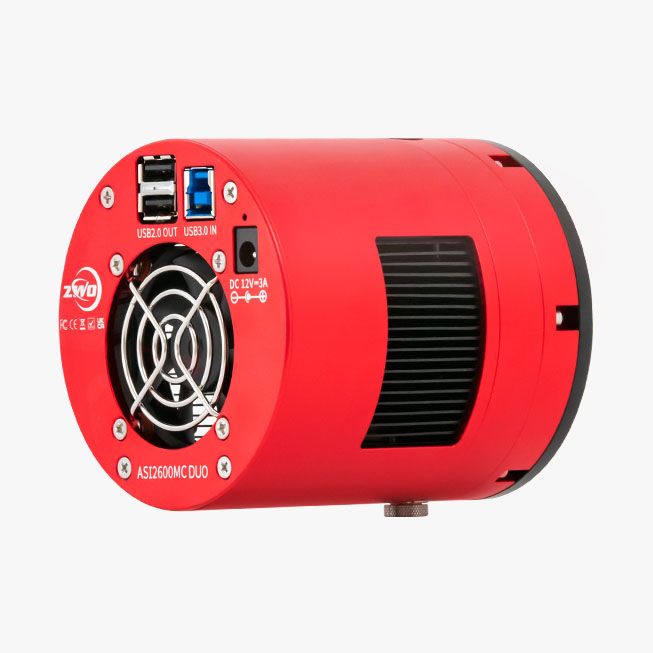
The ASI2600MC Pro includes a high-speed USB 3.0 interface and a built-in 512MB DDR3 cache. Both ensure stable and secure data transmission.
During long exposures, this combination effectively avoids frame dropping and reduces the amp glow effect caused by slow readout speed.
Less Post-Processing Hassles Thanks to Zero Amp Glow
One fantastic change to this entire generation of CMOS sensors is the complete removal of amp glow. Amp-glow is when an infrared light source leaks onto your sensor and leaves an artifact on the final images. This issue is especially bad in many older astronomy cameras, DSLRs, and some newer mirrorless cameras. Most cases are severe enough that your dark frames need their own set of flats to remove it effectively.
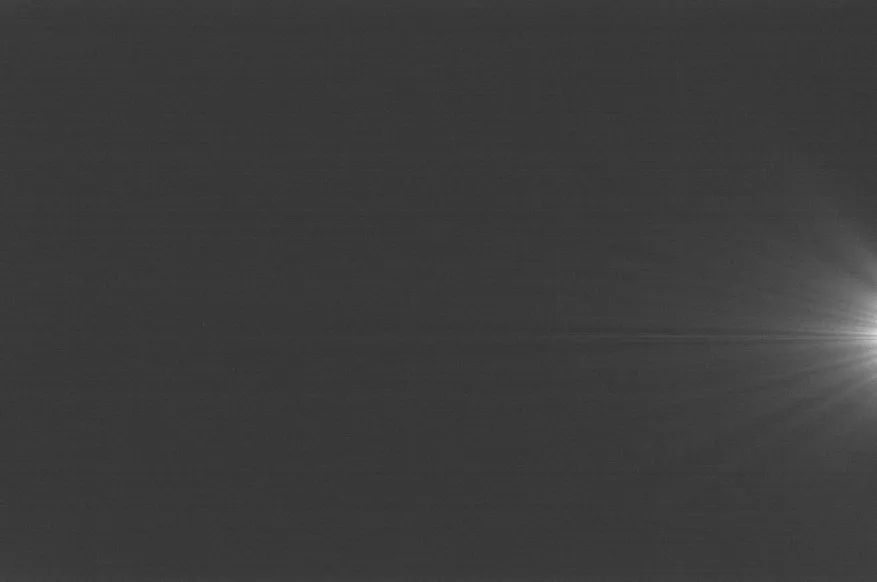
Dark frame with amp glow from the previous generation of CMOS sensors – 300s exposure time

Dark frame from ASI2600 without any amp glow – 300s exposure time
| Free Shipping Graphic | Free Contiguous US Shipping |
|---|---|
| Hide Found a better Shipped Price on Frontend? | No |
- ZWO ASI2600MC Pro Camera Body
- Soft case
- Quick guide
- USB 3.0 cable (2 meter)
- 2x USB 2.0 cable (0.5 meter)
- T2 - M48 Extender (16.5mm)
- T2 Extender (21mm)
- M42 to M48 Adapter
- Dust Cover
- Hexagon Wrench

ASI2600 Duo: Dual Imaging and Guiding Solution for Deep Space Astrophotography
The original ASI2600MC-Pro changed the game when considering what was possible with a color camera. The sensitivity, lack of amp glow, and all the other features that came with the ASI2600MC had never been available at that price. With the ASI2600MC Duo, you get the same amazing IMX571 high-resolution color sensor found in the original model. Except now it has a built-in auto-guiding sensor! Gone are the days of fiddling with an OAG or balancing a finder scope. With the ASI2600MC Duo, if your main camera can focus, then so can your guide camera!
The ZWO ASI2600MC-Duo uses the same 16-bit ADC for an impressive dynamic range of 14 stops. This means the 2600MC-Duo can capture faint details in both the dark shadows and bright highlights of your favorite targets. The 3.76µm pixels also provide an ideal pixel scale for a wide variety of imaging telescopes. This means fewer issues with sampling, better stars, and sharper deep-sky details.
The IMX571 color sensor in the ZWO ASI2600MC-Duo boasts the same 80% quantum efficiency (QE) as the original 2600MC-Pro. This remains an impressive figure as compared to previous generations of astronomy cameras, but where the ASI2600MC-Duo stands out is with a full well capacity of 73ke! This is 23ke larger than the original, and it means the stars won't become over-saturated or lose their detail in longer exposures. And of course, amp glow continues to be a thing of the past with this camera (even with dark frames).
Vela Supernova Remnant - Taken by Astrobin.com user Malcolm Park, using a ZWO ASI2600MC-DUO and a Rokinon 135mm f/2.0 ED UMC lens.
Key Features of the ASI2600MC Duo
- 26 Megapixel Full-Frame Sensor: Delivers exceptional detail for capturing deep-sky objects with precision.
- True 16-bit ADC: Provides up to 14 stops of high dynamic range, ensuring excellent contrast and detail in both bright and dark areas.
- 80% Peak Quantum Efficiency: Greater sensitivity means more light capture, resulting in clearer and more detailed images.
- 73ke- Full Well Capacity: Helps capture bright stars without them looking bloated or overexposed, even during long exposures.
- Ultra-Low Readout Noise (1.0e - 3.3e): Enhances image clarity and dynamic range.
- Zero Amp-Glow: Ensures clean images without the camera adding unwanted light from its electronics, even during extended exposures, reducing post-processing hassle..
- Seamless Compatibility with ZWO Accessories: Integrates with accessories like the ZWO CAA Camera Angle Adjuster Electronic Rotator or the ZWO 7-Position Electronic Filter Wheel for 2" Filters (EFW).
The ZWO ASI2600MC Duo: A simple solution for long-exposure astrophotography!
Integrated Guide Camera for Seamless Imaging and Guiding
The highlight of the ASI 2600 Duo is the camera sensor above the main IMX571 imaging sensor. This secondary sensor is dedicated to auto-guiding, and integrating it in the camera body offers several significant benefits. The first and most noticeable is improved performance. By including the guide sensor within the main camera, you’ll no longer need to deal with mechanical issues like balance or flexure, or worry about finding the focal plane. Plus, removing the need to use an off-axis guider frees up 16.5 millimeters of space in your imaging train! Having this free space means you can use other accessories like the ZWO Camera Angle Adjuster (CAA) or a filter drawer.
When the ASI2600MC Duo was first announced, many people questioned its ability to pick up guide stars. This concern is because of the guide sensor's position behind any filters. Since many filters significantly reduce the amount of incoming light, it was unclear whether the guide camera’s sensor could find enough stars. This has since been thoroughly tested, and the results are clear: the guide camera sensor has no issue picking up guide stars.
The guide camera sensor is the same found in the ASI220MM Mini, which is itself a highly-sensitive guide camera. The sensor is 7.7x4.3 millimeters and has a resolution of 1920x1080 pixels. Autoguiding software uses the centroid of a star to accurately guide. This means that pinpoint stars are not required for good guiding. So, even if stars appear elongated on telescopes with smaller image circles, users report that 2600MC Duo guiding works great.
Cutting-Edge Technical Specifications
The ASI2600MC Duo has some of the best technical capabilities of any cooled astronomy camera on the market. The 80% QE means that 80% of the photons hitting your sensor are recorded as data. This is essential when imaging deep space objects, especially faint objects like galaxies and planetary nebulae. The ASI2600MC-Duo also has a 16-bit analog-to-digital converter (ADC). This allows for a very wide dynamic range, which complements its 73,000e full well capacity.
Comet 12P/Pons-Brooks - Taken by Astrobin.com user James Peirce, using a ZWO ASI2600MC-DUO, Sky-Watcher Esprit 120ED, and ZWO-AM5 Mount. For more information on this incredible image, please see James' full description, available here - https://mypetstars.com/astrophotography/Comet-12P-Pons-Brooks
Reviews for the ZWO ASI2600MC Duo:
Agena Astro affiliate Peter Zelinka breaks down the specs and features of the ZWO ASI2600MC Duo.
Agena Astro affiliate Nico Carver (@NebulaPhotos) does a full test and review of the ZWO ASI2600MC Duo.
Dive Deeper into the ASI2600 Duo’s Full Capability
Dual Gain Structure
A key advancement of the IMX571 over previous generations of camera sensors is the dual gain structure. By setting the gain to 100, you can immediately reduce read noise and boost dynamic range. The sensitivity also increases, allowing you to capture finer details with minimal noise.
ZWO recommends using gain 100 for most applications, the main exception is for very bright deep-space objects or when using short exposures that might benefit from different settings.
Modern Backside-Illuminated Sensor (BSI) For Improved Sensitivity
Sony's backside-illumination (BSI) sensor technology was designed to enhance sensitivity while reducing noise. This is because conventional sensors place their electronics on top of the silicon layer that the light must penetrate. This blocks some of the incoming light from reaching the photodiodes. BSI technology inverts this arrangement, positioning these electronics behind the silicon layer. This approach creates an unobstructed path for photons to reach the light-sensitive areas!
This BSI advancement is especially valuable in high-resolution sensors like the IMX571, along with ZWO's larger full-frame models (ASI6200MM, ASI6200MC, and ASI2400MC). This is because BSI sensors can download images much faster, particularly when handling the expanded file sizes produced by 16-bit sensors. And thanks to this low-noise CMOS architecture, the images have so little noise that traditional calibration frames become almost unnecessary!
Native 16-bit ADC Improves Dynamic Range
The ZWO ASI2600MC-Duo distinguishes itself with an advanced 16-bit analog-to-digital converter (ADC). While some older CCD cameras claim 16-bit capability, this modern CMOS sensor provides a genuine 14-stop dynamic range. Improved dynamic range yields image quality with superior contrast and improved tonal gradations. And this is particularly true when used with narrowband filters. From the faintest details of a nebula to the brilliant stars at its center, the ASI2600MC-Duo handles them with ease! And all in one single exposure!
Reduced Noise with Two-stage TEC Cooling
The ASI2600MC-Duo features a powerful two-stage TEC cooling system to reduce thermal noise during long exposures. It can reduce the sensor temperature by a whopping 63°F (35°C) below ambient conditions!
This impressive system works alongside ZWO's innovative dark current suppression technology to provide industry-leading noise management. At 32°F (0°C), the camera produces an exceptionally low 0.0022 electrons of dark current noise per second per pixel. This means during a 5-minute (300s) exposure, the accumulated dark current noise (0.7e) remains below the camera's basic readout noise. When cooled further to -4°F (-20°C), dark current becomes virtually nonexistent at 0.00012e/s/px, making it inconsequential to final image quality.
*Please note: the camera’s TEC cooler requires a 12V external power supply (not included).
High-Speed Data Transfer with USB 3.0
The ASI2600MC Pro includes a high-speed USB 3.0 interface and a built-in 512MB DDR3 cache. Both ensure stable and secure data transmission.
During long exposures, this combination effectively avoids frame dropping and reduces the amp glow effect caused by slow readout speed.
Less Post-Processing Hassles Thanks to Zero Amp Glow
One fantastic change to this entire generation of CMOS sensors is the complete removal of amp glow. Amp-glow is when an infrared light source leaks onto your sensor and leaves an artifact on the final images. This issue is especially bad in many older astronomy cameras, DSLRs, and some newer mirrorless cameras. Most cases are severe enough that your dark frames need their own set of flats to remove it effectively.
Dark frame with amp glow from the previous generation of CMOS sensors – 300s exposure time
Dark frame from ASI2600 without any amp glow – 300s exposure time
| Free Shipping Graphic | Free Contiguous US Shipping |
|---|---|
| Hide Found a better Shipped Price on Frontend? | No |
- ZWO ASI2600MC Pro Camera Body
- Soft case
- Quick guide
- USB 3.0 cable (2 meter)
- 2x USB 2.0 cable (0.5 meter)
- T2 - M48 Extender (16.5mm)
- T2 Extender (21mm)
- M42 to M48 Adapter
- Dust Cover
- Hexagon Wrench

ZWO ASI2600MC Duo APS-C Cooled Color Astronomy Camera with Built-In Guide Sensor # ASI2600MC-Duo