

ZWO ASI2600MC Pro Cooled Color Astronomy Camera
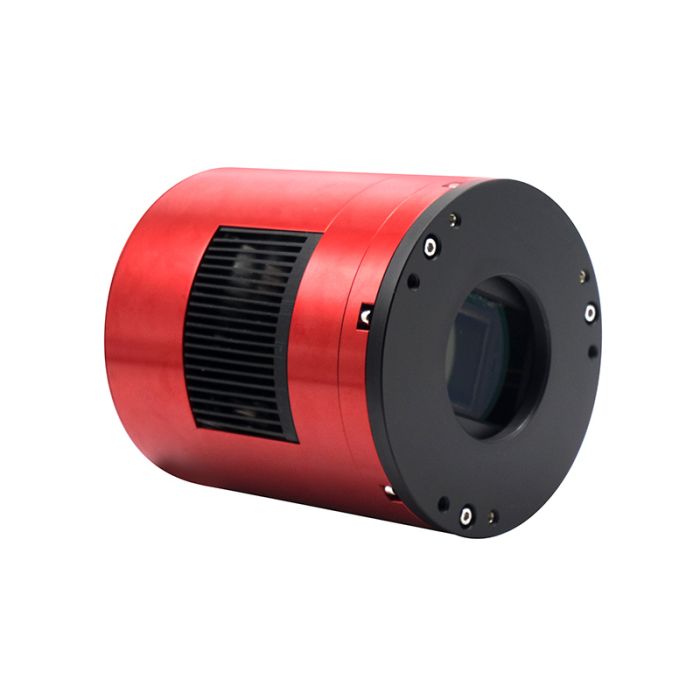
Availability: Discontinued. Replaced by new model 2600MC-P25.
Contiguous US Customers:
All items we sell ship for free within the Contiguous US. Shipping will be via the cheapest shipping method which will vary depending on the items in your order. During checkout, you may also be shown other optional faster shipping choices.
US Customers in Hawaii and Alaska:
Free shipping applies to almost all products. A few large telescopes and mounts are excluded from this free shipping offer. For these items, please contact us to obtain a shipping quote before you check out using the online shopping cart.
International Customers:
Free shipping does not apply to international orders. During check-out, you will be presented with several shipping choices and costs. However, the export of some items may be restricted outside the US due to size or manufacturer restrictions.
The ZWO ASI2600MC Pro: The Perfect Solution for One-Shot Color Astrophotography
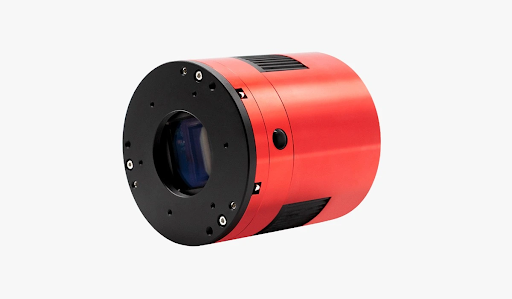
ZWO has been a leader in the astrophotography market since the release of its legendary ASI1600MM monochrome and ASI1600MC color astronomy cameras. And this newest generation of cooled astronomy cameras continues to lead the pack. The ZWO ASI2600MC has set a new standard for deep space astrophotography using one-shot color cameras, with its cutting-edge technology, and it’s large, back-illuminated Sony IMX571 APS-C sensor.
These new CMOS sensors deliver an impressive resolution of 26-megapixels with a native 16-bit ADC, allowing it to capture rich details across a wide dynamic range. The ZWO ASI2600MC Pro uses an innovative two-stage TEC cooling system, further improving the low-noise design of its CMOS sensor. All of this means that your images will end up having so little dark-current noise that many astrophotographers skip taking dark frames for post-processing!
Additional features include an anti-dew heater, a high-speed USB 3.0 interface, and an onboard DDR3 cache. These ensure robust performance and efficient data handling, making the ZWO ASI2600MC a standout choice for astrophotographers seeking reliable, high-quality color cameras for deep sky astrophotography.
ZWO ASI2600MC Pro Review
Check out Agena Astro affiliate Peter Zelinka's detailed review of the ZWO ASI2600MC Pro, after using it for 6 months. He shares his hands-on experience, highlighting the camera's performance, features, and how it stands up to real-world astrophotography.
ZWO ASI2600MC Key Performance Features
- 26 Megapixel Full-Frame Sensor: Delivers exceptional high-resolution detail for capturing deep-sky objects with precision.
- True 16-bit ADC: Provides up to 14 stops of high dynamic range, ensuring excellent contrast and detail in both bright and dark areas.
- 80% Peak Quantum Efficiency (QE): Greater sensitivity means more light capture, resulting in clearer and more detailed images.
- 50ke- Full Well Capacity: Prevents saturation of bright stars, even in long exposures.
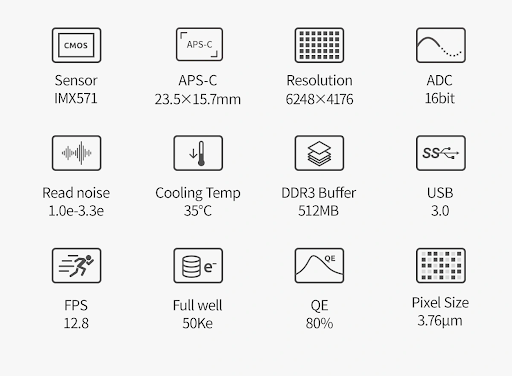
- Ultra-Low Readout Noise (1.0e - 3.3e): Enhances image clarity and dynamic range.
- Zero Amp-Glow: Ensures clean, noise-free images, even during extended exposures, reducing post-processing hassle.
- Seamless Compatibility with ZWO Accessories: Integrates effortlessly with accessories like the ZWO CAA Camera Angle Adjuster Electronic Rotator, the ZWO 7-Position Electronic Filter Wheel for 2" Filters (EFW), and the ZWO OAG-L Large Off-Axis Guider with 1.25" Holder (OAG-L).
ASI2600MC Pro: Exceptional Image Quality with Advanced Sensor Technology
High-Resolution Astrophotography

The ZWO ASI2600MC Pro is a dedicated, cooled, one-shot color astronomy camera with an extremely sensitive CMOS sensor — the famed Sony IMX571. With a sensor array of 6248 x 4176 pixels in an APS-C format, this high-resolution deep sky imaging camera offers 26-megapixels for extremely detailed astrophotography. This means you can print your images, enlarge them, or crop them to your heart's content!
Clearer Images with Zero Amp Glow
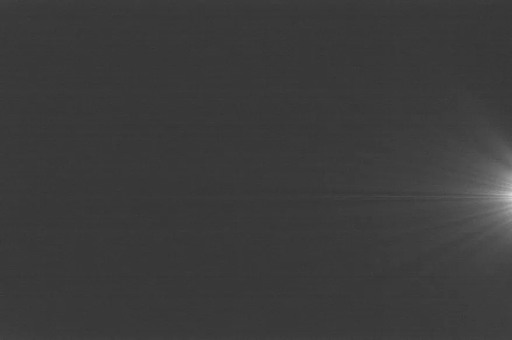

A significant change in this generation of CMOS sensors is the complete removal of any traces of amp glow. Amp-glow is when a typically weak infrared light source leaks onto your sensor and leaves a pattern or shape on the final images. This issue affects many older astronomy cameras, DSLRs, and even newer mirrorless cameras. Most cases are severe enough that your dark frames need their own set of flats to properly calibrate. Thankfully the ASI2600MC Pro does not experience this issue at all, making calibration and post-processing a breeze!
Dual Gain Structure For Greater Sensitivity
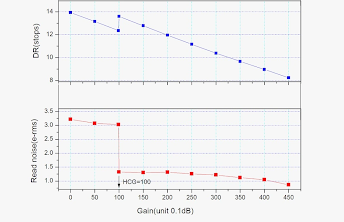
Apart from the disappearance of amp glow, another notable evolution from previous generations of astronomy cameras is the dual gain structure used by the Sony IMX571. This means that at a gain of 100, the read noise plummets, and the dynamic range improves to allow for pristine images. Even at higher gains, the ASI2600MC maintains improved sensitivity, better detail, and reduced noise. While ZWO recommends a gain of 100 for most uses, you can adjust this setting as needed based on the target or set-up you’re using.
Essential features of the ZWO ASI2600MC Pro
Top-Tier Technical Specifications
The ASI2600MC Pro features some of the best technical capabilities of any astrophotography camera currently available to consumers. It has a QE of over 80%. This means more than 80% of the light that hits your sensor is recorded as data. This is essential when imaging faint objects in deep space. The ASI2600MC Pro also has an ADC of 16 bits allowing for a very wide dynamic range, as well as an impressively large full well capacity of 50,000e. This means that each pixel can record a high amount of information without clipping your precious data, as has been the case with some previous generations of CMOS sensors.

Backside-Illuminated Sensor (BSI)
Sony has been developing their backside-illumination sensor (BSI) technology for a while now. This technology greatly improves overall sensitivity and noise reduction. Traditional camera sensors include all of the essential electronics on top of the silicon layer of the sensor. This design blocks some of the light from reaching the sensor, so BSI sensors flip this design and move all the electronics to the back of the silicon layer. This gives the photons a clear path straight to the light-sensitive area of the camera sensor, which improves the sensor's ability to capture light coming in from different angles. It also provides better overall sensitivity across the full visible spectrum of light.
This is particularly important for high-resolution sensors like the IMX571. It is also crucial for ZWO’s larger full-frame models, the ASI6200MM, ASI6200MC, and ASI2400MC.
The importance grows even more when accounting for the larger file sizes of a 16-bit sensor. When combined with the low-noise CMOS architecture of these modern sensors, BSI technology helps to create images with such low-noise they barely need calibration frames!

Native 16-bit ADC
The ASI2600MC continues to set itself apart with a sophisticated 16-bit analog-to-digital converter (ADC). Unlike traditional CCD cameras that might claim 16-bit capability but fall short, this new-generation CMOS sensor delivers a true 14-stop dynamic range. For astrophotographers, this means the ability to capture the faintest wisps of nebulosity and the brightest star cores in a single frame. This isn’t just another stat to pad the numbers - it translates into noticeably sharper images with richer contrast and beautifully smooth tonal transitions, especially when using narrowband filters. This makes the ASI2600 Pro one of the few cameras in its class that can truly handle the extreme brightness range of deep-sky imaging.
Two-stage TEC Cooling
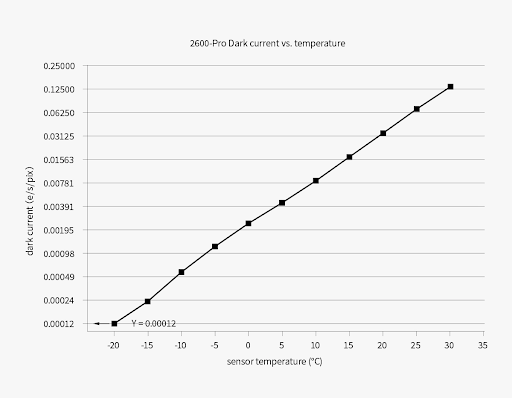
The ASI2600MM Pro's powerful two-stage cooling system can drop the sensor by a massive -31ºF (-35ºC) below the ambient temperature. This dramatically reduces unwanted thermal noise during long deep-sky exposures. While this cooling system is highly effective, it’s only one part of ZWO’s approach to reducing noise.
The ZWO ASI2600MC also uses innovative dark current suppression technology. When cooled to 0°C, the camera produces a mere 0.0022 electrons of dark current noise per second per pixel. To put this into perspective, even during a 5-minute exposure, the total dark current noise (0.7e) remains lower than the camera's base readout noise! Cool the sensor down to -20°C, and the dark current becomes virtually non-existent at 0.00012e/s/pixel - making it so low it's essentially irrelevant to your final image quality.
Please note: the camera’s TEC cooler requires a 12V external power supply (not included).
USB 3.0 for High-Speed Data Transfer
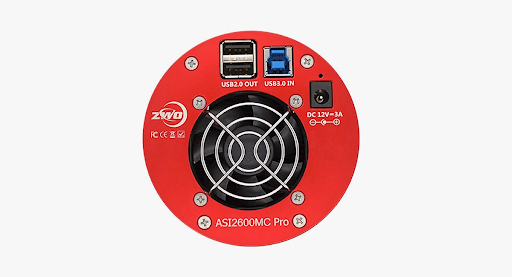
The ASI2600MC Pro is equipped with a high-speed USB 3.0 interface and a built-in 256MB DDR3 cache, both of which ensure stable and secure data transmission. During long exposures, this combination effectively avoids frame dropping and significantly reduces the “glow” effect caused by slow readout speed.
| Product Banner Type | closeout |
|---|---|
| Free Shipping Graphic | Free Contiguous US Shipping |
| Hide Found a better Shipped Price on Frontend? | No |
- ZWO ASI2600MC Pro Camera Body
- Soft Case
- Quick Guide
- USB 3.0 Cable (2 meter)
- 2x USB 2.0 Cable (0.5 meter)
- T2 - M48 Extender (16.5mm)
- T2 Extender (21mm)
- M42 to M48 Adapter
- Dust Cover
- Hexagon Wrench

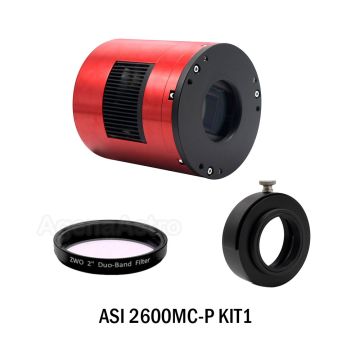

The ZWO ASI2600MC Pro: The Perfect Solution for One-Shot Color Astrophotography
ZWO has been a leader in the astrophotography market since the release of its legendary ASI1600MM monochrome and ASI1600MC color astronomy cameras. And this newest generation of cooled astronomy cameras continues to lead the pack. The ZWO ASI2600MC has set a new standard for deep space astrophotography using one-shot color cameras, with its cutting-edge technology, and it’s large, back-illuminated Sony IMX571 APS-C sensor.
These new CMOS sensors deliver an impressive resolution of 26-megapixels with a native 16-bit ADC, allowing it to capture rich details across a wide dynamic range. The ZWO ASI2600MC Pro uses an innovative two-stage TEC cooling system, further improving the low-noise design of its CMOS sensor. All of this means that your images will end up having so little dark-current noise that many astrophotographers skip taking dark frames for post-processing!
Additional features include an anti-dew heater, a high-speed USB 3.0 interface, and an onboard DDR3 cache. These ensure robust performance and efficient data handling, making the ZWO ASI2600MC a standout choice for astrophotographers seeking reliable, high-quality color cameras for deep sky astrophotography.
ZWO ASI2600MC Pro Review
Check out Agena Astro affiliate Peter Zelinka's detailed review of the ZWO ASI2600MC Pro, after using it for 6 months. He shares his hands-on experience, highlighting the camera's performance, features, and how it stands up to real-world astrophotography.
ZWO ASI2600MC Key Performance Features
- 26 Megapixel Full-Frame Sensor: Delivers exceptional high-resolution detail for capturing deep-sky objects with precision.
- True 16-bit ADC: Provides up to 14 stops of high dynamic range, ensuring excellent contrast and detail in both bright and dark areas.
- 80% Peak Quantum Efficiency (QE): Greater sensitivity means more light capture, resulting in clearer and more detailed images.
- 50ke- Full Well Capacity: Prevents saturation of bright stars, even in long exposures.
- Ultra-Low Readout Noise (1.0e - 3.3e): Enhances image clarity and dynamic range.
- Zero Amp-Glow: Ensures clean, noise-free images, even during extended exposures, reducing post-processing hassle.
- Seamless Compatibility with ZWO Accessories: Integrates effortlessly with accessories like the ZWO CAA Camera Angle Adjuster Electronic Rotator, the ZWO 7-Position Electronic Filter Wheel for 2" Filters (EFW), and the ZWO OAG-L Large Off-Axis Guider with 1.25" Holder (OAG-L).
ASI2600MC Pro: Exceptional Image Quality with Advanced Sensor Technology
High-Resolution Astrophotography
The ZWO ASI2600MC Pro is a dedicated, cooled, one-shot color astronomy camera with an extremely sensitive CMOS sensor — the famed Sony IMX571. With a sensor array of 6248 x 4176 pixels in an APS-C format, this high-resolution deep sky imaging camera offers 26-megapixels for extremely detailed astrophotography. This means you can print your images, enlarge them, or crop them to your heart's content!
Clearer Images with Zero Amp Glow
A significant change in this generation of CMOS sensors is the complete removal of any traces of amp glow. Amp-glow is when a typically weak infrared light source leaks onto your sensor and leaves a pattern or shape on the final images. This issue affects many older astronomy cameras, DSLRs, and even newer mirrorless cameras. Most cases are severe enough that your dark frames need their own set of flats to properly calibrate. Thankfully the ASI2600MC Pro does not experience this issue at all, making calibration and post-processing a breeze!
Dual Gain Structure For Greater Sensitivity
Apart from the disappearance of amp glow, another notable evolution from previous generations of astronomy cameras is the dual gain structure used by the Sony IMX571. This means that at a gain of 100, the read noise plummets, and the dynamic range improves to allow for pristine images. Even at higher gains, the ASI2600MC maintains improved sensitivity, better detail, and reduced noise. While ZWO recommends a gain of 100 for most uses, you can adjust this setting as needed based on the target or set-up you’re using.
Essential features of the ZWO ASI2600MC Pro
Top-Tier Technical Specifications
The ASI2600MC Pro features some of the best technical capabilities of any astrophotography camera currently available to consumers. It has a QE of over 80%. This means more than 80% of the light that hits your sensor is recorded as data. This is essential when imaging faint objects in deep space. The ASI2600MC Pro also has an ADC of 16 bits allowing for a very wide dynamic range, as well as an impressively large full well capacity of 50,000e. This means that each pixel can record a high amount of information without clipping your precious data, as has been the case with some previous generations of CMOS sensors.
Backside-Illuminated Sensor (BSI)
Sony has been developing their backside-illumination sensor (BSI) technology for a while now. This technology greatly improves overall sensitivity and noise reduction. Traditional camera sensors include all of the essential electronics on top of the silicon layer of the sensor. This design blocks some of the light from reaching the sensor, so BSI sensors flip this design and move all the electronics to the back of the silicon layer. This gives the photons a clear path straight to the light-sensitive area of the camera sensor, which improves the sensor's ability to capture light coming in from different angles. It also provides better overall sensitivity across the full visible spectrum of light.
This is particularly important for high-resolution sensors like the IMX571. It is also crucial for ZWO’s larger full-frame models, the ASI6200MM, ASI6200MC, and ASI2400MC.
The importance grows even more when accounting for the larger file sizes of a 16-bit sensor. When combined with the low-noise CMOS architecture of these modern sensors, BSI technology helps to create images with such low-noise they barely need calibration frames!
Native 16-bit ADC
The ASI2600MC continues to set itself apart with a sophisticated 16-bit analog-to-digital converter (ADC). Unlike traditional CCD cameras that might claim 16-bit capability but fall short, this new-generation CMOS sensor delivers a true 14-stop dynamic range. For astrophotographers, this means the ability to capture the faintest wisps of nebulosity and the brightest star cores in a single frame. This isn’t just another stat to pad the numbers - it translates into noticeably sharper images with richer contrast and beautifully smooth tonal transitions, especially when using narrowband filters. This makes the ASI2600 Pro one of the few cameras in its class that can truly handle the extreme brightness range of deep-sky imaging.
Two-stage TEC Cooling
The ASI2600MM Pro's powerful two-stage cooling system can drop the sensor by a massive -31ºF (-35ºC) below the ambient temperature. This dramatically reduces unwanted thermal noise during long deep-sky exposures. While this cooling system is highly effective, it’s only one part of ZWO’s approach to reducing noise.
The ZWO ASI2600MC also uses innovative dark current suppression technology. When cooled to 0°C, the camera produces a mere 0.0022 electrons of dark current noise per second per pixel. To put this into perspective, even during a 5-minute exposure, the total dark current noise (0.7e) remains lower than the camera's base readout noise! Cool the sensor down to -20°C, and the dark current becomes virtually non-existent at 0.00012e/s/pixel - making it so low it's essentially irrelevant to your final image quality.
Please note: the camera’s TEC cooler requires a 12V external power supply (not included).
USB 3.0 for High-Speed Data Transfer
The ASI2600MC Pro is equipped with a high-speed USB 3.0 interface and a built-in 256MB DDR3 cache, both of which ensure stable and secure data transmission. During long exposures, this combination effectively avoids frame dropping and significantly reduces the “glow” effect caused by slow readout speed.
| Product Banner Type | closeout |
|---|---|
| Free Shipping Graphic | Free Contiguous US Shipping |
| Hide Found a better Shipped Price on Frontend? | No |
- ZWO ASI2600MC Pro Camera Body
- Soft Case
- Quick Guide
- USB 3.0 Cable (2 meter)
- 2x USB 2.0 Cable (0.5 meter)
- T2 - M48 Extender (16.5mm)
- T2 Extender (21mm)
- M42 to M48 Adapter
- Dust Cover
- Hexagon Wrench