



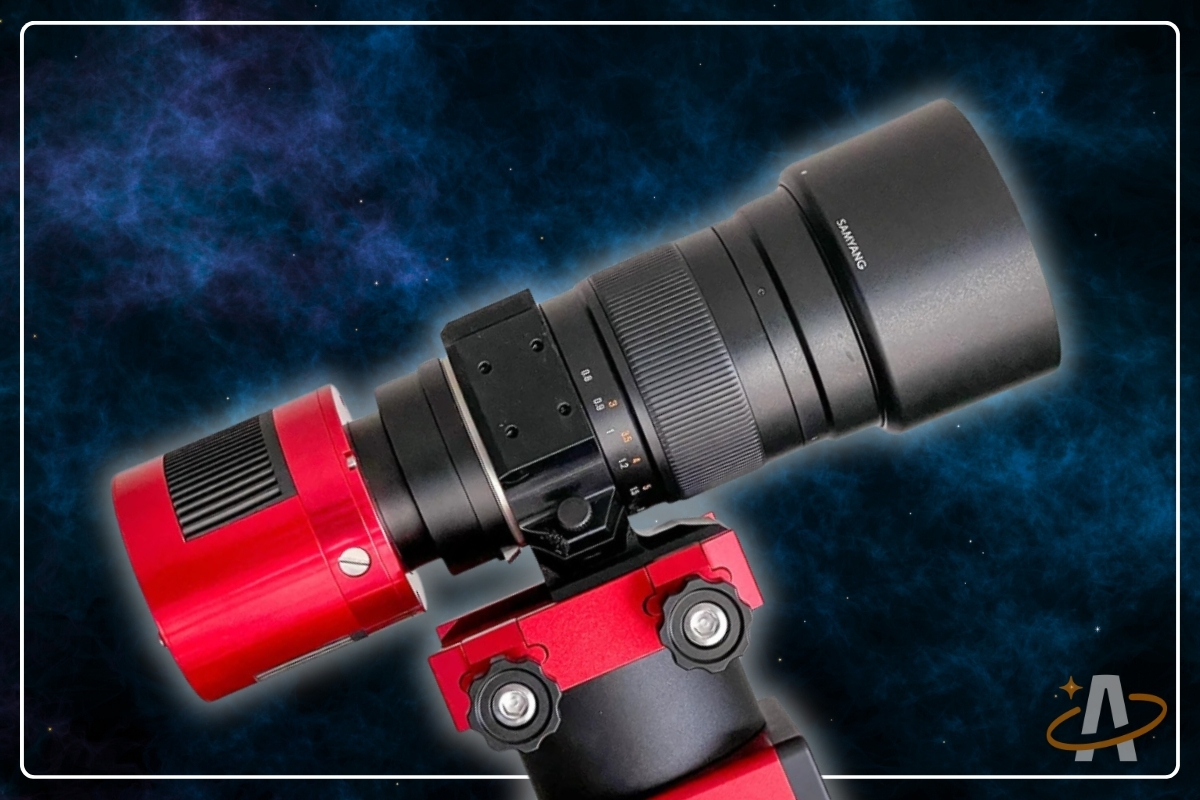
How to Use a Camera Lens With an Astronomy Camera
Pairing a camera lens with an astronomy camera has become highly popular for both beginner and expert astrophotographers alike. With fast focal ratios, affordability, and a variety of focal lengths available, camera lenses can be a powerful tool for capturing wide views of the cosmos!
Looking to use your astronomy camera with a camera lens, but aren’t sure how to set it up or what gear you’ll need? We’ve got you covered! In this guide, we’ll go over things like:
- Camera lens vs. telescope: pros & cons
- How to select a camera lens for astrophotography
- What is flange focal distance?
- Best camera lenses for astrophotography
- How to connect your astronomy camera to a camera lens
- Mounting solutions for astrophotography camera lenses
Note: This guide is about using astronomy cameras with camera lenses on a tracking mount for deep-sky astrophotography. It does not cover using lenses for untracked wide-angle Milky Way photography on a static tripod.
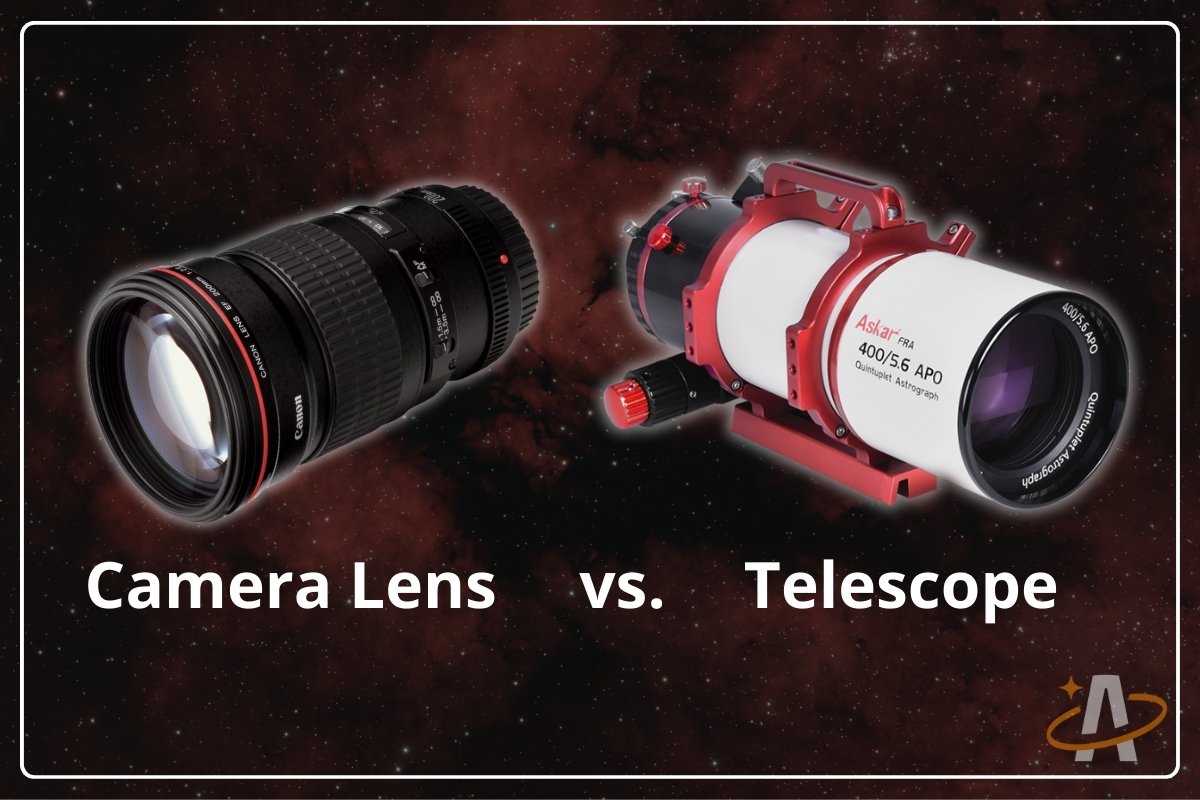
Camera lens vs. telescope: pros & cons
With some telescopes having such short focal lengths these days, it is reasonable to ask: why should I use a camera lens over a telescope? In this section, we’ll go over the pros & cons of owning each for astrophotography.
Camera Lens Pros
- Affordability: Camera lenses, especially manual focus ones like the Samyang / Rokinon 135mm f/2, are very affordable at around $400 USD, or even less if you buy used.
- Versatility: Camera lenses offer more versatility than telescopes, as you can still attach a normal mirrorless or DSLR camera for other types of photography.
- Wide field of view: With a variety of wider focal lengths available, camera lenses allow imagers to access wider angle astrophotography than possible with a telescope.
Camera Lens Cons
- Not designed for astronomy: Camera lenses lack some of the nice features that telescopes have, such as better optics designed for sharp stars, rack & pinion focusers, and tube rings for easy mounting. In addition, the bayonet mount means you need to use an adapter to attach an astronomy camera.
- Limited back focus: As we’ll discuss in the next section, camera lenses have a limited flange focal distance or back focus. At most, the available back focus is around 46mm, which greatly limits you from attaching accessories. Telescopes, especially Petzval lenses, usually have at least 55mm or longer, allowing you to add more accessories like a camera rotator into the image train.
How to select a lens for astrophotography
With endless options for camera lenses, choosing a lens might feel overwhelming for astrophotography. Here are some qualities to look for in a camera lens, regardless of which camera you use it on:
- Fast focal ratio / f-stop: As most of space is quite faint, it’s best to choose a lens with a fast maximum focal ratio aperture. Most ideal lenses start around f/2.8 or faster like f/2 or below. The more light you can let in, the better your images will be.
- Fixed focal length: Having a lens with great optics is highly desirable for astrophotography. Though not required, we strongly recommend a lens with a fixed focal length (also known as a prime lens) such as 50mm. If possible, avoid zoom lenses as they usually perform worse than prime lenses.
- Sweet spot for reach: Most astrophotographers using camera lenses typically find that a focal length range of 50mm to 200mm hits a sweet spot for wide field imaging (not for static tripod Milky Way shots). Wider than 50mm can cause issues with the transmission of astronomy filters, and at longer than 200mm it is typically best to use a telescope instead.
- Newer optics: Recent camera lenses (within the last two decades or so) designed for digital cameras are a better choice for astrophotography thanks to advancements in coating technology. Older lenses designed for film cameras may lack the coatings to produce sharp stars.
- Designed for DSLR, not mirrorless: At first glance, it might seem that a modern mirrorless camera lens would be the ideal choice for pairing with an astronomy camera. In practice, however, this often doesn’t work because mirrorless lenses typically don’t provide enough back focus. See more in our Flange Focal Distance section below.
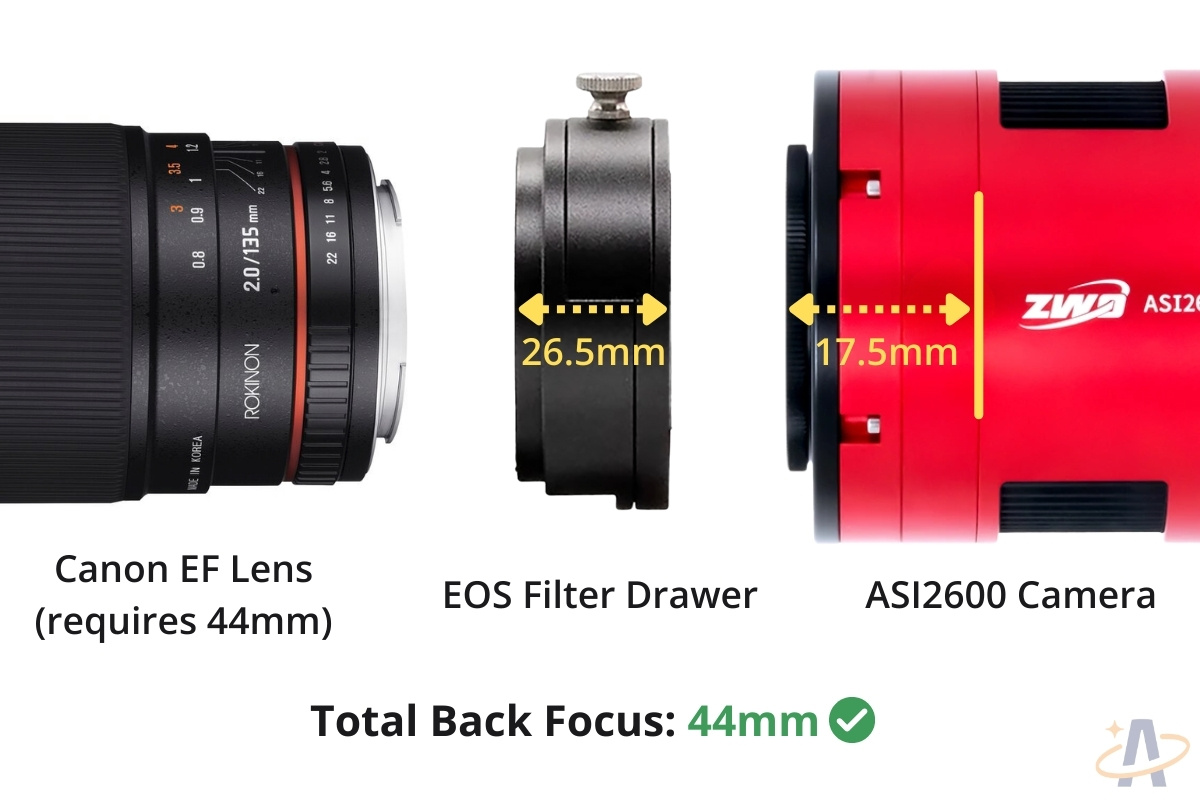
Example back focus configuration with a Canon EF lens
What is flange focal distance?
Flange focal distance, also known as back focus in the astrophotography world, is a fixed point at which a lens or telescope is designed to reach focus. This varies by manufacturer and even lens mount, so it’s important to consider this when selecting a lens.
For example, let’s say your lens’ flange focal distance is 46mm. That means you have 46mm of space to add your astronomy camera, a lens adapter, and/or accessories. Most cameras consume around 17.5mm of this, which would leave just 28.5mm for accessories in your image train. More modern mirrorless camera lenses may only have a flange focal distance of around 16mm, which is too short to attach an astronomy camera as there is no room for attaching an adapter.
If you do not connect the correct accessories to get to your camera lens’ flange focal distance, you may not be able to reach focus at all. It’s possible to reach focus within a few millimeters, but you’ll likely have unwanted optical aberrations such as elongated stars near the corners.
Best lens mounts for astrophotography with a camera lens
Below is a list of camera lens mounts, their flange focal lengths, and our ranking for how suitable they are for attaching an astronomy camera:
| Lens Mount | Mount Type | Flange Focal Distance | Ranking |
|---|---|---|---|
| Canon EF / EF-S | DSLR | 44.0 mm | Excellent |
| Canon RF Mount | Mirrorless | 20.0 mm | Incompatible |
| Nikon F Mount | DSLR | 46.5 mm | Excellent |
| Nikon Z Mount | Mirrorless | 16.0 mm | Incompatible |
| Sony A (Minolta) Mount | DSLR | 44.5 mm | Limited Mounting |
| Sony E Mount | Mirrorless | 18.0 mm | Incompatible |
| Fujifilm X Mount | Mirrorless | 17.7 mm | Incompatible |
| Olympus OM Mount | DSLR | 46.0 mm | Limited Mounting |
| Pentax K Mount | DSLR | 45.46 mm | Limited Mounting |
| Leica R Mount | DSLR | 47.0 mm | Limited Mounting |
| Leica L Mount | Mirrorless | 20.0 mm | Incompatible |
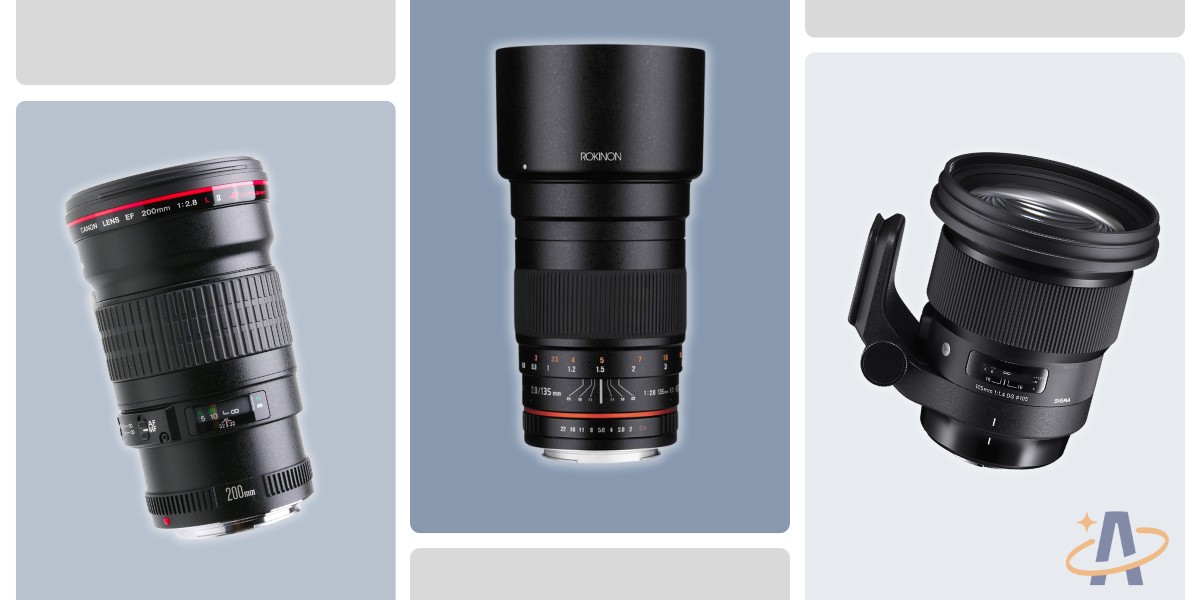
Best camera lenses for astrophotography
The Samyang / Rokinon 135mm f/2 is our top pick for astrophotography. It’s so popular in the community that many accessories already exist for it, including 3D printed rings, ZWO EAF mounts, and more, which you can shop here!
-
Samyang / Rokinon 135mm f/2
- Fast focal ratio
- Good focal length for mosaics
- Very affordable
- Available in both Canon EF and Nikon F mounts
- May have copy to copy issues with sharp stars
- View images taken with the Samyang / Rokinon 135mm f/2
-
Canon EF 200mm f/2.8L II
- Longer focal length with decently fast focal ratio
- Also very affordable
- Designed for full frame cameras
- View images taken with the Canon EF 200mm f/2.8
-
Sigma 105mm f/1.4 Art
- Ultra-fast focal ratio
- Available in both Canon EF and Nikon F mounts
- Significantly more expensive
- View images taken with the Sigma 105mm f/1.4 Art
How to connect an astronomy camera to a camera lens
Connecting your astronomy camera to a camera lens will be different for everyone, as the flange focal distance of each lens mount varies, plus factors such as monochrome cameras vs. color cameras come into play.
Fortunately, if using commonly available gear such as a ZWO astronomy camera and a Canon EF or Nikon F lens, there are off the shelf solutions for attaching your camera.
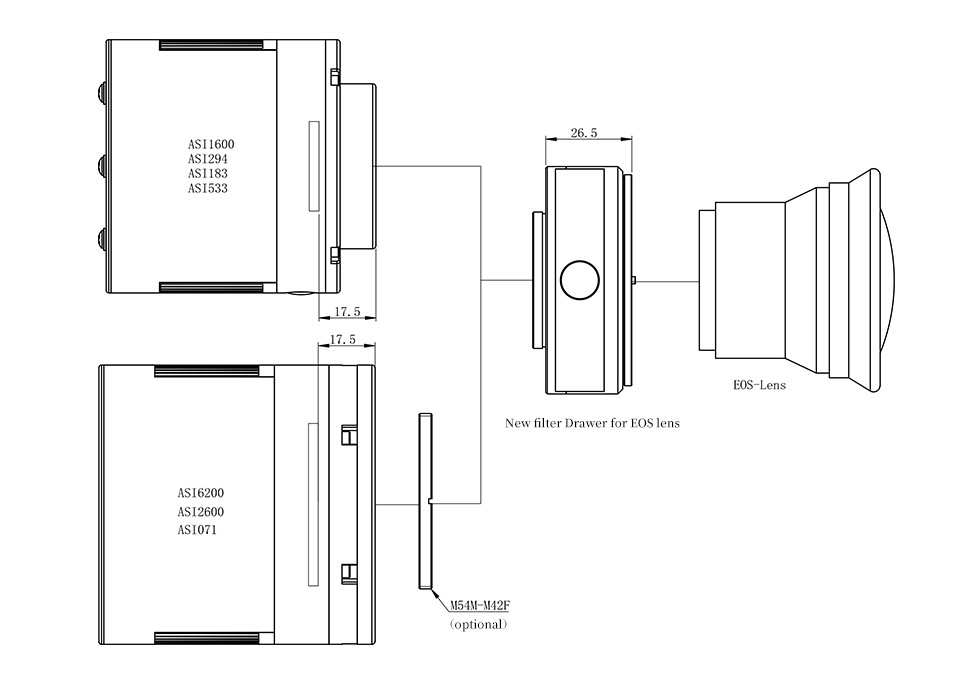
When selecting an adapter to mount your camera, we strongly recommend choosing one that allows the ability to insert astronomy filters. These dual purpose filter drawers allow you to insert a filter as well as adapt the lens bayonet mount to your astronomy camera. Below is a connection diagram plus the correct filter drawers for Canon EF & Nikon F lenses:
How to connect color astronomy cameras
The connection guides below will work with 6200, 2400, 2600, 533, 585, 294, & 183 series cameras or their equivalents. Here are the two most popular filter drawer adapters for color cameras with 17.5mm back focus (ZWO, Touptek, Player One):
- ZWO Filter Drawer for Canon EOS Lens - for Canon EF mount lenses
- ZWO Filter Drawer for Nikon Lens - for Nikon F mount lenses
Note for full frame camera users: The connection on the camera side of these filter drawers is M42. This smaller connection will cause heavy vignetting on full frame sensors, especially at faster focal ratios / f-stops. If using a full frame camera with these filter drawers, we strongly recommend using flat frames to calibrate out the vignetting. You will also need an M54 to M42 zero optical length adapter, which threads into the M54 threads on the camera front plate and allows the filter drawer to thread inside.
How to connect monochrome astronomy cameras to camera lenses
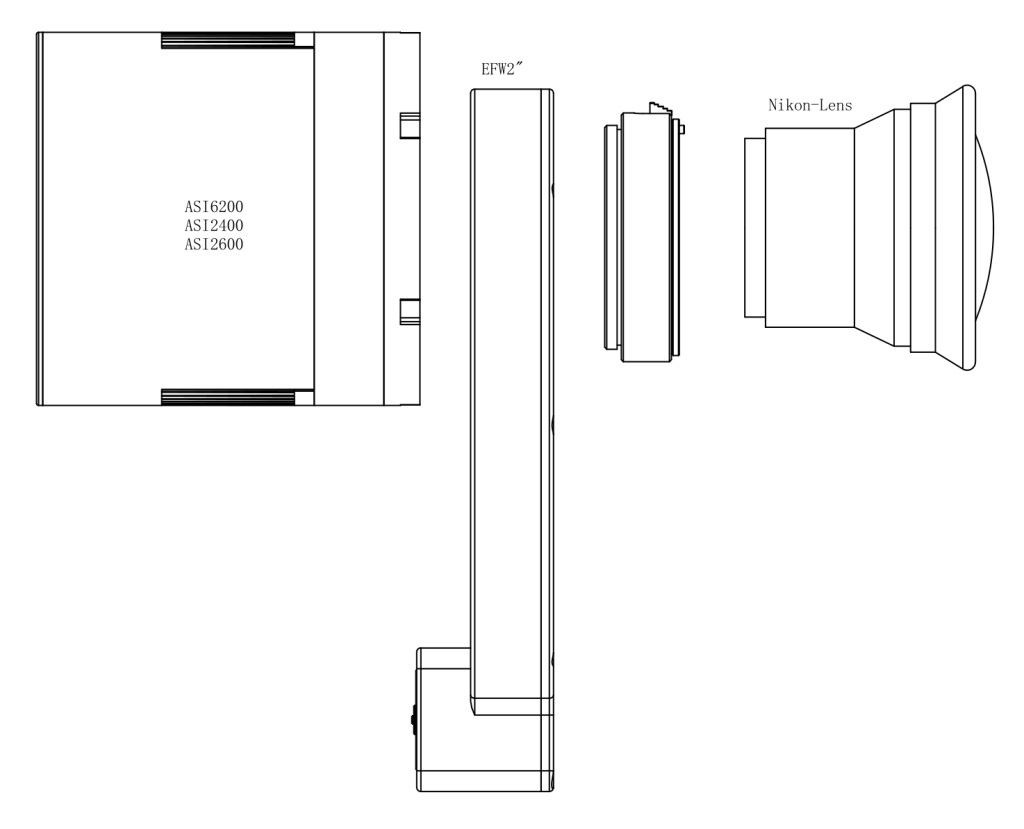
For monochrome cameras, special adapters exist to attach your camera lens to ZWO filter wheels to use monochrome filters. These attach directly to the filter wheel instead of the camera. Be sure to select the correct adapter depending on if you're using a 2" filter wheel or a smaller size:
Canon Lens Adapters to Filter Wheels
- ZWO Canon EOS Lens Adapter for ZWO 2" Electronic Filter Wheel
- ZWO Canon EF Lens Short Adapter for ZWO 1.25"/31mm/36mm Electronic Filter Wheel
Nikon Lens Adapters to Filter Wheels
- ZWO Nikon Lens Adapter for ZWO 2" Electronic Filter Wheel
- ZWO Nikon Lens Short Adapter for ZWO 1.25”/31mm/36mm Electronic Filter Wheel
Mounting solutions for astrophotography camera lenses
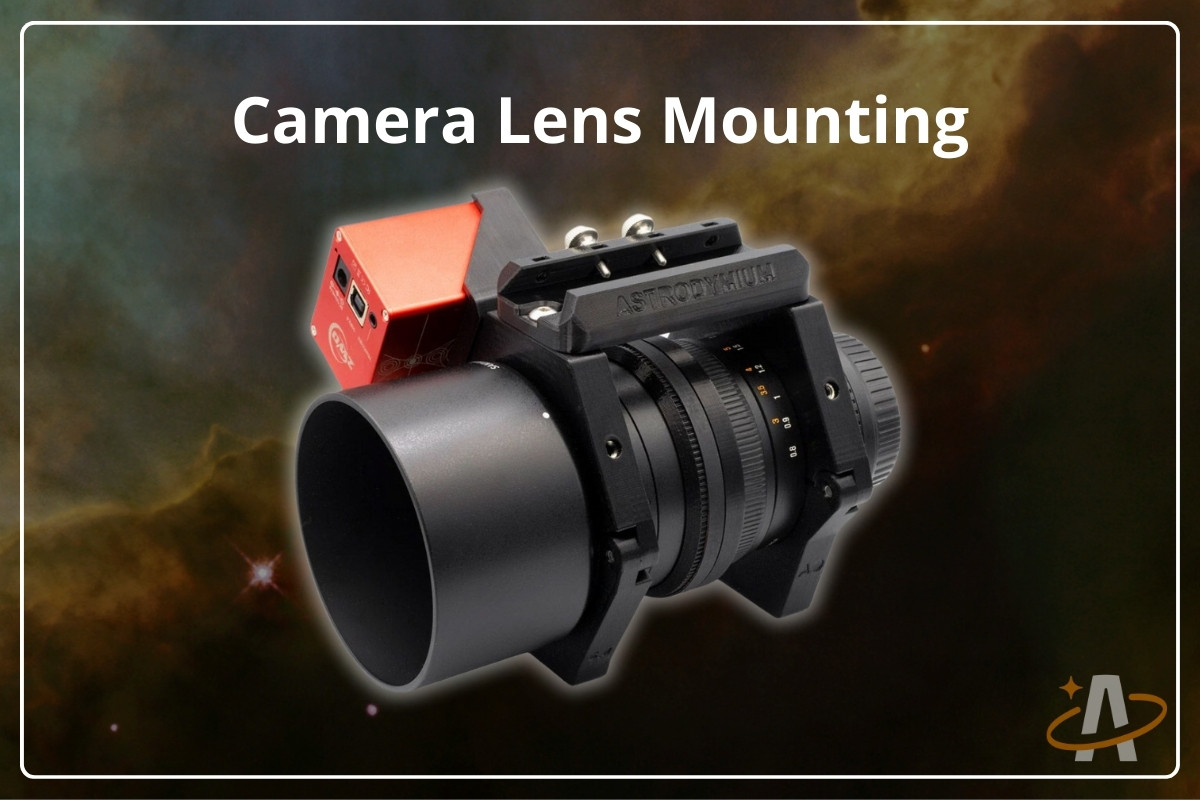
For mounting your lens to an equatorial mount, there are a few options. The best option is a complete ring system with at least two tube rings. At Agena Astro, we carry a few of these 3D printed options for the Rokinon / Samyang 135mm lens. If you're using a different lens, such as the Canon 200mm f/2.8, you may still be able to find 3D printed ring sets elsewhere.
If you're using a lens without a good 3D printed ring set, the best option is to use a holder ring that attaches directly to the camera body itself. At Agena Astro, we carry models of these holder rings specifically for ZWO cameras. Be sure to double check the diameter of your camera to ensure it will fit snugly.
Using either method, you can then connect the lens and camera to your telescope mount using a dovetail bar.