



Choosing the Best Telescope for Beginners 2024
1. Introduction
Welcome to the wonderful hobby of amateur astronomy and astrophotography! If you've landed here, you're likely considering your first telescope purchase. Amateur astronomy guides are often full of confusing lingo which can be intimidating for first-time telescope buyers. This article will recommend some beginner telescopes while also educating you in layman's terms about what specs to look out for so you can make an educated buying decision for yourself.
In general, almost all beginner telescopes are designed for visual astronomy with eyepieces, though most telescopes now allow you to use a smartphone to capture images of the moon and planets with an additional adapter. This article will focus primarily on visual astronomy as the starting point for a first-time telescope owner. For those looking to get into astrophotography of deep sky objects, please note you will be best suited with different equipment than what's recommended here.
If you're simply looking for telescope recommendations, skip down to the bottom of this article. If you're hoping to learn more about how telescopes work first so you can make a more informed decision, continue reading below.
2. The Top 5 Most Important Telescope Specs Explained
To understand which telescope to buy, you should know a few basic specifications to look at first. You should see all of these specifications (except magnification, which varies depending on the eyepiece you use) listed with every telescope:
Aperture is the most important specification of any telescope. It measures the diameter of the largest glass element of the telescope. Generally speaking, the larger the aperture, the better the view you will get.
Focal Length is the distance between a telescope's primary lens or mirror and the point where light comes to focus. The longer the focal length, the more detailed the view, but at the tradeoff of a dimmer view for fainter objects.
Focal Ratio is simply a telescope's focal length divided by the aperture, which you'll see written out as f/8. The lower the focal ratio, the brighter the view, but this usually comes at the cost of less detail on objects like planets and the Moon. Conversely, the higher the focal ratio, the fainter the view, but more detail can usually be seen. Generally speaking, a focal ratio of around f/10 or more is best for viewing the planets and the Moon, whereas a focal ratio around f/5 is ideal (but not required) for viewing deep sky objects like galaxies and nebulae.
Magnification is the number of times an object appears magnified through a telescope & eyepiece compared to the naked eye, such as 100x. To calculate this, take the focal length of your telescope divided by the focal length of your eyepiece. A telescope with a focal length of 1000mm paired with an eyepiece with a focal length of 10mm will yield a magnification of 100x. The higher the number, the more “zoomed in” the view will appear, but telescopes and eyepieces have their limits:
Maximum Useful Magnification is the most magnification you can get with a given telescope & eyepiece when sky conditions are nearly perfect. For most beginner telescopes, you can calculate this by multiplying the aperture in inches by 30. For example, a telescope with a 6” (150mm) aperture has a maximum useful magnification of 180x. This is yet another reason why aperture is the most important specification, as the larger the aperture, the more magnification you can push a telescope to, and therefore the more detail you can see. This is especially important for viewing objects like planets, which are extremely small in most telescopes.
3. The Three Types of Telescopes
There are three different types of telescopes:
Refractor Telescopes
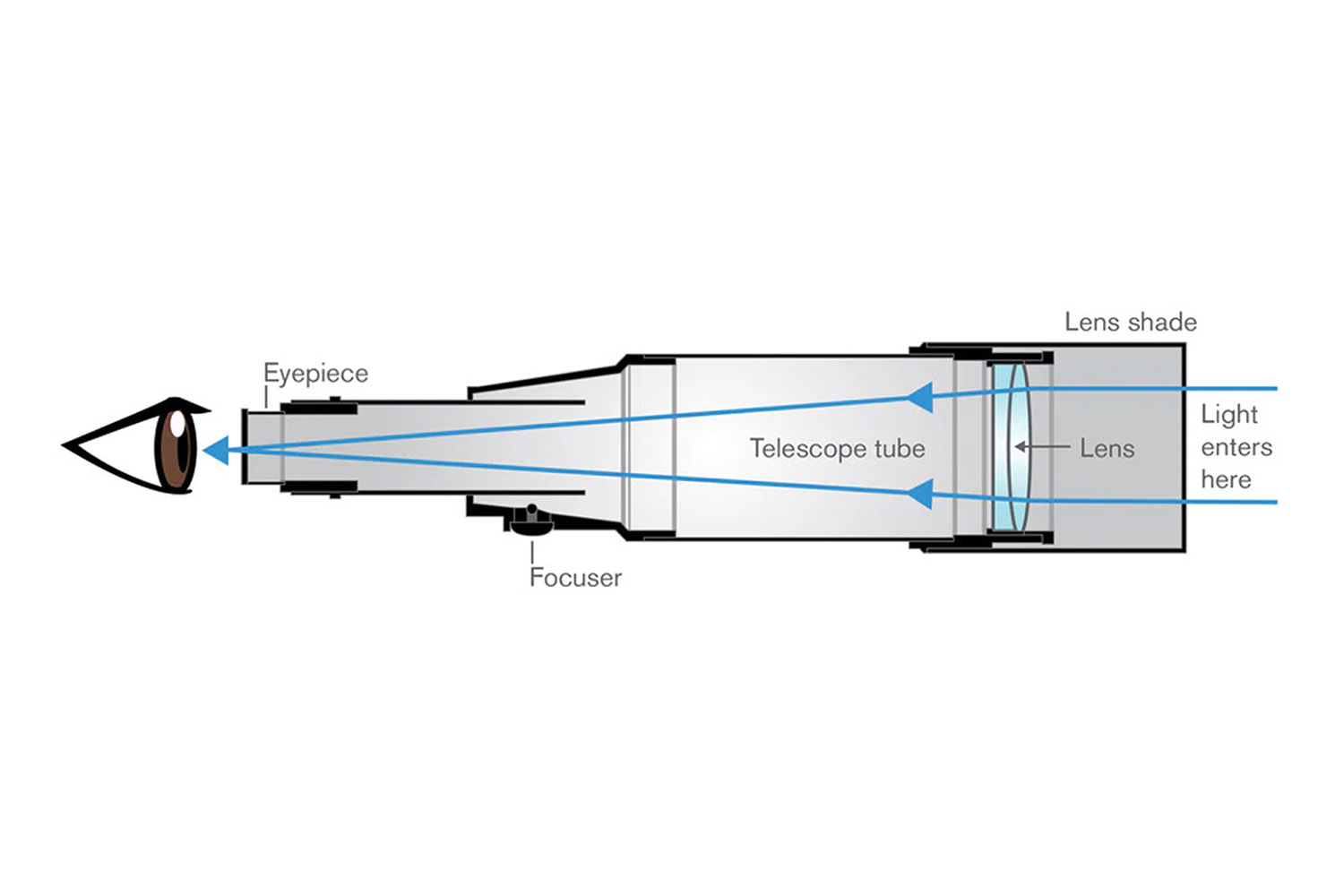
Refractor telescopes use lenses to refract (bend) light into focus.
Reflector Telescopes
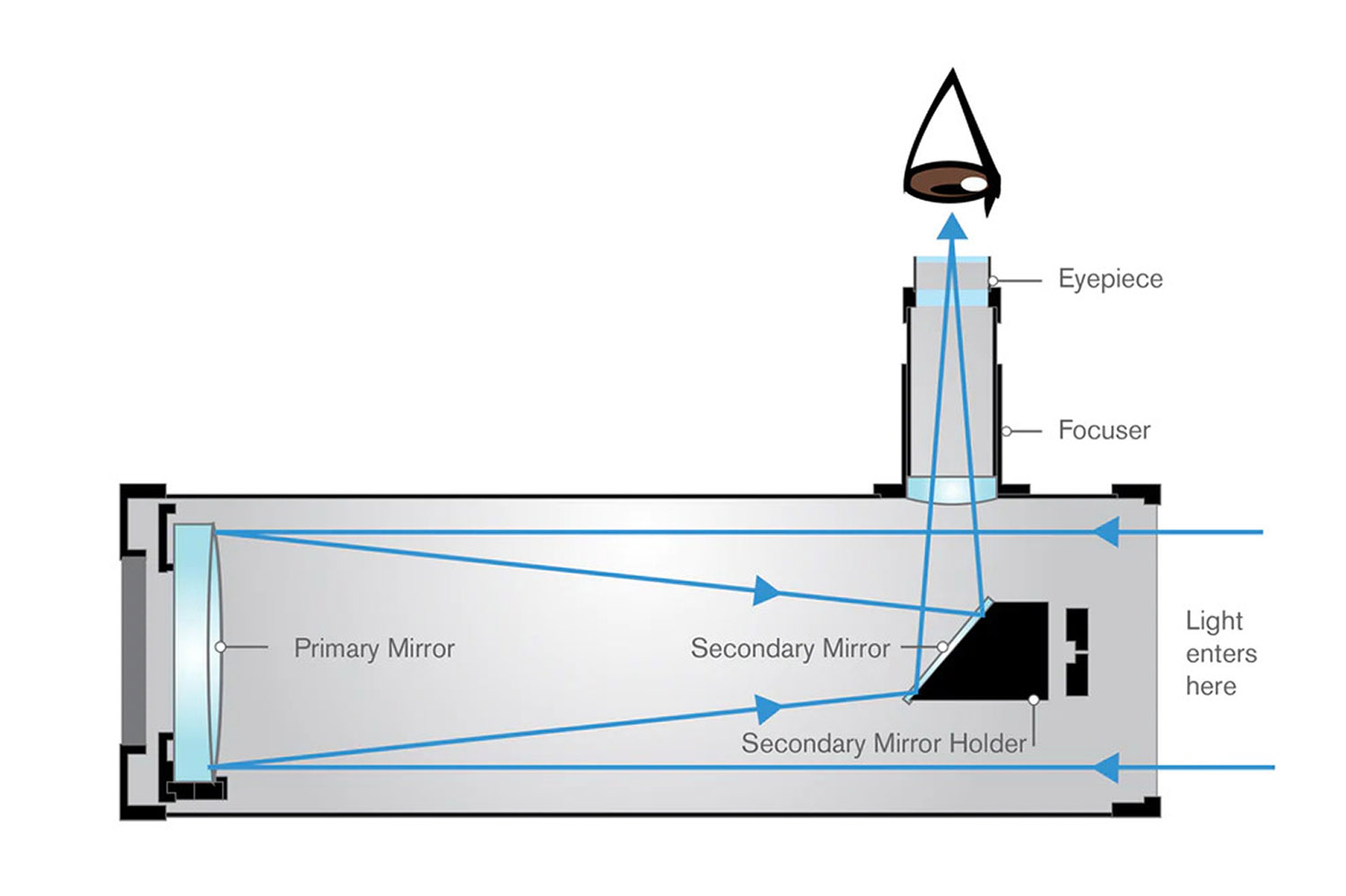
Reflector telescopes use mirrors to reflect light into focus.
Catadioptric Telescopes
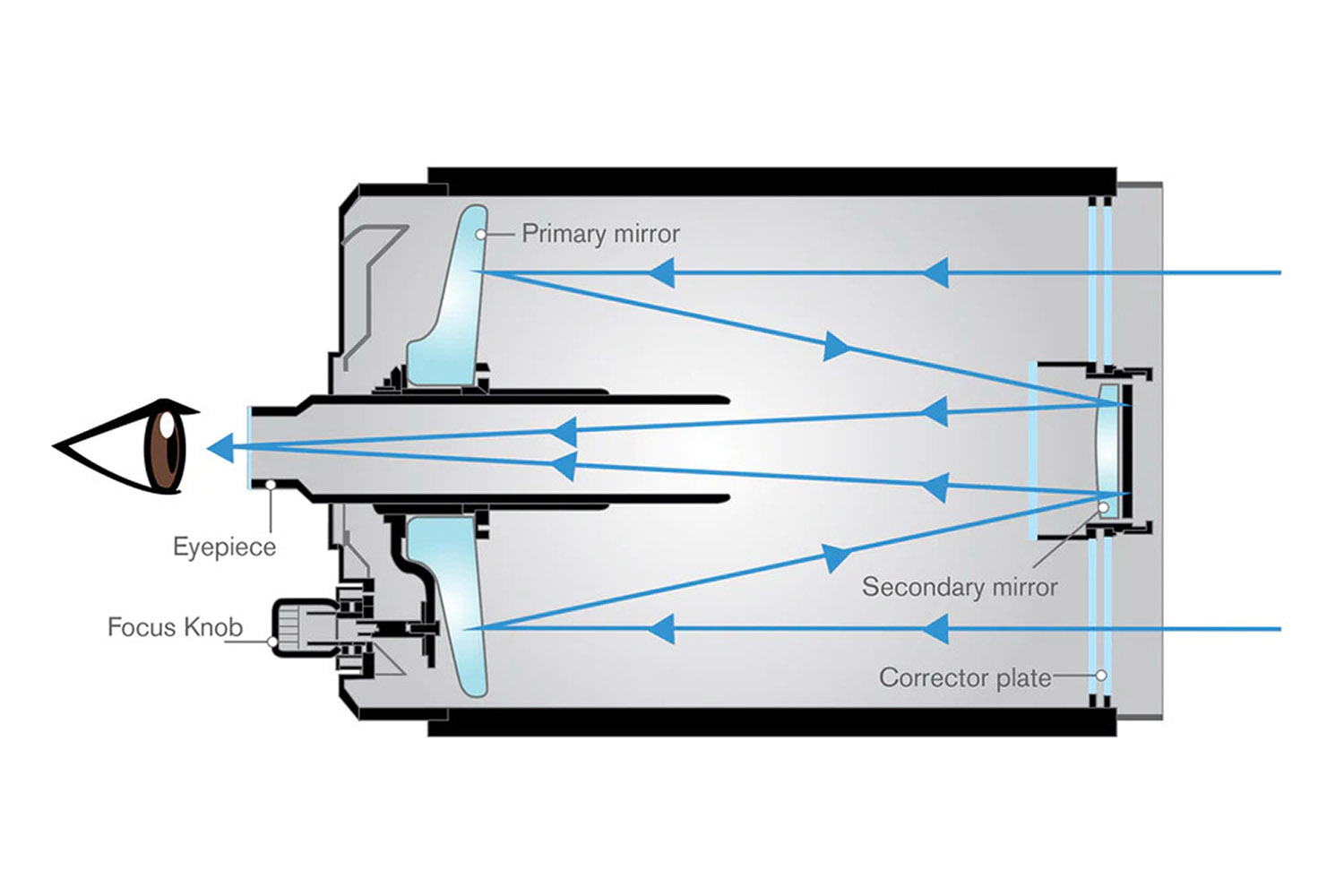 Catadioptric telescopes use a combination of lenses and mirrors to bring objects into focus.
Each of these beginner telescope types have their own pros and cons for visual observing:
| Refractor | Reflector | Catadioptric | |
|---|---|---|---|
| Telescope Subtypes | Doublet Refractor, Triplet Refractor | Newtonian, Dobsonian | Schmidt-Cassegrain Telescope (SCT), Maksutov |
| Pros | Most affordable & portable option, no maintenance required | Still affordable for a larger aperture and detailed views | Highly versatile telescope, can usually locate objects automatically (GoTo) |
| Cons | Small aperture leads to less detailed views, usually requires manually finding objects | Often heavy and not very portable, usually requires manually finding objects, occasional maintenance | Usually the most expensive option, still bulky and heavy, infrequent maintenance |
| Best for | Those on a budget, kids, or those who need portability | Those who want the most aperture for the money | Those who want the most complete package and have the budget for it |
Deciding early on whether you want a refractor, reflector, or catadioptric telescope will help you immensely in narrowing down which telescope is right for you and your needs.
Budget for Beginner Telescopes
The next critical consideration in purchasing a beginner telescope is of course your budget. Advances in astronomy equipment and manufacturing have recently paved the way for quality telescopes and other equipment to be available at quite reasonable costs. It is important to note, however, that as the optical quality and size of the telescope goes up, so too does the price. A modest but effective telescope for beginners can range anywhere from around $250 USD for a completely manual telescope to $1000 or more for larger and computerized “GoTo” models. If your budget allows, extra money can be diverted to the purchase of upgraded eyepieces, cell phone adapters, or other accessories discussed below.
4. Best Telescopes For Beginners
The following are some of our recommended best beginner telescopes, including our recommendation for best telescope for kids and best beginner telescope for adults. These options are affordable, easy to use, and serve as a great entry level option to test your or your children’s interests in the hobby without too much of a financial commitment.
For those with a higher budget, we highly recommend looking at the benefit of GoTo functionality in a telescope mount. This feature allows you to align the mount with the night sky, have the mount automatically move the telescope to your desired target, and then track that object as it appears to move across the sky, allowing you to spend much more time observing and less time constantly readjusting to locate your intended target. The telescopes recommended below all offer this GoTo function at a reasonable price, and with a reasonably sized aperture as the icing on the cake.
Best Overall Beginner Telescope:
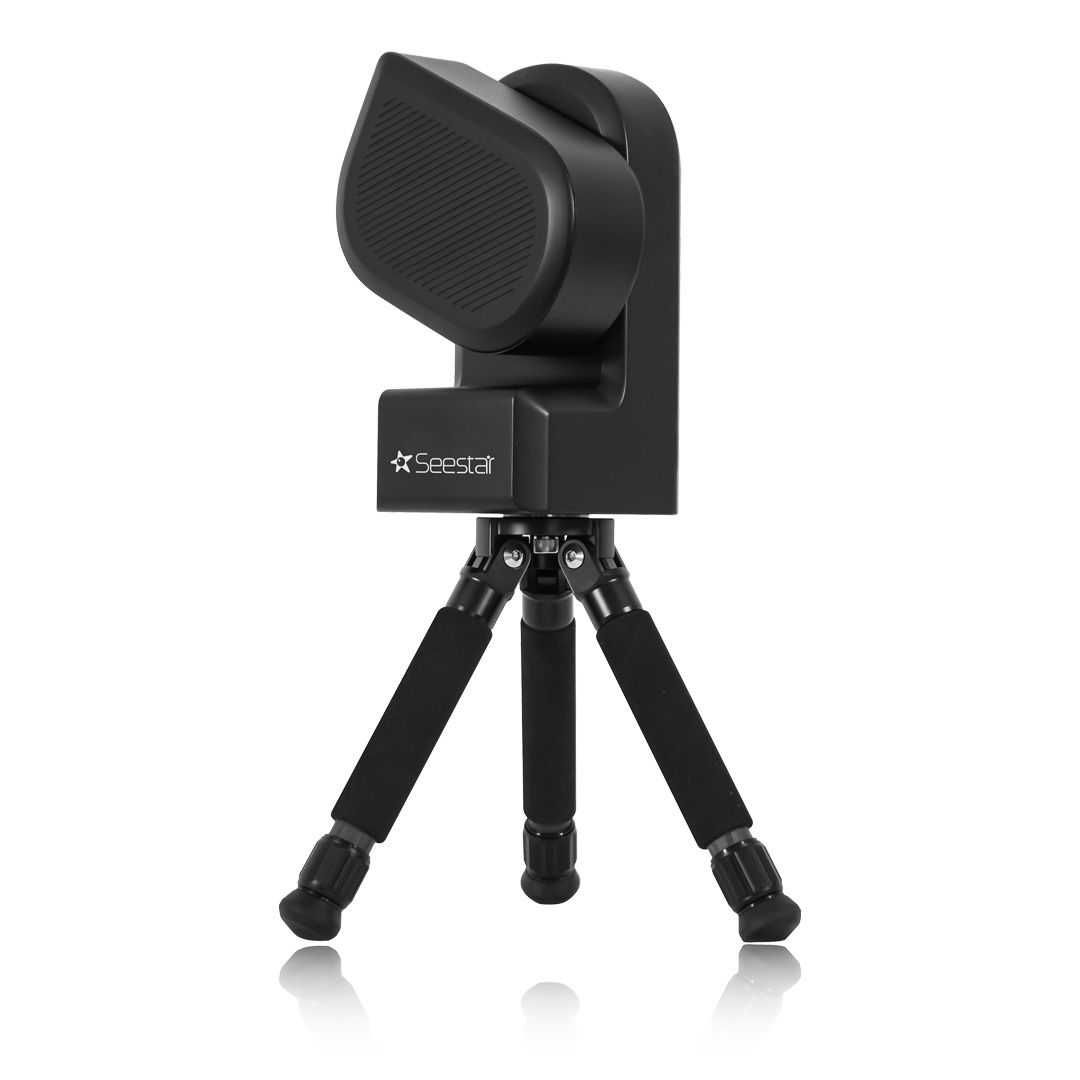
Seestar S50 All-In-One Smart Telescope by ZWO
 |
|
| Pros | Cons |
|---|---|
| Least expensive option for entering astrophotography | No eyepiece, so visual viewing is not possible |
| Automatically finds objects in the night sky | Not ideal for planetary imaging |
| Ultra-portable and weighs just 6 pounds | |
| No astronomy experience required, can be used by kids |
Most Affordable Beginner Telescope:
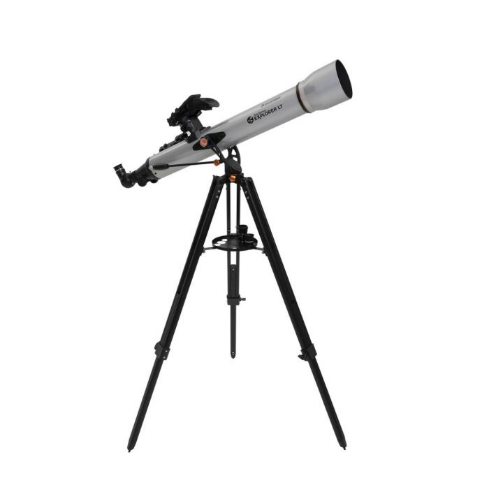
Celestron StarSense Explorer LT 80AZ App-Enabled Refractor
 |
|
| Pros | Cons |
|---|---|
| Modest focal length for viewing solar system objects | Small aperture, less detailed views |
| Uses your smartphone to guide you to objects | Slow focal ratio, difficult to view fainter objects |
| Easy setup & highly portable | |
| Great telescope for kids and families |
Best Beginner Telescope for Adults on a Budget:
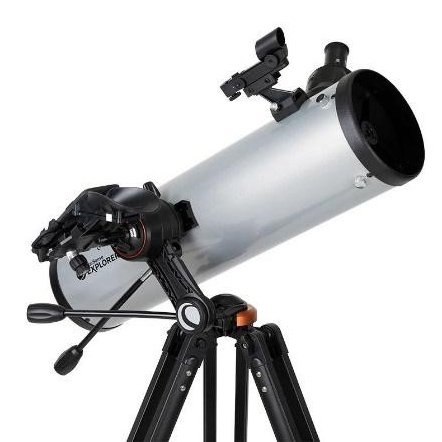
Celestron StarSense Explorer DX 130AZ App-Enabled Newtonian Reflector
 |
|
| Pros | Cons |
|---|---|
| Larger aperture, more detailed views | Shorter focal length, less ideal for viewing solar system objects without additional eyepieces or a Barlow lens |
| Faster f/ratio, ideal for dark skies and faint targets | No GoTo functionality |
| Eyepieces included | |
| Uses your smartphone to guide you to objects | |
| Easy setup & highly portable |
Best Beginner Telescope for Viewing Planets and Galaxies for Beginners:
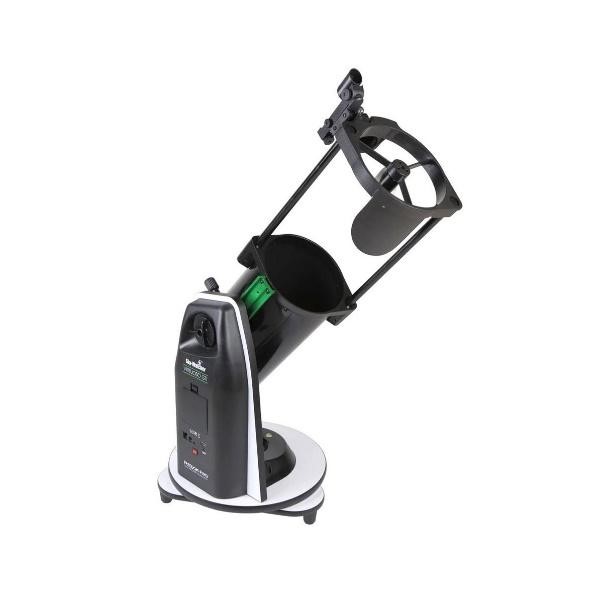
Sky Watcher 150mm Virtuoso GTi 150P GoTo Collapsible Dobsonian Telescope
These recently released tabletop reflector telescopes upgrade the traditional Dobsonian mount commonly found in beginner telescopes with full GoTo functionality in an extremely portable telescope. This telescope offers fast optics at a medium range focal length, making it great for nights under dark skies viewing faint targets and large nebulae. It can also be used for higher magnification planetary and lunar viewing, though we recommend a Barlow lens or a shorter focal length eyepiece (sold separately). Available in both 130mm or 150mm aperture models.
 |
|
| Pros | Cons |
|---|---|
| Larger aperture, more detailed views | Shorter focal length, less ideal for solar system observing |
| Faster f/ratio, ideal for dark skies and faint targets | Will require occasional collimation (extra cost & time) |
| Eyepieces included | |
| Highly portable | |
| Full GoTo and tracking function |
Best Telescope for Viewing Planets:
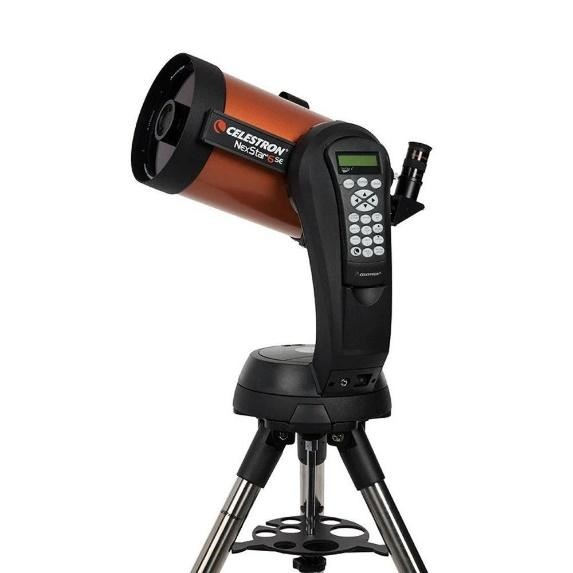
Celestron NexStar 6SE Schmidt-Cassegrain Telescope
If you're looking for a telescope to see planets, the Celestron SE lineup offers full GoTo functionality and features a 1500mm focal length to provide stunning close-up views of the lunar surface and planetary features. The SE model is also available in a range of sizes to accommodate various price points, though the 6" seems to be a sweet spot for price/aperture in this beginner telescope. The 6SE is a catadioptric telescope known as the Schmidt-Cassegrain, which helps to draw out the focal length by forcing light to travel down the scope, back up, and then back down. This design allows for a much longer focal length to be packed into a relatively portable telescope optical tube, making it our recommendation for best telescope to see planets and the Moon.
 |
|
| Pros | Cons |
|---|---|
| Larger aperture, more detailed views | Slower f/ratio, less ideal for faint targets |
| Long focal length, ideal for solar system observing | Modest setup required |
| Full GoTo and tracking functionality | Higher end of beginner budget |
| Eyepieces included | |
| Relatively portable |
Don't see what you're looking for? Browse Agena Astro's complete selection of beginner telescopes!
5. Best Beginner Telescope Accessories
Most beginner telescopes will come packaged with all the necessities to get you out under the stars, including the telescope, mount, and one or two eyepieces. We recommend taking some time to learn the basic functions of your telescope and getting oriented to the night sky before adding any additional accessories. Once you're comfortable with how to locate targets in the sky and operate your telescope, we offer a wide variety of accessories to help expand your telescopes functionality and improve your overall experience:
- Eyepieces: Most beginner telescopes will come packaged with one or two eyepieces included, typically a 1.25" 10mm or 25mm. Upgraded eyepieces are one of the more costly accessories in visual astronomy, but a quality eyepiece can truly transform the views you see. Unlike telescopes, the lower the focal length of an eyepiece, the higher the magnification it will provide. For example, a 10mm eyepiece will double the magnification of a 20mm eyepiece. Once comfortable with your skills setting up and controlling the telescope, we invite you to browse our wide selection of 1.25” and 2” eyepieces to take your observing to the next level. Whether you want a narrower field of view to peek at the Great Red Spot of Jupiter, or a widefield eyepiece to take in the beauty of the Orion Nebula, eyepiece upgrades will provide the greatest enhancement to your beginner telescope.
- Barlows & Focal Extenders: These lenses extend the focal length of your telescope, allowing you to see even further! Ideal for viewing lunar surface features and closeup views of the planets.
- Smartphone Adapters: Cell phone adapters are simple devices which hold your cell phone in place at the eyepiece of the telescope, allowing you to capture brief snapshots of the Moon, planets and others objects.
- Solar Filters & Film: Solar filters attach easily to the front of your telescope, allowing for safe viewing of the Sun and its variety of surface features! Check out our article Solar Astronomy 101 for more info.
- Neutral Density & Polarizing Filters: Neutral density or polarizing filters help to cut down some of the intensity of especially bright targets, such as a full moon or Venus. This can help to greatly improve the contrast through the eyepiece.
- Star Charts & Apps: Star charts are an important tool to navigate the night sky. You can purchase physical versions, known as planispheres, or download a digital star chart in app form on your smartphone or tablet.
6. Beginner Telescope FAQs
What Can You See With A Telescope?
For those living in heavy light pollution, visual astronomy is often limited to solar system objects like planets and the Moon. Luckily, these objects are so bright that you can see them even if you live in the most light polluted city. The Moon is spectacular through any telescope, and you'll be able to easily see craters on its surface.
Just about any telescope should also be able to resolve the rings of Saturn and Jupiter's four main moons. Larger telescopes (around 6” / 150mm or more in aperture) will be able to see even more details on the planets, like the Cassini Division (a gap in Saturn's rings) or the Great Red Spot on Jupiter.
On the other hand, most deep sky objects like galaxies and nebulae are very faint and require little to no light pollution to get the best views. Don't worry, though, even if you live in a light-polluted area, you can usually still see a few deep sky objects like star clusters, and sometimes even the Orion Nebula or Andromeda Galaxy, depending on your level of light pollution. These objects only get better with darker skies, and other fainter objects become visible the darker the location.
What is the best beginner telescope?
There’s a popular phrase in the astronomy community: “the best telescope is the one you will use the most.” The larger the telescope, the heavier and more bulky it will be. While a 10” telescope will produce breathtaking views of nearly anything, its large size and difficulty transporting can make it much less likely to be taken out regularly than a portable 4” telescope. If you won’t need to transport your telescope often, then a larger telescope may be a better choice and will typically provide better views than a more portable telescope. If you plan to travel to dark sites for your observations, ask yourself “will this fit in my car?” Similarly, a computerized (often referred to as GoTo) telescope will keep objects centered in your eyepiece as it tracks across the sky, but does require a bit more setup time than a simple “point and look” design such as a manual Dobsonian telescope. You may find that there are nights with only brief clear skies, and on these occasions the easiest telescope to use will typically be the one that requires the least muscle and setup time.
A Note on Telescope Maintenance
Some telescopes will require occasional maintenance to get the best views. Over time, the mirrors in reflector telescopes and catadioptric telescopes can become slightly misaligned, which degrades the view. Aligning the mirrors again is a simple process known as collimation, but it does require some light knowledge and a special tool known as a collimator. Reflector telescopes will need to be collimated every few uses, especially if the telescope has been transported in a vehicle. Catadioptric telescopes will need to be collimated much less frequently, about once every year or two. While this process may seem daunting to a new telescope owner, it is relatively simple and with practice can be completed in only a few minutes. Refractor telescopes, on the other hand, should never need to be collimated (unless they are dropped), and are much easier to maintain. Both refractor and catadioptric telescopes may benefit from an occasional optics cleaning of the front lens elements when they become dirty, which you can use an optics cleaning kit for.
Follow us on Facebook, Instagram, and Twitter as well as sign up to our email list to stay up to date on the latest gear, sales, and news from Agena!