



A Primer on T-Rings and T-Adapters for Astronomy and Astrophotography
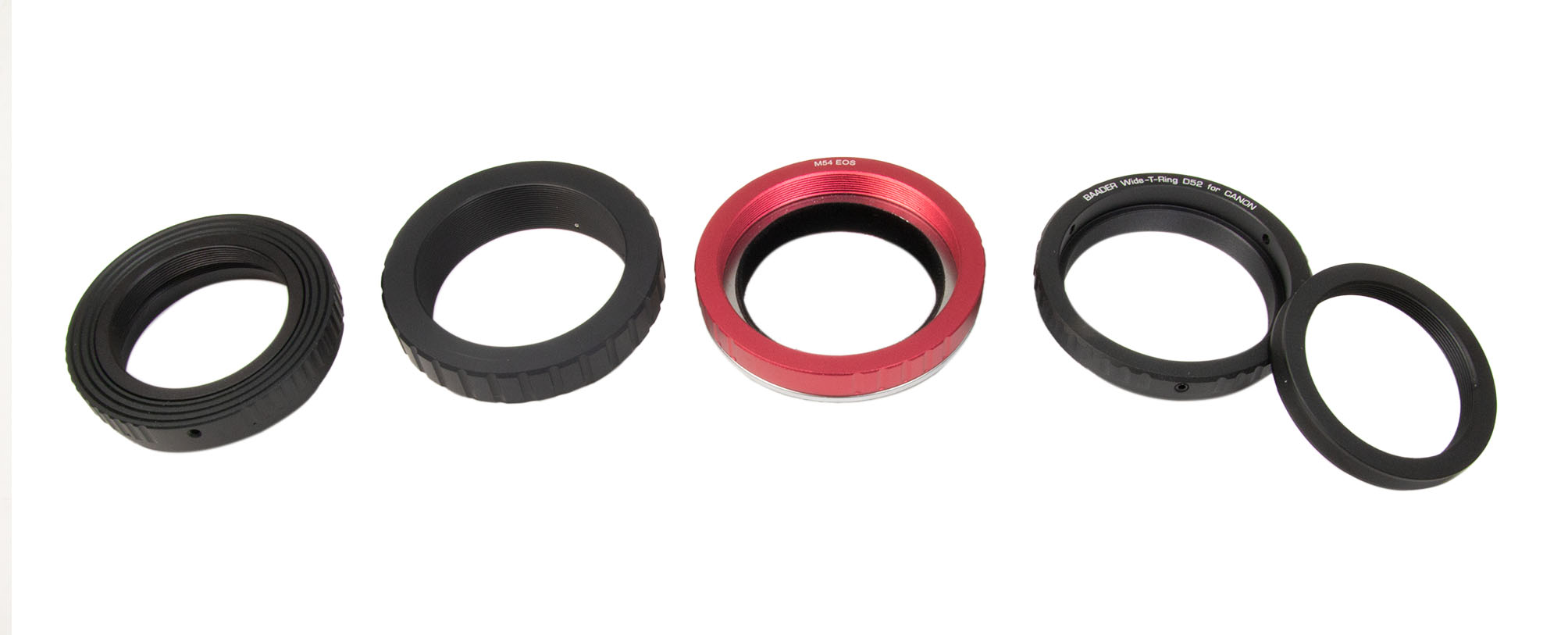
Figure 1 – T-rings for Canon EOS cameras with, from left to right, M42, M48, M54, and Baader S52 threads. Image credit – Agena AstroProducts.
1. Overview
While many dedicated astronomy cameras are now available for astrophotographers, many imagers want to use standard DSLR or mirrorless cameras with their telescope. These cameras from manufacturers such as Nikon, Canon, Fujifilm, and Sony are powerful imaging tools. But they aren’t designed for connecting to a telescope for prime focus imaging where the telescope takes the place of the camera lens. That’s where T-rings and T-adapters come in. These two essential accessories used together allow you to interface a DSLR or mirrorless camera body directly to a wide range of telescopes. This short primer explains the basics of T-rings and T-adapters in more detail and helps you choose the correct components for your own astrophotography set-up.
2. All About T-Rings
A T-ring is a small adapter that, on one side, connects directly to the lens mount (or flange) of a camera and, on the other side, offers a standard female thread (usually M42x0.75) that connects to another component or adapter. When T-mounting schemes were first developed by Japan’s Tamron Corporation in the late 1950s and early 1960s, these threads were used to connect a threaded camera lens to a wide range of cameras from various manufacturers. Today, camera manufacturers use bayonet style mounts to connect lenses directly to the camera, so T-rings are rarely used to mount photographic lenses. In astrophotography, however, T-rings are indispensable for connecting mirrorless or DSLR cameras to telescopes and accessories. Figure 1 shows a number of T-rings with various thread sizes for Canon EOS cameras.
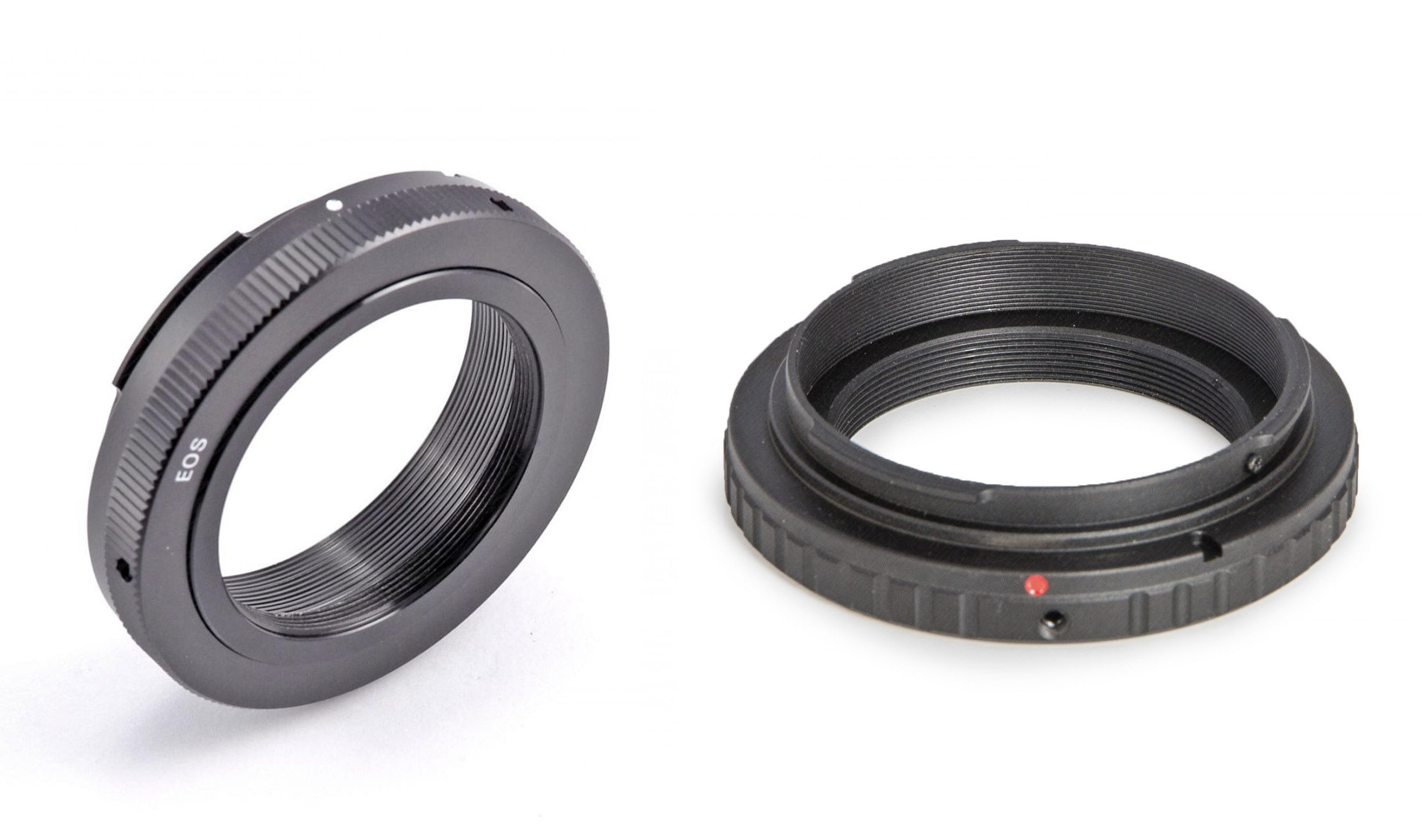
Figure 2 – A T-ring for Canon EOS cameras showing the M42x0.75 thread on the telescope-facing side (left) and the bayonet connection on the camera-facing side (right). Image credit: Baader Planetarium.
The camera side of the T-ring is designed to connect to the front flange of the camera where the camera lens usually goes (see Figure 2 and 3). Since each camera manufacturer has their own proprietary flange design, T-rings are made for specific camera brands and models. T-rings are available for Canon cameras, Nikon F and Z mount cameras, Fujifilm, Pentax, and more. When selecting a T-ring, make sure to choose one that matches your camera type.
The ‘telescope side’ of the T-ring features a female threaded aperture. The M42x0.75 thread is still the most common, and this is often called a ‘T thread’. More recently, T-rings are available with larger threads such as M48x0.75 or even M54x0.75 (Figure 1). Unfortunately, the term “T” thread or T ring is now routinely used in astronomy regardless of the thread size (M42 or M48 or M54), which can lead to confusion. Before buying a T-ring, make sure you know its thread size and make sure it matches the adapters and accessories you’re trying to interface with your camera.
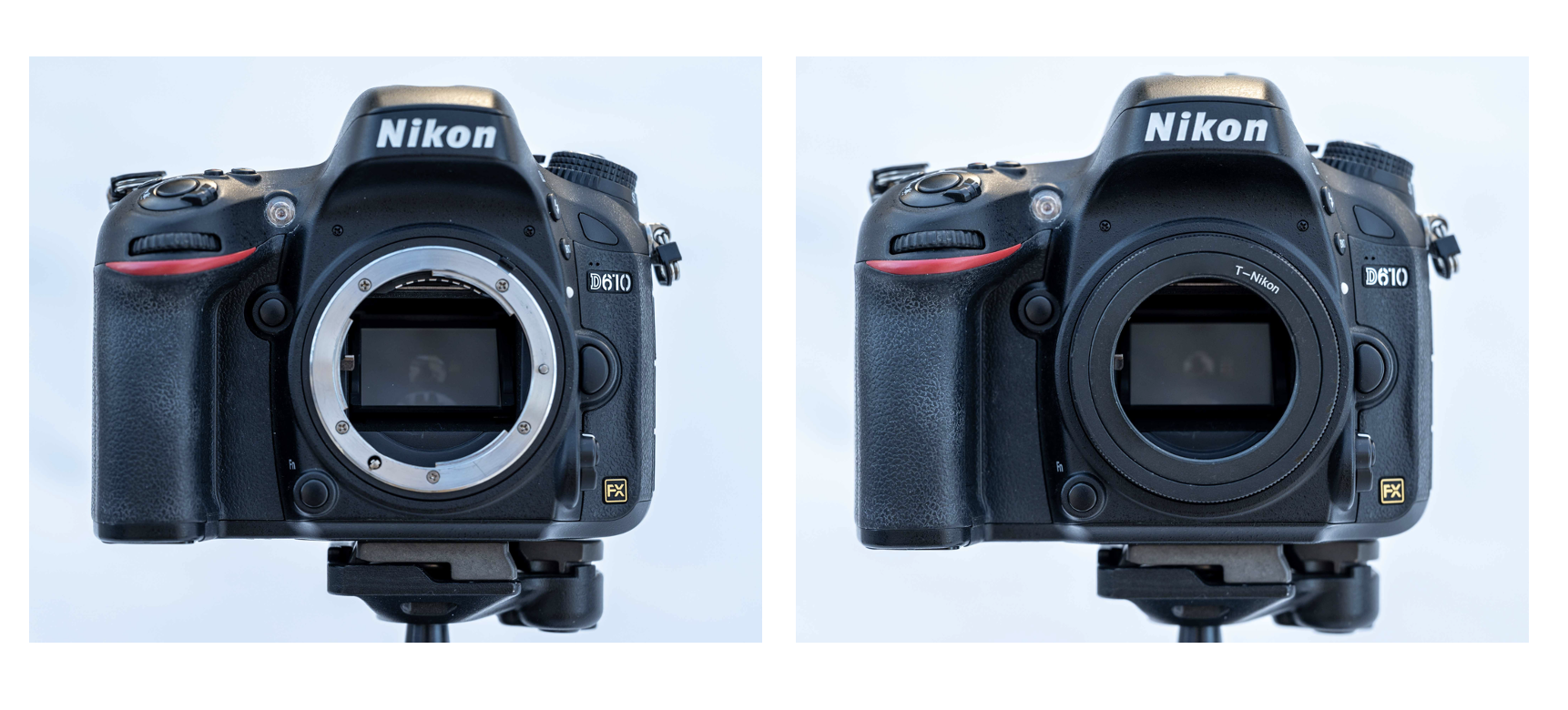
Figure 3 – A DSLR camera with the lens flange exposed (left) and with an M42x0.75 T-ring installed (right). Image credit: Agena AstroProducts.
Baader Planetarium in Germany uses a ‘T2’ thread in many of their accessories. This thread is, effectively, identical to a T-thread for astronomical applications. Baader, which offers a huge array of adapters, also makes “T-rings” in which the thread is replaced by a 52mm diameter unthreaded dovetail attachment designed to work only with other 52mm dovetailed adapters in the Baader lineup.
How thick is a T-ring? It depends on the camera type and brand for which the ring is intended. In nearly all cases, a T-ring has a thickness that, when added to the flange focal distance (FFD) of the camera, works out to a total of 55mm. The FFD is the distance from the cameras focal plane, where the sensor is located, to the front circular metal flange (see Figure 4). For example, for Nikon F-mount cameras, the FFD is 46.5mm. For Canon EF-mount cameras it’s 44.0mm. For the newer Canon mirrorless EOS R cameras, the FFD is just 20mm. T-rings for Nikon F-mount cameras have a length of 8.5mm, while T-rings for Canon EF cameras have a length of 11mm, and T-rings for mirrorless cameras are even longer (Figure 5). These values do not include the length of the T-threads since they are screwed atop male threads on the optical component. Table 1 below lists the flange focal distance for the most commonly used camera brands and mounts used in astronomy, and this article has a detailed list of flange focal distance for a wide range of camera systems.
| Camera Mount | FFD (mm) | T-Ring Thickness for Meeting 55mm Back Focus Requirement (mm) |
|---|---|---|
| Canon EOS EF/EF-S | 44 | 11 |
| Canon EOS-M | 18 | 37 |
| Canon EOS-R/RP | 20 | 35 |
| Fuji X | 17.7 | 37.3 |
| Micro Four-Thirds | 19.25 | 35.75 |
| Nikon F | 46.5 | 8.5 |
| Nikon Z | 16 | 39 |
| Pentax K | 45.46 | 9.54 |
| Sony E | 18 | 37 |
Table 1: FFD and standard T-ring optical lengths for some camera mounts commonly used in astronomy
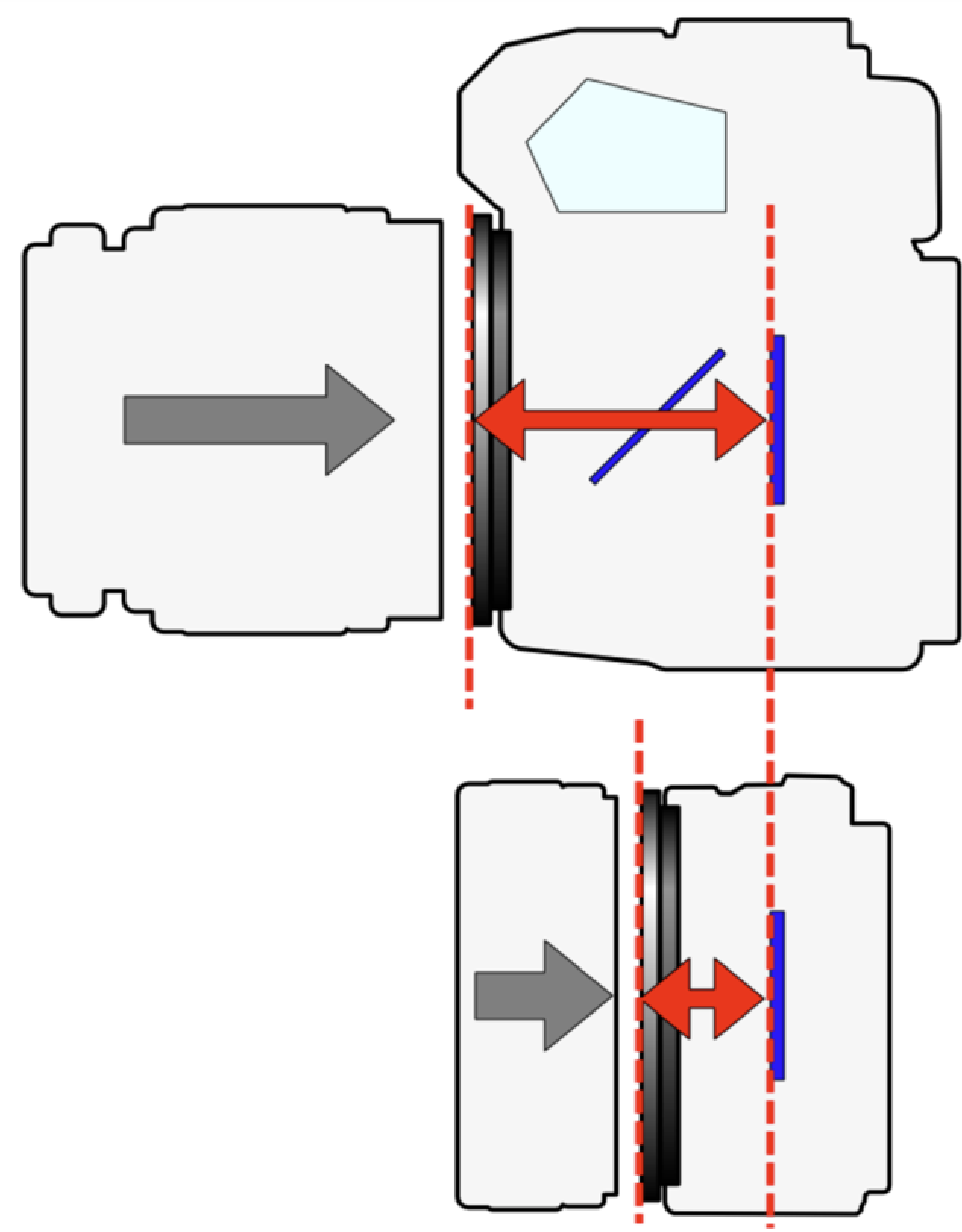
Figure 4 – The red arrow shows the flange focal distance (FFD) of a DSLR (top) and mirrorless camera (bottom). Image credit: Wikipedia/User Shigeru23.
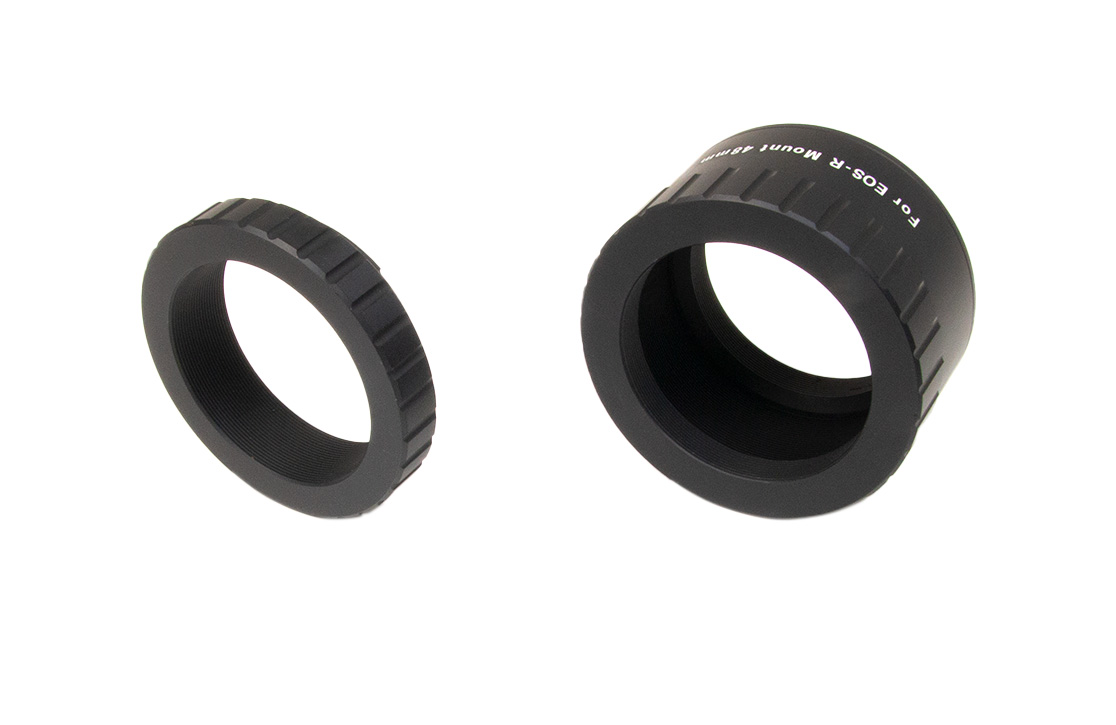
Figure 5 – A T-ring for a Canon DSLR camera (left) and mirrorless camera (right). Image credit – Agena AstroProducts.
3. Connecting a DSLR or Mirrorless Camera and T-ring to a Focal Reducer or Field Flattener
Is there anything special about 55mm? The 55mm working distance delivered by a T-ring on a camera matches the most common working distance (also called back focus) of many optical components such as field flatteners and focal reducers. If you want to use a DSLR or mirrorless camera with a focal reducer with a 55mm back focus (or working distance), then simply connect a T-ring to the camera and thread the T-ring to the reducer, making sure the female threads of the T-ring match the male threads of the reducer. By design, the sensor will be at the correct working distance of 55mm (Figure 6). (Learn more about back focus in this article by Agena AstroProducts).
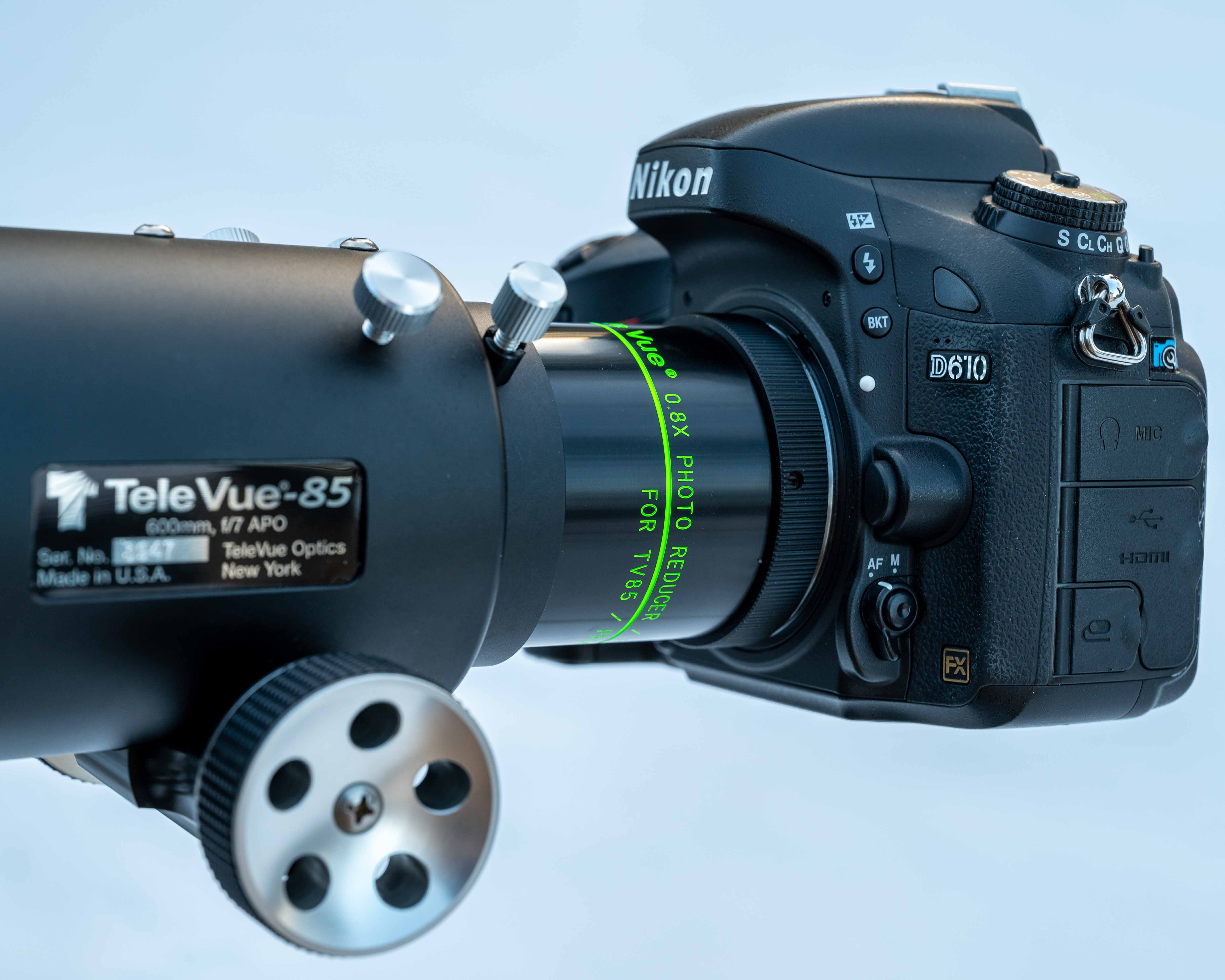
Figure 6 – A DSLR camera with a mounted T-ring threaded onto a focal reducer with a 2” barrel (not shown) inserted into a telescope focuser. This Tele Vue focal reducer has a working distance of 55mm, which matches, by design, the distance from outer surface of the T-ring to the camera sensor. Image credit: Agena AstroProducts.
There are situations in which a 55mm working is not needed or desired. Newtonian reflectors, for example, often have very limited available back focus. For applications where every bit of back focus is precious, some manufacturers such as Explore Scientific and Artesky, make “low profile” T ring (usually just for Canon and Nikon) that are slimmer than standard T rings.
4. T-Adapters
In applications without the need for a focal reducer or field flattener, the threaded side of the T-ring connects to a T-adapter, a small tube that attaches directly a telescope. Just as T-rings can come with different thread sizes, T adapters also can have different thread types. So, it’s important to match the T-ring thread to that of the T adapter.
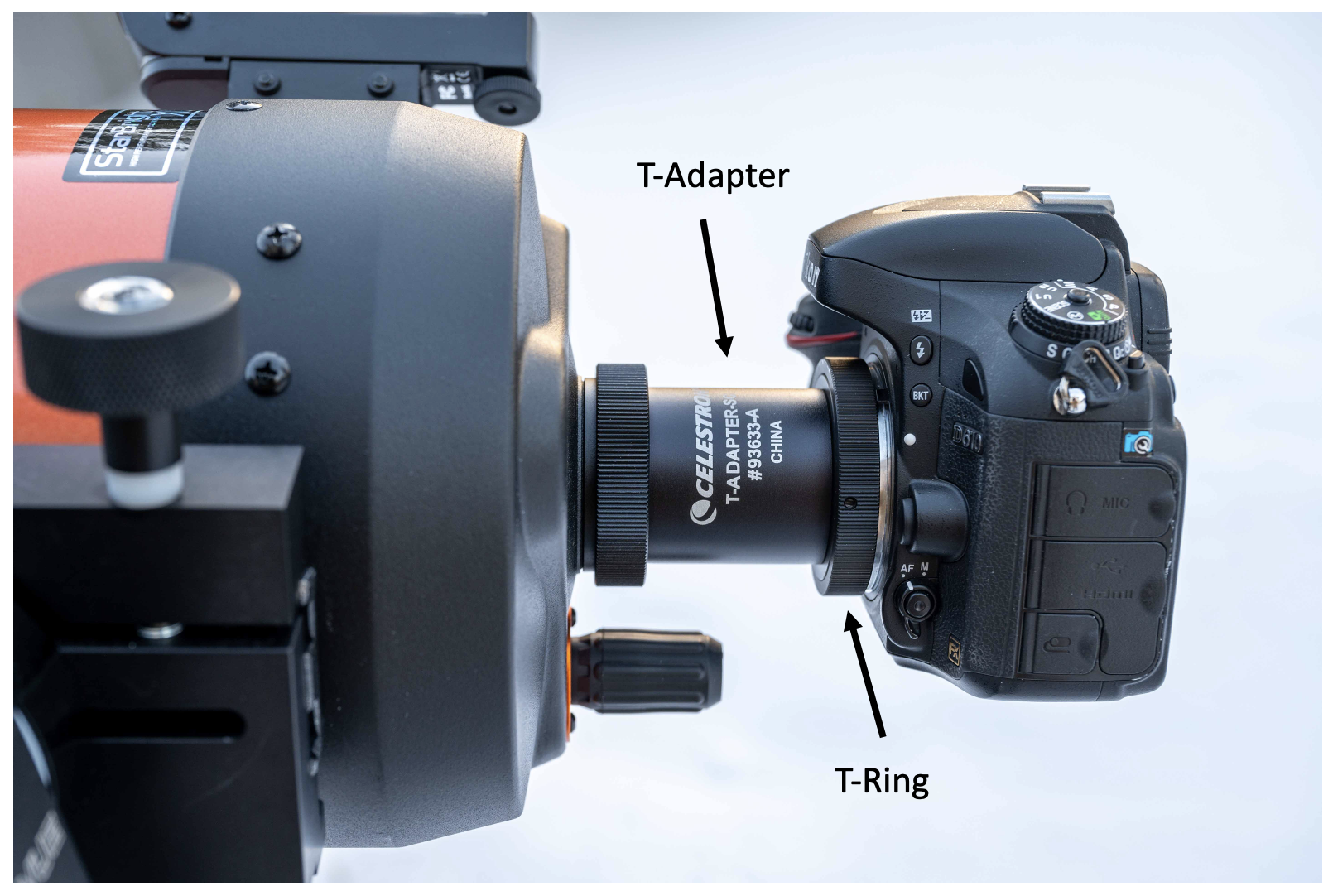
Figure 7 – A DSLR camera with a T-ring threaded onto a T-adapter. The telescope side of the T-adapter has female 2”-24 threads that are threaded to the visual back of this Celestron 6” Schmidt-Cassegrain telescope. Image credit: Agena AstroProducts.
T-adapters come in a variety of incarnations (Figure 8). T-adapters for Schmidt-Cassegrain telescopes often feature 2”-24 threads on the telescope side that thread directly to the back of the telescope. Figure 7 shows a DSLR and T-ring threaded to a T-adapter, which is threaded to the back of a 6” SCT without a focal reducer. This combination works well for prime focus imaging of terrestrial or celestial targets. It can also be used with a Celestron 0.63x focal reducer which can be threaded onto the back of the SCT. The T-adapter has an optical length of about 50mm, and when combined with a T-ring and camera, has a length of 105mm which matches the back focus of the reducer. Celestron EdgeHD telescopes have their own 0.7x focal reducers, these telescopes require specific focal reducers designed for them.
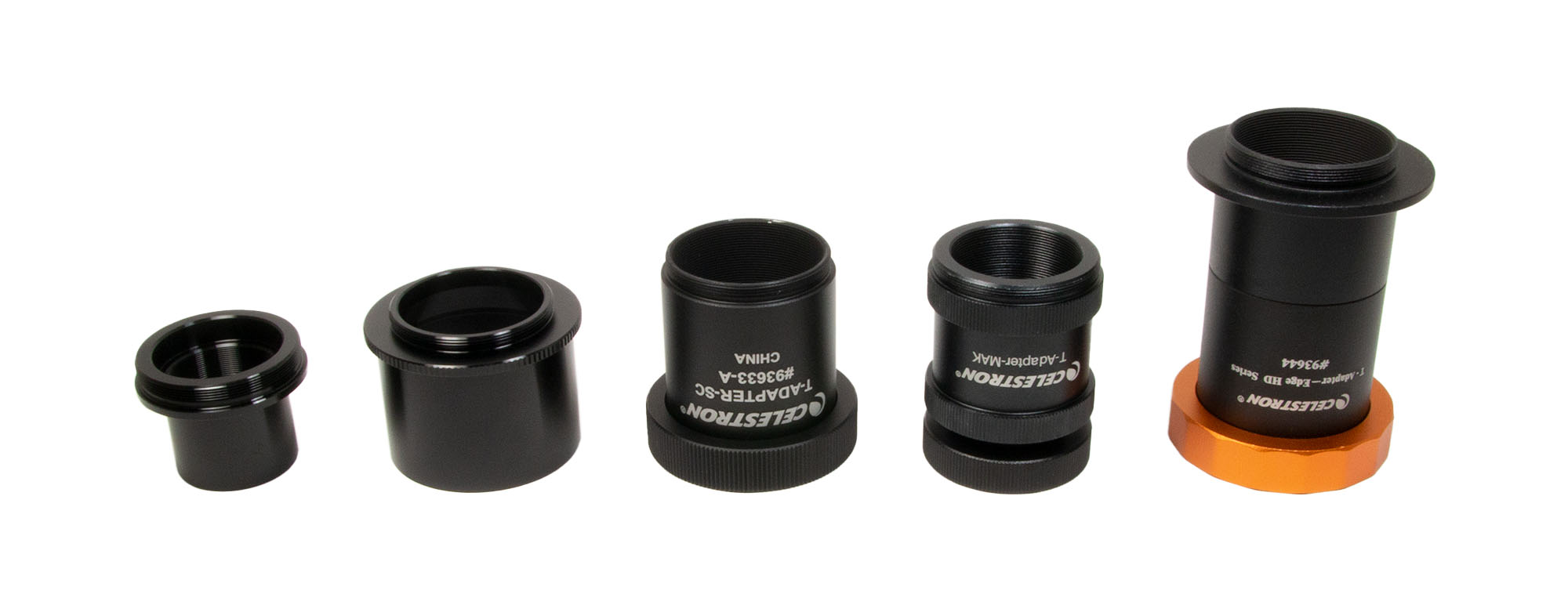
Figure 8 – A sample of the wide variety of T-adapters available.
T-adapters are also available with 1.25” or 2” barrels that insert into the focuser of a telescope for prime focus imaging. Some adapters have a T-ring and T-adapter integrated into a single unit. For example, Blue Fireball offers a range of such adapters with 2” barrels. Baader has a similar offering.
5. Summary and Key Points
- A T-ring connects to a DSLR or mirrorless camera in place of the camera lens
- When choosing a T-ring, make sure to select one that matches your camera brand and model – they are not interchangeable
- Also, when choosing a T-ring, make sure the female threads on the telescope-facing side match that of your optical accessory (focal reducer or flattener) or T-adapter
- Once the T-ring is installed on the camera, it can be connected to a focal reducer, field flattener, or T-adapter
- A T-adapter has male threads that connect to the female threads on a T-ring with the same thread size
- The telescope-facing side of the T-adapter threads onto the back of a telescope (usually a Schmidt-Cassegrain) or slides (with a 1.25” or 2” barrel) into the focuser of a refractor or reflector

About the Author
Manish Panjwani has been an active amateur astronomer since before Halley's Comet last flew by our neighborhood. A former wireless communications consulting engineer and management consultant to various Fortune 500 companies, Manish started Agena AstroProducts in 2003. Since then, Agena has become one of the leading online retailers of telescopes and astronomical accessories worldwide. Besides observing from his heavily light polluted backyard in Los Angeles, Manish enjoys conducting astronomy outreach programs in local schools. Manish holds a Master's degree in Electrical Engineering from Virginia Tech and an MBA from the Kellogg School of Management at Northwestern University.

About the Author
Brian Ventrudo is a writer, scientist, and astronomy educator. He received his first telescope at the age of 5 and completed his first university course in astronomy at the age of 12, eventually receiving a master's degree in the subject. He also holds a Ph.D. in engineering physics from McMaster University. During a twenty-year scientific career, he developed laser systems to detect molecules found in interstellar space and planetary atmospheres, and leveraged his expertise to create laser technology for optical communications networks. Since 2008, Brian has taught astronomy to tens of thousands of stargazers through his websites OneMinuteAstronomer.com and CosmicPursuits.com.