



Agena Buyer's Guide to ZWO Astronomy Cameras
- 1. Overview
- 2. Types of ZWO Cameras
- 3. ZWO Camera Specifications to Consider
- 3.1 Footprint and Mechanics
- 3.2 Port Configurations and Cables
- 3.3 Sensor Size and Field of View
- 3.4 Pixel Size and Resolution
- 3.5 Pixel Number and Binning
- 3.6 Color vs Monochrome
- 3.7 Noise and Cooling
- 3.8 Other Specifications to Consider - Shutter Speeds, Data Resolution, and Download Rates
- 4. General Recommendations
- 4.1 Starter Cameras
- 4.2 Solar System Imaging Cameras
- 4.3 Deep-Sky Imaging Cameras
- 4.4 Electronically-Assisted Astronomy (EAA)
- 4.5 Autoguiding Cameras
- 5. Accessories for ZWO Cameras
- 6. Summary
1. Overview
As a result of their low noise and high sensitivity, CCD sensors have been the gold standard for digital astronomy cameras. These semiconductor-based sensors are based on a mature technology that is ideal for low-light applications because of the efficiency at which they convert light into electrical signals. But CMOS sensors, based on another semiconductor technology, are catching up to CCD sensors in low-light performance. These sensors are widely used in mass-produced digital cameras, and since they lend themselves to high-volume manufacturing techniques, their price continues to drop. In some applications, including astronomy, the performance of CMOS sensors enables the design of cameras with an excellent price-to-performance ratio.
Over the past few years, Chinese manufacturer ZW Optical (ZWO) has introduced a line of CMOS-based cameras for planetary and general purpose astronomy imaging that have developed a large following among amateur astronomers. These cameras are easy to use, affordable, compact, and they work with standard camera control and imaging software. They also have high quantum efficiencies that are beginning to rival CCD-based cameras, and a wide range of exposure times to capture nearly any celestial object.
However, as more ZWO cameras are introduced, it has become challenging, especially for beginning astronomy imaging enthusiasts, to select a camera from the growing product line. At first glance, the sheer variety of available ZWO cameras, coupled with the array of model numbers and other specifications, can be difficult to navigate.
This Agena Buyer's Guide will help you break down all of this information into manageable chunks. You will understand the factors and specifications of ZWO astronomy cameras including sensor size, pixel size, read noise, download rate, cooling, and color vs. monochrome. As you read through this guide, we will help you narrow down your choices and select the best ZWO camera for your interests, equipment, and budget. While this guide is geared towards the first-time astronomy camera buyer, intermediate and advanced imagers should also find this content - especially the summary specification table and recommendations near the end - useful in making their choices.
2. Types of ZWO Cameras
At present, ZWO offers well over 25 camera models. The subsequent sections will dissect all of these models based on various technical parameters, specifications, and suggested applications. At the highest level, ZWO cameras can be classified into one or more of these categories:
- Monochrome (B&W)
- Color Cameras
- Cooled cameras
- Pro cameras
- Mini cameras
3. ZWO Camera Specifications to Consider
3.1 Footprint and Mechanics
ZWO astronomy cameras are housed in CNC machined red-anodized aluminum bodies that stand up to heavy field use. The cooled and Pro cameras are larger than the uncooled cameras because they must accomodate large heat sinks and fans to manage heat flow. Mini cameras have the smallest form factor.
With the exception of the Mini cameras, ZWO camera bodies also feature a standard T / T2 M42x0.75 internal (female) thread interface on the telescope/lens side. This thread is very commonly used in astronomy and photography, allowing you to attach a wide variety of adapters and other accessories to the camera body. Most cameras include a 1.25"-T threaded nosepiece adapter so the camera can be inserted directly in standard 1.25" telescope focusers. The front of the camera also has a short 2" barrel that can be directly inserted into 2" telescope focusers. This barrel is 8mm-11mm in length depending on the model. However, a separate 2" T threaded prime focus adapter (not included with the camera) is recommended for a more robust and secure connection to 2" telescope focusers.
The 'Pro' cameras, which have larger sensors that would be vignetted by a 1.25" nosepiece, have 2" extenders so they can mount into larger 2" focuers.
The opposite side of most uncooled ZWO cameras features a 1/4-20 thread in the bottom to make it easy to attach the camera device to a photo camera tripod or mount for use without a telescope. Cooled ZWO cameras can be mounted in an optional adapter ring for mounting to a camera tripod.
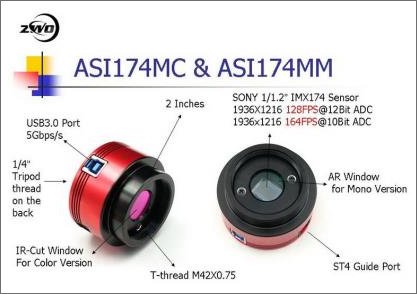
Table 2 below summarizes key physical specifications of all ZWO cameras.
| ZWO Camera Model | Color / Monochrome | Diameter (mm / in) | Weight (g / oz) | Backfocus (mm) | 1/4"-20 Mounting Thread |
|---|---|---|---|---|---|
| ASI034MC* | Color | 62 / 2.4 | 100 / 3.5 | 12.5 | Yes |
| ASI071MC-COOL* | Color | 78 / 3.1 | 500 / 17.8 | 17.5 | No |
| ASI071MC-PRO | Color | 86 / 3.4 | 640 / 22.6 | 17.5 | No |
| ASI094MC-PRO* | Color | 86 / 3.4 | 640 / 22.6 | 17.5 | No |
| ASI120MC* | Color | 62 / 2.4 | 100 / 3.5 | 12.5 | Yes |
| ASI120MM* | Monochrome | 62 / 2.4 | 100 / 3.5 | 12.5 | Yes |
| ASI120MC-S | Color | 62 / 2.4 | 100 / 3.5 | 12.5 | Yes |
| ASI120MM-S | Monochrome | 62 / 2.4 | 100 / 3.5 | 12.5 | Yes |
| ASI120MM-MINI | Monochrome | 36 / 1.42 | 60 / 2.1 | 8.5 | No |
| ASI128MC-PRO* | Color | 86 / 3.4 | 640 / 22.6 | 17.5 | No |
| ASI174MC* | Color | 62 / 2.4 | 140 / 4.9 | 17.5** | Yes |
| ASI174MC-COOL* | Color | 78/ 3.1 | 410 / 14.5 | 17.5 | Yes |
| ASI174MM | Monochrome | 62 / 2.4 | 140 / 4.9 | 17.5** | Yes |
| ASI174MM-COOL* | Monochrome | 78 / 3.1 | 410 / 14.5 | 17.5 | No |
| ASI174MM-MINI | Monochrome | 36 / 1.42 | 60 / 2.1 | 8.5 | No |
| ASI178MC | Color | 62 / 2.4 | 120 / 4.2 | 12.5 | Yes |
| ASI178MC-COOL* | Color | 78 / 3.1 | 410 / 14.5 | 17.5 | No |
| ASI178MM | Monochrome | 62 / 2.4 | 120 / 4.2 | 12.5 | Yes |
| ASI178MM-COOL* | Monochrome | 78 / 3.1 | 410 / 14.5 | 17.5 | No |
| ASI183MC | Color | 62 / 2.4 | 120 / 4.2 | 17.5** | Yes |
| ASI183MC-PRO | Color | 78 / 3.1 | 410 / 14.5 | 17.5** | No |
| ASI183MM | Color | 62 / 2.4 | 120 / 4.2 | 17.5** | Yes |
| ASI183MM-PRO | Color | 78 / 3.1 | 410 / 14.5 | 17.5** | No |
| ASI183GT | Monochrome | 110mm / 4.3 Square | 800 / 28.2 | 26.5 | No |
| ASI185MC* | Color | 62 / 2.4 | 120 / 4.2 | 12.5 | Yes |
| ASI185MC-COOL* | Color | 78 / 3.1 | 410 / 14.5 | 17.5 | No |
| ASI224MC | Color | 62 / 2.4 | 120 / 4.2 | 12.5 | Yes |
| ASI224MC-COOL* | Color | 78 / 3.1 | 410 / 14.5 | 17.5 | No |
| ASI290MC | Color | 62 / 2.4 | 120 / 4.2 | 12.5 | Yes |
| ASI290MC-COOL* | Color | 78 / 3.1 | 410 / 14.5 | 17.5 | No |
| ASI290MM | Monochrome | 62 / 2.4 | 120 / 4.2 | 12.5 | Yes |
| ASI290MM-COOL* | Monochrome | 78 / 3.1 | 410 / 14.5 | 17.5 | No |
| ASI290MM-MINI | Color | 78 / 3.1 | 410 / 14.5 | 8.5 | No |
| ASI294MC | Color | 62 / 2.4 | 120 / 4.2 | 17.5** | Yes |
| ASI294MC-PRO | Color | 78 / 3.1 | 410 / 14.5 | 17.5** | No |
| ASI294MM-PRO | Monochrome | 78 / 3.1 | 410 / 14.5 | 17.5** | No |
| ASI385MC | Color | 62 / 2.4 | 120 / 4.2 | 12.5 | Yes |
| ASI385MC-COOL* | Color | 78 / 3.1 | 410 / 14.8 | 17.5** | No |
| ASI462MC |
Color |
62 / 2.4 | 120 / 4.2 | 12.5 | Yes |
| ASI482MC |
Color |
62 / 2.4 | 133 / 4.7 |
17.5** | Yes |
| ASI485MC |
Color |
62 / 2.4 | 133 / 4.7 | 17.5** | Yes |
| ASI533MC-PRO | Color | 78 / 3.1 | 470 / 16.6 | 17.5** | No |
| ASI1600MC | Color | 62 / 2.4 | 140 / 4.9 | 17.5** | Yes |
| ASI1600MC-COOL* | Color | 78 / 3.1 | 410 / 14.5 | 17.5** | No |
| ASI1600MC-PRO | Color | 78 / 3.1 | 410 / 14.5 | 17.5** | No |
| ASI1600MM | Monochrome | 62 / 2.4 | 140 / 4.9 | 17.5** | Yes |
| ASI1600MM-COOL* | Monochrome | 78 / 3.1 | 410 / 14.5 | 17.5** | No |
| ASI1600MM-PRO | Monochrome | 62 / 2.4 | 140 / 4.9 | 17.5** | Yes |
| ASI1600MM-COOL* | Monochrome | 78 / 3.1 | 410 / 14.5 | 17.5** | No |
| ASI1600GT | Monochrome | 110mm / 4.3 Square | 800 / 28.2 | 26.5 | No |
| ASI2400MC-PRO | Color | 90/3.5 | 700/24.7 | 17.5 | No |
| ASI2600MC-PRO | Color | 90/3.5 | 700/24.7 | 17.5 | No |
| ASI6200MM-PRO | Monochrome | 90/3.5 | 700/24.7 | 17.5 | No |
| ASI6200MC-PRO | Color | 90/3.5 | 700/24.7 | 17.5 | No |
NOTES: Cameras marked (*) have been discontinued by ZWO; Backfocus marked (**) includes 2" nosepiece. Without the nosepiece, the backfocus distance is 6.5mm
3.2 Port Configurations and Cables
Every ZWO camera comes with a series of ports and cables for power and communication, but the port configuration for the cooled and uncooled cameras are slightly different.
Uncooled camera ports include:
- A USB port for data communications and powering the camera. The port can be configured for both USB2.0 and USB3.0 communications (except for the ASI120MM/MC cameras which only have USB2.0 capability). A 2 meter USB3.0 cable is included with the camera
- An autoguiding port with ST4 connector to allow the camera to be used as an autoguider. ZWO includes an autoguiding cable.
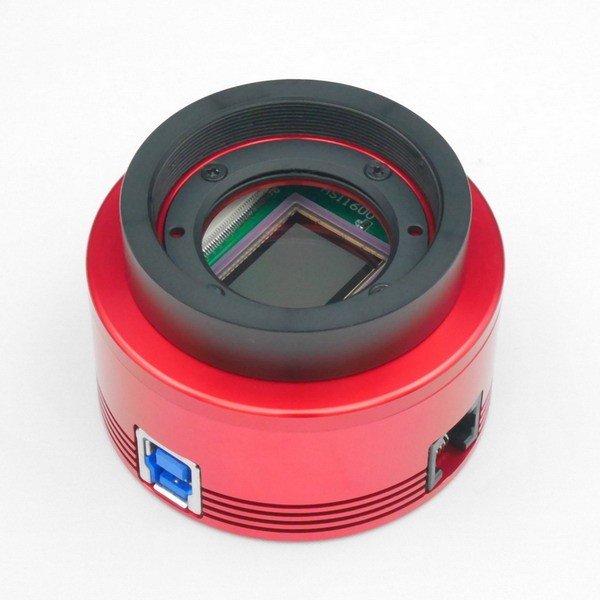
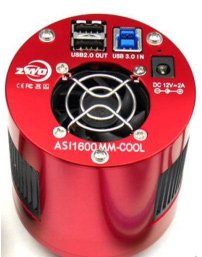
Cooled and Pro ZWO cameras have the following ports:
- A USB3.0 port for communications and powering the camera. A 2 meter USB3.0 cable is included.
- A USB2.0 hub (two ports) to connect an electronic filter wheel (EFW) and a guiding camera to the ZWO camera where, through the communications port, these devices can be controlled with a computer. Two short USB cables are included to be used with these ports.
- A 2.1mm center-positive connector for an external DC power supply for the cooler. The power supply for the camera is not included with the camera. ZWO recommends a 12V 3A-5A DC power supply for the cooler. Some (but not all) cooled ZWO camera can also be powerered with outputs on the ZWO ASIAIR-PRO controller.
(NOTE: Some older production model ZWO cooled cameras include an ST4 autoguider port instead of the USB2.0 hub).
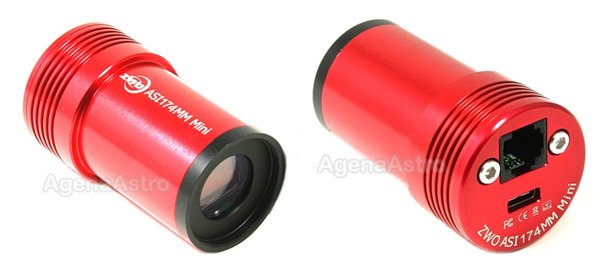
The ZWO Mini cameras have an ST4 port for autoguiding and USB2.0 ports with a Type C interface connection for power and control.
3.3 Sensor Size and Field of View
The physical size of the sensor on an astronomy camera governs the field of view of the camera, that is, how much of the sky you can fit in an image with a given camera and telescope. The field of view does not depend on the size of the pixels or the number of megapixels in the sensor. It only depends on the size of the sensor and the focal length of the telescope, along with any Barlow lenses or focal reducers used in the optical path.
If you know the size of the sensor, you can calculate the field of view of a camera using this formula:
Here, D is the dimension in millimeters of the sensor, either the length or width of the sensor, for example, or the dimension of the sensor's diagonal. The quantity L is the effective focal length of the telescope system in millimeters. (Note: There are 60 arc-minutes in a degree and 60 arc-seconds in an arc-minute).
When considering a ZWO astronomy camera, it is important to match the size of the diagonal and the focal length of your telescope to the size of the type of object you wish to image. Planets are quite small. Jupiter grows to a size of 40-50 arc-seconds at opposition. Galaxies, smaller star clusters and nebulae range in size from 3-4 arc-minutes to 20-30 arc-minutes or more. And the sprawling North America Nebula is nearly 180 arc-minutes at its longest dimension. Table 3 below gives approximate sizes of some common celestial objects.
| Object Name | Approximate Apparent Size |
|---|---|
| Mars | 20 arc-seconds (at opposition) |
| Jupiter | 40 arc-seconds (at opposition) |
| Ring Nebula (M57) | 1.4x1.0 arc-minutes |
| Dumbbell Nebula (M27) | 8.0x6.0 arc-minutes |
| Hercules Cluster (M13) | 15 arc-minutes in diameter |
| Wild Duck Cluster (M11) | 14.0x14.0 arc-minutes |
| Moon/Sun | 30 arc-minutes in diameter |
| Orion Nebula (M42) | 80x60 arc-minutes |
| Andromeda Galaxy (M31) | 190x60 arc-minutes |
Given the wide range of the size of astronomical objects, no single camera and telescope can frame all objects in an optimum way. But if you wish to image planets, you need a telescope system with long focal length and a camera with a small sensor size so that the sensor is not underfilled. If you are interested in the Moon and Sun, you want a telescope with intermediate focal length and a slightly larger sensor to that you can get full-disk images. And if you are after large deep-sky objects, you want a sensor of intermediate to large size and a telescope with a relatively fast focal ratio to achieve bright images of extended objects.
Example 1:
The diagonal size of the sensor in the ZWO ASI224MC camera is 6.09mm. If you have a 127mm f/7 refractor and use it with a 2x Barlow lens, the effective focal length of the system is 127x7x2=1778mm. So this ASI224MC camera and the telescope and Barlow will result in an image with a diagonal size of 3436x6.09/1778=11.8 arc-minutes.
This field is about 1/3 the diameter of the full Moon or the disk of the Sun and about 17x the apparent diameter of Jupiter at opposition. So the entire Moon or Sun will not fit into the frame of this system, while Jupiter would be reasonably well framed, and could even benefit from an optical system with more focal length to give a larger image. The image size can be adjusted with this telescope to some extent by using different Barlow lenses or focal reducers.
Example 2:
The ASI178MC camera has a sensor with a diagonal size of 8.92mm. When used with a small 80mm f/6 refractor, which has a focal length of 480mm, the camera has a field of view of 3436x8.92/480=63.9 arc-minutes, or a little more than 1 degree. A one degree field of view easily fits the full-disk image of the Moon and Sun, and it nicely frames moderately-large deep-sky objects like the globular cluster Messier 13.
With the same telescope, the ASI2600MC-Pro camera, which has a full-frame sensor with a large 43mm diagonal, the field of view along the diagonal is 308 arc-minutes or more than 5 degrees! That is large enough to frame even larger celestial objects like the Andromeda Galaxy.
3.4 Pixel Size and Resolution
In consumer cameras for everyday use, 'resolution' usually refers to the total number of pixels in a sensor. So a 10 megapixel camera has 10 million pixels on its sensor, for example. But this tells us nothing about the size of the sensor or the size of the individual pixels. When it comes to astronomical imaging, the size of the individual pixels is important. Larger pixels can capture more light with less noise, but they imply a lower resolution across an image of a planet or other object projected on your sensor by your telescope.
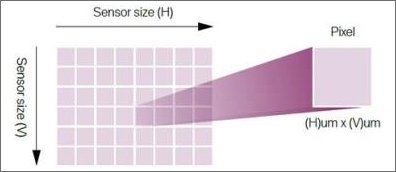
The effect of pixel size for a particular telescope is governed by the image scale, which is the angle subtended by each camera pixel with a given telescope system. It is usually expressed in arc-seconds per pixel, and it's calculated with this simple formula:
where s is the pixel size in microns and L is the focal length in millimeters.
For imaging planets and small deep-sky objects, where the overall image size is small to begin with, you want to have small pixels to get high resolution across the planet's disk. Experienced planetary imagers recommend a telescope-camera combination that gives an image scale of close to 0.25 arc-seconds/pixel in good sky conditions where the air is steady. In the steadiest air when seeing is excellent, an image scale of 0.1 arc-seconds/pixel can work well.
For full-disk lunar and solar imaging, and for basic deep-sky imaging, since the image is larger and since larger sensors are used compared to planetary imaging, the pixels can be larger without sacrificing resolution. When imaging larger objects, larger pixel sizes on larger sensors give better signal-to-noise ratio and larger fields of view. An image scale of 1 to 2 arc-seconds per pixel works well for lunar, solar, and basic deep-sky imaging in good sky conditions.
The ZWO ASI120, ASI224, ASI290-series, and ASI462MC cameras have both small sensors and small pixel size, so they work well for imaging planets and small deep-sky objects. The ZWO ASI174, ASI178, and ASI385-series cameras have larger sensors and larger pixels, and work well for imaging the Moon and Sun and slightly larger deep-sky objects, depending on the focal length of your telescope, and they work reasonably well with planets.
Example 3:
The ASI224MC camera has a sensor with 6.09mm diagonal and 3.75 micron pixels. Let's calculate the image scale with an 8" (200mm) aperture f/10 Schmidt-Cassegrain telescope with a 2x Barlow lens.
The telescope and Barlow have an effective focal length of 200x10x2 = 4000mm. The image scale of this system is 206x3.75/4000=0.19 arc-seconds per pixel. When imaging Jupiter at opposition, for example, when its apparent size might be 40 arc-seconds, the image of the planet would span 210 pixels on the camera's sensor, which has a dimension of 1304x976 pixels.
For dedicated deep-sky cameras with large sensors like the ASI071MC-Pro, ASI094MC-Pro, and ASI128MC-Pro, the pixels are large so they can collect light from extended faint objects like nebulae and galaxies quickly while minimizing noise. The pixel sizes in these cameras are 4.88 microns, 4.88 microns, and 5.97 microns, respectively.
Table 4 below summarizes key sensor specifications for all ZWO cameras.
| ZWO Camera Model | Color / Monochrome | Sensor | Sensor Diagonal Size (mm) |
Sensor Dimensions (mm) |
Sensor Resolution (MB) |
Sensor Dimensions (pixels) |
Pixel Size (microns) |
|---|---|---|---|---|---|---|---|
| ASI034MC* | Color | ONS ASX340CS | 5.0 | 4.1x2.9 | 0.3 | 728x512 | 5.60 |
| ASI071MC-COOL* | Color | Sony IMX071 | 28.4 | 23.6x15.7 | 16.2 | 4928x3264 | 4.80 |
| ASI071MC-PRO | Color | Sony IMX071 | 28.3 | 23.6x15.6 | 16.0 | 4944x3284 | 4.78 |
| ASI094MC-PRO* | Color | Sony IMX094 | 43.3 | 36.0x24.0 | 36.0 | 736x4928 | 4.88 |
| ASI120MC* | Color | ONS AR0130CS | 6.09 | 4.8x3.6 | 1.2 | 1280x960 | 3.75 |
| ASI120MM* | Monochrome | ONS MT9M034 | 6.09 | 4.8x3.6 | 1.2 | 1280x960 | 3.75 |
| ASI120MC-S | Color | ONS AR0130CS | 6.09 | 4.8x3.6 | 1.2 | 1280x960 | 3.75 |
| ASI120MM-S | Monochrome | ONS MT9M034 | 6.09 | 4.8x3.6 | 1.2 | 1280x960 | 3.75 |
| ASI120MM-MINI | Monochrome | ONS AR0130CS | 6.09 | 4.8x3.6 | 1.2 | 1280x960 | 3.75 |
| ASI128MC-PRO* | Color | Sony IMX128 | 43.3 | 36.0x24.0 | 24.0 | 6032x4032 | 5.97 |
| ASI174MC* | Color | Sony IMX174 | 13.4 | 11.3x7.1 | 2.3 | 1936x1216 | 5.86 |
| ASI174MC-COOL* | Color | Sony IMX174 | 13.4 | 11.3x7.1 | 2.3 | 1936x1216 | 5.86 |
| ASI174MM | Monochrome | Sony IMX174 | 13.4 | 11.3x7.1 | 2.3 | 1936x1216 | 5.86 |
| ASI174MM-COOL* | Monochrome | Sony IMX174 | 13.4 | 11.3x7.1 | 2.3 | 1936x1216 | 5.86 |
| ASI174MM-MINI | Color | Sony IMX174 | 13.4 | 11.3x7.1 | 2.3 | 1936x1216 | 5.86 |
| ASI178MC | Color | Sony IMX178 | 8.92 | 7.4 x 5.0 | 6.4 | 3096x2080 | 2.40 |
| ASI178MC-COOL* | Color | Sony IMX178 | 8.92 | 7.4 x 5.0 | 6.4 | 3096x2080 | 2.40 |
| ASI178MM | Monochrome | Sony IMX178 | 8.92 | 7.4 x 5.0 | 6.4 | 3096x2080 | 2.40 |
| ASI178MM-COOL* | Monochrome | Sony IMX178 | 8.92 | 7.4 x 5.0 | 6.4 | 3096x2080 | 2.40 |
| ASI183MC | Color | Sony IMX183 | 15.9 | 13.2x8.8 | 20.1 | 5496x3672 | 2.4 |
| ASI183MC-PRO | Color | Sony IMX183 | 15.9 | 13.2x8.8 | 20.1 | 5496x3672 | 2.4 |
| ASI183MM | Monochrome | Sony IMX183 | 15.9 | 13.2x8.8 | 20.1 | 5496x3672 | 2.4 |
| ASI183MM-PRO | Monochrome | Sony IMX183 | 15.9 | 13.2x8.8 | 20.1 | 5496x3672 | 2.4 |
| ASI183GT | Monochrome | Sony IMX183 | 15.9 | 13.2x8.8 | 20.1 | 5496x3672 | 2.4 |
| ASI185MC* | Color | Sony IMX185 | 8.58 | 7.3x4.6 | 2.3 | 1944x1224 | 3.75 |
| ASI185MC-COOL* | Color | Sony IMX185 | 8.58 | 7.3x4.6 | 2.3 | 1944x1224 | 3.75 |
| ASI224MC | Color | Sony IMX224 | 6.09 | 4.8x3.6 | 1.2 | 1304x976 | 3.75 |
| ASI224MC-COOL* | Color | Sony IMX224 | 6.09 | 4.8x3.6 | 1.2 | 1304x976 | 3.75 |
| ASI290MC* | Color | Sony IMX290 | 6.46 | 5.6x3.2 | 2.1 | 1936x1096 | 2.90 |
| ASI290MC-COOL* | Color | Sony IMX290 | 6.5 | 5.6x3.2 | 2.1 | 1936x1096 | 2.90 |
| ASI290MM | Monochrome | Sony IMX290 | 6.46 | 5.6x3.2 | 2.1 | 1936x1096 | 2.90 |
| ASI290MM-COOL* | Monochrome | Sony IMX290 | 6.5 | 5.6x3.2 | 2.1 | 1936x1096 | 2.90 |
| ASI290MC-MINI | Monochrome | Sony IMX290 | 6.46 | 5.6x3.2 | 2.1 | 1936x1096 | 2.90 |
| ASI294MC | Color | Sony IMX294 | 23.2 | 19.1x13.0 | 11.7 | 4144x2822 | 4.63 |
| ASI294MC-PRO | Color | Sony IMX294 | 23.2 | 19.1x13.0 | 11.7 | 4144x2822 | 4.63 |
| ASI294MM-PRO | Monochrome | Sony IMX294 | 23.2 | 19.1x13.0 | 11.7 | 4144x2822 | 4.63 |
| ASI385MC | Color | Sony IMX385 | 8.4 | 7.3x4.1 | 2.1 | 1936x1096 | 3.75 |
| ASI385MC-COOL* | Color | Sony IMX385 | 8.35 | 7.3x4.1 | 2.1 | 1936x1096 | 3.75 |
| ASI462MC | Color | Sony IMX462 | 6.46 | 5.6x3.2 | 2.1 | 1936x1096 | 2.90 |
| ASI482MC | Color | Sony IMX482 | 12.86 | 11.13x6.26 | 2.1 | 1920x1080 | 5.8 |
| ASI485MC | Color | Sony IMX485 | 12.86 | 11.13x6.26 | 8.3 | 1920x1080 | 2.9 |
| ASI533MC-PRO | Color | Sony IMX533 | 16.0 | 11.3x11.3 | 9.0 | 3008x3008 | 3.76 |
| ASI1600MC | Color | 4/3" CMOS | 21.9 | 17.7x13.3 | 16.0 | 4656x3520 | 3.80 |
| ASI1600MC-COOL* | Color | 4/3" CMOS | 21.9 | 17.7x13.3 | 16.0 | 4656x3520 | 3.80 |
| ASI1600MMC-PRO | Color | 4/3" CMOS | 21.9 | 17.7x13.3 | 16.0 | 4656x3520 | 3.80 |
| ASI1600MM | Monochrome | 4/3" CMOS | 21.9 | 17.7x13.3 | 16.0 | 4656x3520 | 3.80 |
| ASI1600MM-COOL* | Monochrome | 4/3" CMOS | 21.9 | 17.7x13.3 | 16.0 | 4656x3520 | 3.80 |
| ASI1600MM-PRO | Color | 4/3 CMOS | 21.9 | 17.7x13.3 | 16.0 | 4656x3520 | 3.80 |
| ASI1600GT | Monochrome | 4/3 CMOS | 21.9 | 17.7x13.3 | 16.0 | 4656x3520 | 3.80 |
| ASI2400MC-PRO | Color | Sony IMX410 | 43.3 | 36.0x24.0 | 24.0 | 6072x4042 | 5.94 |
| ASI2600MC-PRO | Color | IMX571 | 28.0 | 23.5x15.7 | 26.0 | 6248x4176 | 3.76 |
| ASI6200MM-PRO | Monochrome | IMX455 | 43.3 | 36.0x24.0 | 62.0 | 9576x6388 | 3.76 |
| ASI6200MM-PRO | Color | IMX455 | 43.3 | 36.0x24.0 | 62.0 | 9576x6388 | 3.76 |
3.5 Pixel Number and Binning
Sensor size and pixel size, as explained above, are important parameters when choosing an astronomy camera. The number of pixels in an astronomy camera is, of course, a direct consequence of these two specifications. But does the number of pixels matter? Large pixel counts make it easier to obtain pleasing large images in print or on a computer screen without the obvious effect of pixelation. And large pixel counts also make it easier to crop images while retaining reasonably high resolution. So when imaging extended objects like galaxies and nebulae, a larger pixel count is often better. The ZWO ASI1600 and ASI294 cameras, for example, which are optimized for deep-sky imaging, have sensors with 16 megapixels. The ASI2400MC-Pro and ASI6200MC-Pro, which use the same full-frame sensors found in high-end DSLR cameras, have 24 megapixels and 62 megapixels, respectively.
There is one disadvantage to large pixel counts, however. It takes the camera longer to download data from all those pixels, so a larger number of pixels tends to make overall download times longer. This can be a disadvantage when imaging planets, especially Jupiter and Saturn, because they have rapid rotation rates. That means an ideal camera for planetary imaging needs to have fast download speeds to achieve good image sharpness and counteract the effect of planetary rotation. Many cameras optimized for planetary imaging, such as the ASI174, ASI224, and ASI120 cameras do not have sensors with more than 1 or 2 megapixels.
Most ZWO astronomy cameras also enable 2x2 binning of pixels. This is the process, controlled in software, of combining four pixels together to effectively make one larger pixel. The signal increases by a factor of four, but the read noise also increases slightly, so the all-important signal-to-noise ratio improves by less than a factor of four. Binning is accomplished at the expense of image resolution.
Binning is commonly used, for example, to achieve an image scale that is more realistic for the seeing conditions. For example, if your telescope and camera give an image scale of 0.3 arcsec/pixel, but your seeing is only 1.5 arcseconds, then this will result in decreased sensitivity without improved resolution, and you need to attend more carefully to guiding during the image. Binning can help improve this situation. Binning is also used in color imaging with a monochrome camera and appropriate color filters (see section 3.6 below). Many imagers take the monochrome images without binning, then capture the color images binned. The binned pixels are four times more sensitive, so the time needed to capture color data is reduced by a factor of four. In post processing, the color images are blended with the more detailed mono images.
3.6 Color vs Monochrome
Should you choose a color camera, or a monochrome camera?
If you're just starting out, or you want to keep your astrophotography workflow simple, a color camera is a good bet. A color astronomy camera uses the same sensor as its monochrome counterpart, but it incorporates a color filter array, often a Bayer filter, permanently fixed over the sensor. The filter passes red, green, or blue light into each pixel on the sensor, and an algorithm in the camera interprets the intensity of light on each pixel and produces a full-color image.
A color astronomy camera lets you capture a full-color image of planets or deep-sky object in a single shot without much additional processing and without the need for additional filters. Using standard astro-imaging software, color images can be stacked, sharpened, and enhanced as needed. However, you are restricted to the colors provided by the color array filter and processing techniques. There is no easy way to add information from colors outside the visible spectrum- IR data, for example - which may enhance the image. And there can be some loss of image sharpness and resolution when working with images from color astronomy cameras.
That's why most serious astrophotographers use monochrome cameras for their best work. A monochrome camera produces a single monochrome image of a planet or DSO. But more commonly, a monochrome camera is used to make a series of images through color or narrowband filters. For planets, separate images are captured through a series of color filters then combined using standard image-processing techniques to produce full-color images with far more detail than is accessible with a single color image. For deep-sky objects, especially nebulae, multiple images are collected through color and narrowband filters such as H-alpha or OIII ("oh-3") then combined into a single image. Again, far more details are accessible in such objects with this approach using multiple images through filters and a monochrome camera.
The disadvantage of imaging with monochrome cameras? In some cases, it can take more time to gather multiple images through filters, and it takes more time to combine the images in post processing.You need to buy the filters, of course, and also a manual or automated filter wheel to hold and swap the filters into the optical path. And when imaging planets, to achieve the sharpest images, you must work quickly to capture each image before a planet's rotation smears the image.
While monochrome has been the choice of serious imagers, even expert astrophotographers appreciate the benefits and ease of using color cameras, especially when shooting the deep sky. The latest 'Pro' level ZWO cameras are built around larger color sensors that allow experienced imagers to capture 'one-shot' color images that are of impressive quality. These are the same sensors used on high-end DSLR cameras. Because of the large sensors, these cameras, which include the ASI071MC-Pro, ASI094MC-Pro, and ASI128MC-Pro, tend to be quite expensive.
The bottom line? If you value convenience and speed, if you're just interested in casual imaging, or if you are just starting out in astrophotography, then a color ZWO camera is the best bet for planetary, lunar/solar, and deep-sky imaging. If you want to get the sharpest possible images and you don't mind investing in additional equipment like filters and a filter wheel, as well as extra complexity in acquiring and processing images, then consider a monochrome camera. And if you have deep pockets and value the ease of 'one-shot' color imaging, a high-end color 'Pro' camera is an excellent choice.
3.7 Noise and Cooling
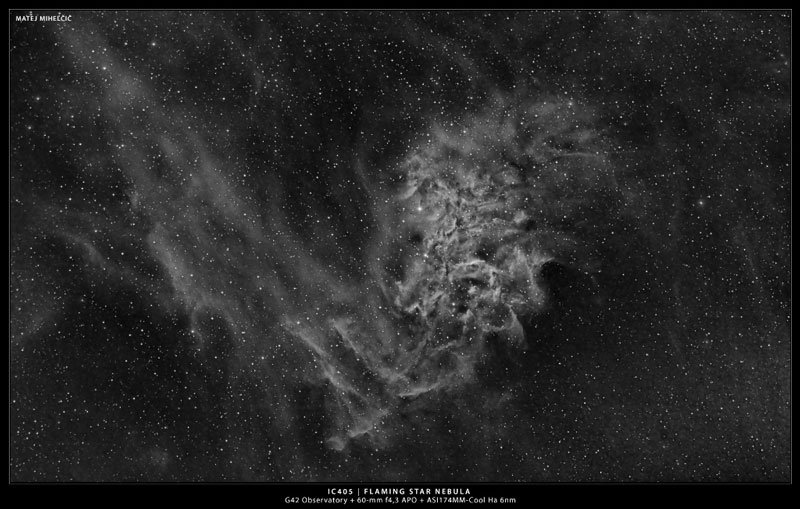
Noise is a key specification in astronomy cameras, and there are many types of noise that arise in digital cameras. Some, like photon noise and quantization noise, are inherent to the detection process in the semiconductor electronics and the conversion of the signal to a digital format. Other types of noise are a consequence of the design of the sensor or of the operation of the sensor in various environmental conditions.
Read noise, for instance, is generated by electronics on the sensor and in the camera as the electric charge produced by light in the pixels is converted to a signal. Read noise is inherent in the design of the CMOS sensor and the amplifier and associated electronics that create the digital output of the camera. Low read noise is essential to accurately detecting small signals from faint objects or a dark background. Read noise tends to dominate the signal-to-noise ratio of an image for short exposures of less than a second, approximately. It's expressed in the number of unwanted electrons e- produced. For example, the ZWO ASI1600MM camera has a read noise of 1.2e- when the camera's electronics is set to 30 dB gain. This is a very low read noise and it's ideal for getting good contrast images of deep-sky objects against a dark sky.
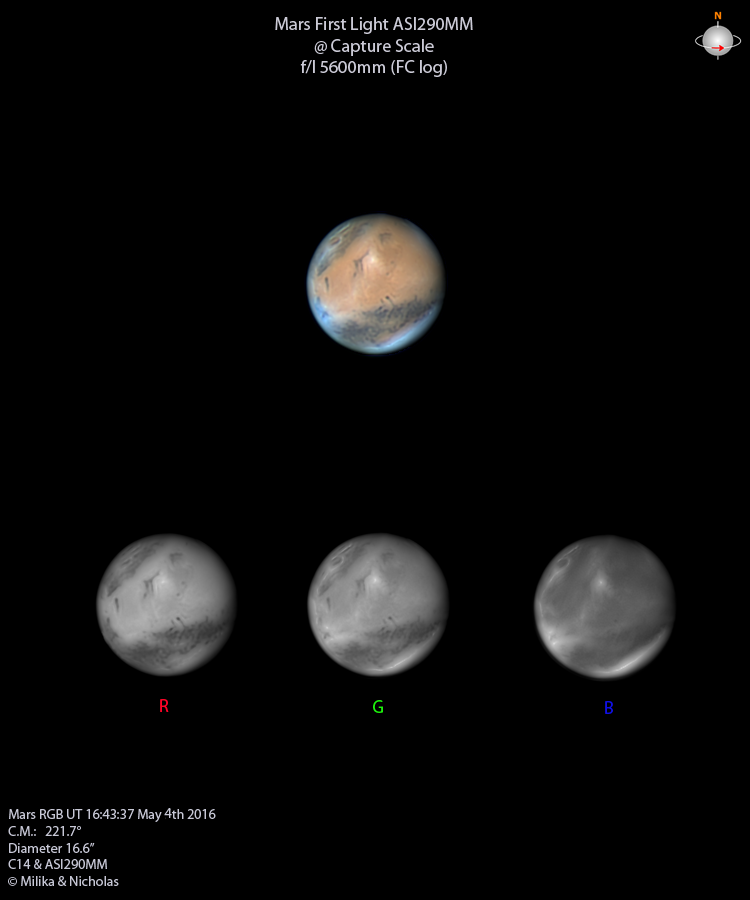
Then there is thermal noise. This is produced by processes in the semiconductor that produce unwanted electrons that are not caused by a signal. The amount of noise goes up with temperature, so this noise can be reduced, or at least held to a tolerable level, by controlling the temperature of the sensor with a thermoelectric cooler (TEC).
Cooled and Pro ZWO cameras include regulated TEC cooling. This is a big advantage because you can set the target temperature of the camera and take dark frames that include the thermal noise. If the temperature is regulated, the noise in the dark frame matches the light frame during imaging, and you can more easily calibrate your image. If the temperature is changing, as it might in an uncooled camera, while you take your calibration frames and during your image capture, you cannot calibrate your image very well.
Cooling is only important for exposures longer than about 500 ms. That means it is not critical, usually, when imaging the planets, Moon, or Sun. But for longer exposures of deep-sky objects, active thermal control is a big advantage when trying to achieve the best image quality.
The noise sources mentioned above can affect any pixel in the sensor equally. But fixed pattern noise, as its name implies, is a result of some pixels giving a signal of higher intensity above the general background noise. This is caused by a variation in some of the millions of pixels in the sensor. "Hot pixels", pixels that show a signal even in the absence of a real signal, are an example of this type of noise. The advanced CMOS sensors used in ZWO astronomy cameras are designed to keep fixed-pattern noise to a minimum.
3.8 Other Specifications to Consider - Shutter Speeds, Data Resolution, and Download Rates
Like any digital camera, ZWO astronomy cameras have a range of user-selectable shutter speeds. Most ZWO cameras have shutter speeds ranging from 32 microseconds to 1000 seconds. While the extremes of this range of shutter speeds are enabled by the design of the camera's electronics, they may not be required for most imaging applications. In general, longer exposures of many seconds are used for faint deep-sky objects while shorter speeds on the order of milliseconds to hundreds of milliseconds are used for the planets, Moon, Sun (through a telescope with a safe solar filter).
As ZWO cameras use CMOS sensors, most are equipped with rolling shutters that scan the image sequentially, from one side of the sensor (usually the top) to the other, line by line. Only the ASI174-series cameras use a global shutter which scans the entire area of the image simultaneously.
The download rate of an astronomy camera defines how quickly an image frame can be downloaded from the camera to a computer. Fast download rates are essential when imaging objects like planets that may rotate quickly during image capture. The download rate is governed by the sensor and readout electronics, but for a given camera and sensor, the more data there is to download, the longer it takes. As mentioned above, most cameras optimized for planetary use only have sensor sizes of 1 or 2 megapixels, so the data can be downloaded fairly quickly. Larger sensors generate more data and have slower download rates.
ZWO's line of 'Pro' cameras include a large onboard 256MB DDR3 memory buffer. This enables quick and stable data transfer off the camera and has the effect of reducing 'amp glow' that degrades image quality around the edge of the sensor, especially at high gain.
The data resolution also affects transfer rates. Digital cameras translate analog images from a telescope into numbers that can be read by a computer. The larger number of bits in each digital number enable a larger range of tonality and shades in the grayscale which may make for better images. A 12-bit resolution has 2 bits more levels of gray than 10-bit, but the larger number of bits means a longer transfer time and more data to store on your hard drive. ZWO cameras have user-selectable data resolution of 14 bits, 12 bits, or 10 bits so you can configure the camera for what's best for your situation.
All ZWO cameras also have a user selectable image resolution to enable you to trade off faster data transfer against image resolution. For example, the ASI224MC camera has a maximum data transfer rate of 64 frames per second when set for the maximum resolution of 1304x976 at a data resolution of 12 bits. But when the camera is software-configured to render an image resolution of 640x480, for example, the transfer rate doubles to 127 frames per second at the same 12-bit data resolution.
Except for the ASI120MM/MC cameras, all ZWO cameras enable a USB 3.0 interface for fast download speeds. But they can be software-configured to work at USB 2.0 speeds with computers with slower communications ports.
Table 5 below summarizes some additional specifications discussed above.
| ZWO Camera Model | Color / Monochrome | ADC Data Resolution (bits) |
Max Download Rate@Max Resolution (fps) |
USB Data Interface | TEC Cooling |
|---|---|---|---|---|---|
| ASI034MC* | Color | 8 | 95 | 2.0 | No |
| ASI071MC-COOL* | Color | 14 | 10 | 3.0 | Yes |
| ASI071MC-PRO | Color | 14/10 | 10 | 3.0 | Yes |
| ASI094MC-PRO* | Color | 14/10 | 5 | 3.0 | Yes |
| ASI120MC* | Color | 12/10 | 35 | 2.0 | No |
| ASI120MM* | Monochrome | 12/10 | 35 | 2.0 | No |
| ASI120MC-S | Color | 12/10 | 60 | 3.0 | No |
| ASI120MM-S | Monochrome | 12/10 | 60 | 3.0 | No |
| ASI120MM-MINI | Monochrome | 12 | 35 | 2.0 | No |
| ASI128MC-PRO* | Color | 14/10 | 7 | 3.0 | Yes |
| ASI174MC* | Color | 12/10 | 164 | 3.0 | No |
| ASI174MC-COOL* | Color | 12/10 | 164 | 3.0 | Yes |
| ASI174MM | Monochrome | 12/10 | 164 | 3.0 | No |
| ASI174MM-COOL* | Monochrome | 12/10 | 164 | 3.0 | Yes |
| ASI174MM-MINI | Monochrome | 12 | 18.4 | 2.0 | No |
| ASI178MC | Color | 14/10 | 60 | 3.0 | No |
| ASI178MC-COOL* | Color | 14/10 | 60 | 3.0 | Yes |
| ASI178MM | Monochrome | 14/10 | 60 | 3.0 | No |
| ASI178MM-COOL* | Monochrome | 14/10 | 60 | 3.0 | Yes |
| ASI183MC | Color | 12/10 | 19 | 3.0 | No |
| ASI183MC-PRO | Color | 12/10 | 108 | 3.0 | Yes |
| ASI183MM | Monochrome | 12/10 | 19 | 3.0 | No |
| ASI183MM-PRO | Monochrome | 12/10 | 19 | 3.0 | Yes |
| ASI183GT | Monochrome | 12/10 | 19 | 3.0 | Yes |
| ASI185MC* | Color | 12/10 | 108 | 3.0 | No |
| ASI185MC-COOL* | Color | 12/10 | 108 | 3.0 | Yes |
| ASI224MC | Color | 12/10 | 150 | 3.0 | No |
| ASI224MC-COOL* | Color | 12/10 | 150 | 3.0 | Yes |
| ASI290MC* | Color | 12/10 | 170 | 3.0 | No |
| ASI290MC-COOL* | Color | 12/10 | 170 | 3.0 | Yes |
| ASI290MM | Monochrome | 12/10 | 170 | 3.0 | No |
| ASI290MM-COOL* | Monochrome | 12/10 | 170 | 3.0 | Yes |
| ASI290MM-MINI | Monochrome | 12 | 20.4 | 2.0 | No |
| ASI294MC | Color | 14/10 | 19 | 3.0 | No |
| ASI294MC-PRO | Color | 14/10 | 19 | 3.0 | Yes |
| ASI294MM-PRO | Monochrome | 14/10 | 19 | 3.0 | Yes |
| ASI385MC | Color | 12/10 | 120 | 3.0 | No |
| ASI385MC-COOL* | Color | 12/10 | 120 | 3.0 | Yes |
| ASI462MC | Color | 12/10 | 136 | 3.0 | No |
| ASI482MC | Color | 12/10 | 83 | 3.0 | No |
| ASI485MC | Color | 12/10 | 39 | 3.0 | No |
| ASI533MC-PRO | Color | 14 | 20 | 3.0 | Yes |
| ASI1600MC | Color | 12/10 | 23 | 3.0 | No |
| ASI1600MC-COOL* | Color | 12/10 | 23 | 3.0 | Yes |
| ASI1600MC-PRO | Color | 12/10 | 23 | 3.0 | Yes |
| ASI1600MM | Monochrome | 12/10 | 23 | 3.0 | No |
| ASI1600MM-COOL* | Monochrome | 12/10 | 23 | 3.0 | Yes |
| ASI1600MM-PRO | Monochrome | 12/10 | 23 | 3.0 | Yes |
| ASI1600GT | Monochrome | 12/10 | 23 | 3.0 | Yes |
| ASI2400MC-PRO | Color | 14 | 8 | 3.0 | Yes |
| ASI2600MC-PRO | Color | 16 | 3.51 | 3.0 | Yes |
| ASI6200MM-PRO | Monochrome | 16 | 2.0 | 3.0 | Yes |
| ASI6200MC-PRO | Color | 16 | 2.0 | 3.0 | Yes |
4. General Recommendations
So which ZWO camera is right for you? The general features and strengths of each camera are summarized in Table 6 below. In this table, each camera is given a somewhat subjective rating out of five stars for its relative performance for planetary, lunar/solar, deep-sky, and all-sky imaging. This five-star rating is not intended to evaluate the camera in absolute terms; the rating suggests the performance of the camera for each application relative to other ZWO cameras for a particular application.
| ZWO Camera Model | Color / Monochrome | All-Sky Lens Included | Best Applications | Planetary | Solar/Lunar | Deep-Sky | All-Sky |
|---|---|---|---|---|---|---|---|
| ASI034MC* | Color | No | Planetary imaging | ★★★ | ★★ | ★ | ★ |
| ASI071MC-COOL* | Color | No | Deep Sky | ★★★ | ★★★★ | ★★★★★ | ★★★★★ |
| ASI071MC-PRO | Color | No | Deep Sky | ★★★ | ★★★★ | ★★★★★ | ★★★★★ |
| ASI094MC-PRO* | Color | No | Deep Sky | ★★★ | ★★★★ | ★★★★★ | ★★★★★ |
| ASI120MC* | Color | Yes | Planetary imaging | ★★★★★ | ★★★★ | ★★★ | ★★★ |
| ASI120MM* | Monochrome | Yes | Planetary imaging | ★★★★★ | ★★★★ | ★★★ | ★★★ |
| ASI120MC-S | Color | Yes | Planetary imaging | ★★★★★ | ★★★★ | ★★★ | ★★★ |
| ASI120MM-S | Monochrome | Yes | Planetary imaging | ★★★★★ | ★★★★ | ★★★ | ★★★ |
| ASI120MM-MINI | Monochrome | No | Autoguiding; solar system | ★★★★★ | ★★★★ | ★★★ | ★★★ |
| ASI128MC-PRO* | Color | No | Deep Sky | ★★★ | ★★★★ | ★★★★★ | ★★★★★ |
| ASI174MC* | Color | No | Solar and lunar imaging | ★★★★ | ★★★★★ | ★★★ | ★★★ |
| ASI174MC-COOL* | Color | No | Solar and lunar imaging | ★★★★ | ★★★★★ | ★★★★ | ★★★ |
| ASI174MM | Monochrome | No | Solar and lunar imaging | ★★★★ | ★★★★★ | ★★★ | ★★★ |
| ASI174MM-COOL* | Monochrome | No | Solar and lunar imaging | ★★★★ | ★★★★★ | ★★★★ | ★★★ |
| ASI174MM-MINI | Monochrome | No | Autoguiding; solar system | ★★★★ | ★★★★★ | ★★★★ | ★★★ |
| ASI178MC | Color | Yes | Planetary imaging;solar/lunar | ★★★★★ | ★★★★ | ★★★ | ★★★★ |
| ASI178MC-COOL* | Color | No | Planetary imaging;solar/lunar | ★★★★★ | ★★★★ | ★★★★★ | ★★★★★ |
| ASI178MM | Monochrome | Yes | Planetary imaging;solar/lunar | ★★★★★ | ★★★★ | ★★★ | ★★★★ |
| ASI178MM-COOL* | Monochrome | No | Planetary imaging;solar/lunar | ★★★★★ | ★★★★ | ★★★★ | ★★★★★ |
| ASI183MC | Color | No | Deep Sky | ★★★ | ★★★★ | ★★★★ | ★★★★★ |
| ASI183MC-PRO | Color | No | Deep Sky | ★★★ | ★★★★ | ★★★★★ | ★★★★★ |
| ASI183MM | Monochrome | No | Deep Sky | ★★★ | ★★★★ | ★★★★★ | ★★★★★ |
| ASI183MM-PRO | Monochrome | No | Deep Sky | ★★★ | ★★★★ | ★★★★★ | ★★★★★ |
| ASI183GT | Monochrome | No | Deep Sky | ★★★ | ★★★★ | ★★★★★ | ★★★★★ |
| ASI185MC* | Color | Yes | Planetary imaging;solar/lunar | ★★★★★ | ★★★★★ | ★★★★ | ★★★★ |
| ASI185MC-COOL* | Color | No | Planetary imaging;solar/lunar | ★★★★★ | ★★★★★ | ★★★★★ | ★★★★★ |
| ASI224MC | Color | Yes | Planetary imaging | ★★★★★ | ★★★★ | ★★★★ | ★★★★ |
| ASI224MC-COOL* | Color | No | Planetary imaging | ★★★★★ | ★★★★ | ★★★★★ | ★★★★★ |
| ASI290MC* | Color | Yes | Planetary imaging | ★★★★★ | ★★★★ | ★★★★ | ★★★★ |
| ASI290MC-COOL* | Color | No | Planetary imaging | ★★★★★ | ★★★★ | ★★★★★ | ★★★★★ |
| ASI290MM | Monochrome | Yes | Planetary imaging | ★★★★★ | ★★★★ | ★★★★ | ★★★★ |
| ASI290MM-COOL* | Monochrome | No | Planetary imaging | ★★★★★ | ★★★★ | ★★★★★ | ★★★★★ |
| ASI290MM-MINI | Monochrome | No | Autoguiding; solar system | ★★★★ | ★★★★★ | ★★★★ | ★★★ |
| ASI294MC | Color | No | Deep Sky | ★★★ | ★★★★ | ★★★★ | ★★★★★ |
| ASI294MC-PRO | Color | No | Deep Sky | ★★★ | ★★★★ | ★★★★★ | ★★★★★ |
| ASI294MM-PRO | Monochrome | No | Deep Sky | ★★★ | ★★★★ | ★★★★★ | ★★★★★ |
| ASI385MC | Color | No | Solar and lunar imaging | ★★★★★ | ★★★★ | ★★★ | ★★★★★ |
| ASI385MC-COOL* | Color | No | Solar and Lunar imaging | ★★★★★ | ★★★★ | ★★★★ | ★★★★★ |
| ASI462MC | Color | Yes | Planetary imaging | ★★★★★ | ★★★★ | ★★★★ | ★★★★ |
| ASI482MC | Color | No | Solar, Lunar, Planetary imaging | ★★★★ | ★★★★★ | ★★★★ | ★★★★ |
| ASI485MC | Color | No | Solar and lunar imaging | ★★★★★ | ★★★★ | ★★★★ | ★★★★ |
| ASI533MC-PRO | Color | No | Deep sky | ★★★ | ★★★★ | ★★★★★ | ★★★★★ |
| ASI1600MC | Color | No | Deep sky | ★★★ | ★★★★ | ★★★★ | ★★★★★ |
| ASI1600MC-COOL* | Color | No | Deep sky | ★★★ | ★★★★ | ★★★★★ | ★★★★★ |
| ASI1600MC-PRO | Color | No | Deep sky | ★★★ | ★★★★ | ★★★★★ | ★★★★★ |
| ASI1600MM | Monochrome | No | Deep sky | ★★★ | ★★★★ | ★★★★★ | ★★★★★ |
| ASI1600MM-COOL* | Monochrome | No | Deep sky | ★★★ | ★★★★ | ★★★★★ | ★★★★★ |
| ASI1600MM-PRO | Monochrome | No | Deep sky | ★★★ | ★★★★ | ★★★★★ | ★★★★★ |
| ASI1600GT | Monochrome | No | Deep sky | ★★★ | ★★★★ | ★★★★★ | ★★★★★ |
| ASI2400MC-PRO | Color | No | Deep sky | ★★★ | ★★★★ | ★★★★★ | ★★★★★ |
| ASI2600MC-PRO | Color | No | Deep sky | ★★★ | ★★★★ | ★★★★★ | ★★★★★ |
| ASI6200MM-PRO | Monochrome | No | Deep sky | ★★★ | ★★★★ | ★★★★★ | ★★★★★ |
| ASI6200MC-PRO | Color | No | Deep sky | ★★★ | ★★★★ | ★★★★★ | ★★★★★ |
4.1 Starter Cameras
If you are just starting out in astrophotography, and if you are on a budget, then the ASI120 series of cameras is a great place to start. These cameras can do planetary, lunar/solar, and some deep-sky imaging at a good entry-level price. The ASI120-S series have a faster USB 3.0 interface than the standard ASI120s.
If you have slightly deeper pockets, you can go right into the ASI385MC with the faster download rate and state-of-the-art sensor. It's just as easy to use as the ASI120 cameras and is a good general-purpose small-sensor camera.
4.2 Solar System Imaging Cameras
In 2020, ZWO introduced the ASI462MC color camera. With its low read noise, high sensitivity, and ability to capture light in the near infrared, this camera is the best color planetary imaging camera. It has somewhat enhanced performance over the ASI290MC, which is also a very good planetary camera. The ASI290MM is the best mono planetary imaging camera.
The ASI224MC is also an excellent color planetary imaging camera. It has a similar sensor size to the ASI120MC-S, but the sensor allows much faster download rates, which is very important in capturing planetary images. It has a lower resolution compared to the ASI290-series and the ASI462MC.
For lunar and solar imaging, as well as planetary imaging at longer focal lengths, you can consider higher resolution cameras like the ASI178-series, ASI174-series, and ASI385-series cameras. These cameras also work well for small to medium sized deep-sky objects.
Introduced in late 2021, the ASI482MC and ASI485MC cameras also offer a good option for solar system imagers. Both cameras a 11.1mm x 6.3mm sensor, which is larger than the ASI290-series, ASI385MC, or ASI462MC cameras. This gives them a larger field of view with a given telescope, so they can also be used for lunar and solar imaging like the ASI178-series and ASI174MM-series cameras. The ASI482MC has larger 5.8 micron pixels and a resolution of 2.1 megapixels, while the ASI485MC has 2.9 micron pixels and a 8.3 megapixel resolution.
4.3 Deep-Sky Imaging Cameras
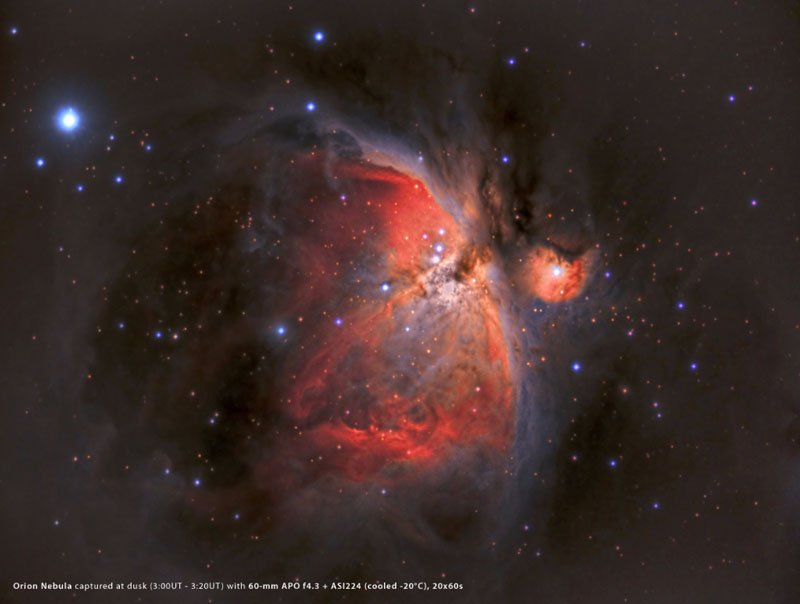
The best ZWO cameras for deep-sky imaging on a budget are the uncooled ASI294MC and the cooled ASI294MC-Pro cameras. These 11.7 megapixel cameras have large pixels to capture faint detail with lower noise. The cooled Pro version has TEC cooling to reduce thermal noise and improve image quality. These cameras are also available in monochrome.
The ASI1600MM-series and ASI1600MC-series are also an excellent choice for deep-sky imaging, especially the 'Pro' versions which TEC cooling. These cameras have 16 megapixel resolution but smaller pixels than the ASI294MC series. With slightly smaller 1"-class sensors that have higher quantum efficiency, the ASI183-series cameras are also a good choice for deep-sky imaging with shorter focal-length telescopes. They are also less expensive than the ASI1600-series.
Both the ASI1600-series and ASI183-series are also available in a monochrome format with integrated 5-position filter wheels to make it easier to capture color and narrowband images with 1.25" and 31mm astronomy filters. Both these cameras- the ASI1600GT and ASI183GT- are cooled camera systems.
Moving up in price and image quality, you might also consider the ASI071MC-Pro. This camera has a larger APS-C sensor than the ASI294-series or ASI1600-series, so it captures a wider field and yet still has large 4.8 micron pixels. The download times are a little slower, however. Introduced in 2019, the ASI2600MC-Pro color camera with a 26 megapixel sensor and 16-bit ADC is a newer and more powerful APS-C format camera for deep-sky imaging.
In 2019, ZWO also introduced the ASI533MC-Pro camera with a 9 megapixel square 3008 x 3008 sensor. This unusual sensor format is useful for framing deep-sky objects such as globular clusters and nebulae that are more or less symmetric and which may not be framed as well by a rectangular sensor.
At the high-end of the ZWO product line for deep-sky imaging are the (now discontinued) ASI094MC-Pro and ASI128MC-Pro cameras. These are both one-shot color astronomy cameras with full-frame CMOS sensors. The former has a 36 megapixel resolution, while the latter has a 24 megapixel resolution. The ASI128MC-Pro has larger pixels for ultimate sensitivity and low noise at the expense of overall sensor resolution.
The ASI094MC-Pro and ASI128MC-Pro cameras were replaced in 2019-2020 by the ASI6200MC-Pro (color) and ASI6200MM-Pro (monochrome) full-frame cameras. Both use 62 megapixel fullframe (36mm X 24mm) sensors and 16-bit ADC, and are the best cameras ZWO offers for deep-sky imaging. In 2020, ZWO introduced another full-frame camera, the ASI2400MC-PRO. It also uses a 36mm X 24mm sensor with large 5.9 micron pixels and has a resolution of 24 MB (6072 x 4042). The larger pixels enable better photon collection and noise performance, and are more forgiving of guiding errors, than the small-pixel ASI6200-series full-frame cameras. But they have lower overall resolution.
The ASI071MC-Pro, the discontinued ASI094MC-Pro and ASI128MC-Pro, the ASI2600MC-Pro, and ASI533MC-Pro cameras can also be outfitted with external camera lens (using appropriate adapters), so they can be used with a Nikon or Canon DSLR to capture wide-field images of the sky but with advantage of cooled sensors and much lower thermal noise. All three cameras also have built-in dew heaters on the protective windows in front of the sensors to eliminate dew and frost formation.
4.4 Electronically-Assisted Astronomy (EAA)
Most astrophotographers are interested in capturing data with their cameras and doing significant post-processing after their observing session to achieve a final image. So the time from initial exposure to final image can be hours or days. But some observers simply want the extra boost in sensitivity of an astronomy camera compared to the human eye to see celestial objects right away, in more or less real time, on their computer screens or on a TV monitor in the field. The image need not be optimized and highly processed, but it needs to be pleasing enough to enjoy and to show others, for example, at an outreach event, and it needs to be updated continuously. This sort astrophotography is often called electronically-assisted astronomy (EAA) because the camera sensor is used to see more detail than the human eye, and the image is delivered by the camera in more or less real time.
(Note: Learn more about choosing cameras and other equipment for EAA with this guide from Agena AstroProducts).
The most common type of camera for EAA has been astronomy video cameras such as the Revolution Imager or one of the many versions of a Mallincam. These devices use CCD sensors and processing electronics that output an analog video signal to a TV or monitor or, with analog-to-digital conversion electronics, to a computer. The high sensitivity of these cameras results from their CCD sensor design and large pixels that collect a lot of light. But the high sensitivity comes at the expense of an image with much lower resolution. The Revolution Imager, for example, has a pixel resolution of 976x582; the Mallincam Extreme has a resolution of just 640x480.
As CMOS sensors improve in sensitivity, it is becoming possible to use CMOS-based astronomy cameras for EAA. Real-time lunar and solar EAA can be done with many of the small-sensor ZWO cameras listed in this guide. The ASI224-series, ASI290-series, and ASI385-series are particularly good cameras for EAA because of their rapid data transfer rates and high sensitivity. These cameras have resolutions of 1304x976 (ASI224) and 1936x1096 (ASI290 and ASI385). However, they only have 6mm or 8mm diagonals, so they have limited fields of view for observing extended celestial objects.
To capture larger objects, the ASI183-series is a better choice for EAA. The high quantum efficiency of the sensor and the reasonably fast data transfer rate (19 fps at full 5496x3672 resolution, and much faster at lower resolutions) make this a good multi-purpose camera for both astrophotography and EAA. The Pro versions of these cameras with two-stage TEC cooling are ideal for low-noise EAA of fainter deep-sky objects, especially in warm ambient conditions. The square-sensor ASI533MC-Pro camera with a resolution of 3008x3008 and 3.76-micron pixels also works well for EAA of deep-sky objects, especially because it has relatively little visible amp glow.
And moving one step up in sensor size, the ASI294-series is also an excellent choice for EAA. The larger micro-4/3 sensor with 4144x2822 resolution (11.7 megapixels) and 4.63-micron pixel size can capture data at 16fps at full resolution. The larger pixels also collect more light and offer the promise of better signal-to-noise ratio. Again, the cooled version of the camera will keep thermal noise low. The larger sensor size works well to frame extended deep-sky objects like nebulae and large galaxies.
4.5 Autoguiding Cameras
Long-exposure imaging often requires a separte camera connected to a guide scope or an off-axis guider. A guide camera need not be as sophisticated or expensive as your main imaging camera. But ideally, the guide camera should have the following characteristics:
- High sensitivity and low noise to allow for short exposures and smaller-aperture and lighter guide scopes
- A monochrome sensor because, while color sensors will work, but there's no advantage to using them and they will result in a loss of resolution and sensitivity because of the Bayer matrix in front of the sensor
- Compact size and lightweight to minimize load on the mount and focuser of the guide scope.
- Fast download rates (at least USB2.0)
- A built-in ST-4 guiding port to connect the guide camera directly back to the equatorial mount for corrections (which are supplied through the camera from the computer and autoguiding software connected to the camera through the USB port). An ST-4 port is not required but can be convenient
Sensor size is also a consideration. Larger sensors give a wider field of view and more potential guide stars, but they are expensive. If the camera has a relatively recently-made sensor, even a small one with a diagonal of 6-7mm, it may likely pick up enough guide stars to do the job. It's rarely necessary to get an autoguiding camera with a considerably larger sensor.
If money is no object, nearly any monochrome astronomy camera can serve as an autoguiding camera. But if you want to save money, you can use an older "obsolete" astronomy camera. Or you can acquire a newer but relatively basic monochrome astronomy camera that you can also use for applications such as lunar or planetary imaging. Or you can get a camera designed especially for autoguiding.
In the past, many imagers have used the ASI120MM-series cameras as autoguiders. ZWO is now offering the ASI120MM-Mini camera for those who are looking for an affordable mononchrome autoguiding camera. This camera has a 4.8mm x 3.6mm sensor with small pixels 3.75 micron pixels. It is also more compact than other ASI120-series cameras and slides directly into a 1.25" focuser.
ZWO has also released the ASI174MM-Mini and ASI290MM-Mini cameras for autoguiding. These cameras have the same small size as the ASI120MM-Mini and slide into a 1.25" focuser. Both have higher sensitivity than the ASI120MM-Mini so they can detect more potential guide stars. The ASI290MM-Mini is less expensive and has a 5.6mm x 3.2mm sensor with 2.9 micron pixels. It's well suited for use with a small guide scope. The small pixel size of this camera results in more precise guiding because the camera can detect smaller deviations in guide star position during an exposure. The camera has, for example, about 30% better guiding precision than the ZWO ASI120MM-series cameras.
The more expensive ASI174MM-Mini uses a larger 11.3mm x 7.1 mm sensor with 5.86 micron pixles. With a sensor much larger than the ASI290MM-Mini or ASI120MM-Mini guide cameras, the ASI174MM-Mini offers a larger field of view that makes it ideal for use with an off-axis guider when imaging with longer focal length Schmidt-Cassegrain or Ritchey-Chretien telescopes.
All the ZWO monochrome 'Mini' cameras can also serve as good monochrome planetary imaging cameras. They have USB2.0 interfaces.
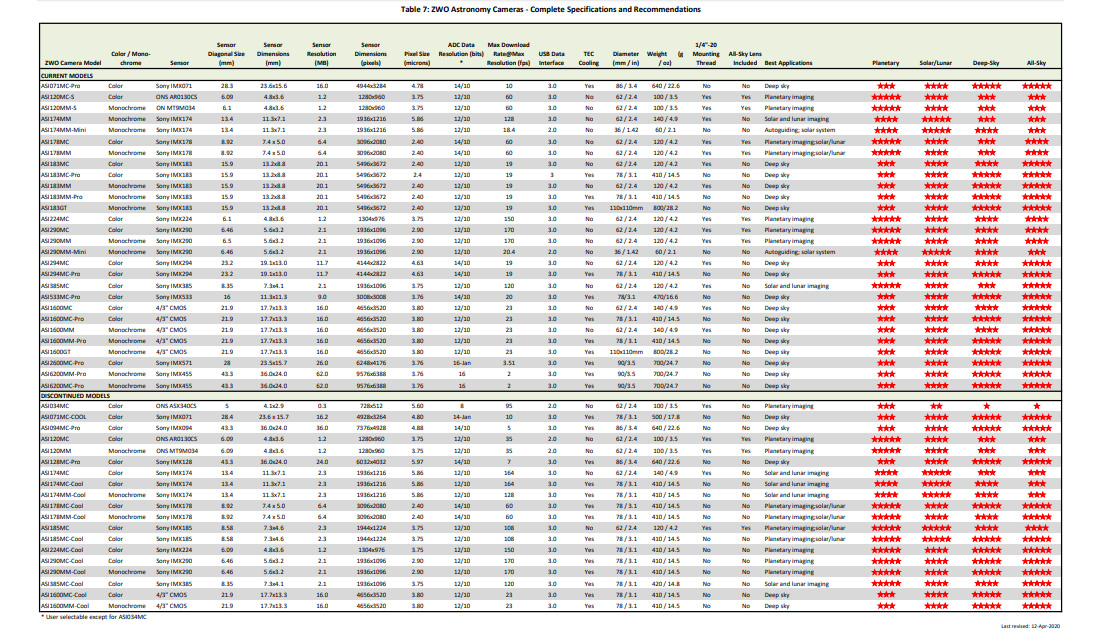
5. Consolidated Specification and Recommendation Table
For your convenience, all of the ZWO camera specifications and recommendations listed above have been compiled into one master table (Table 7) below. Click on the table image below to see a larger PDF version.
6. Accessories for ZWO Cameras
ZWO has a wide range of accessories available for their cameras including adapters, wide-angle lenses and lens adapters, as well as filters and filter wheels. While ZWO astronomy cameras include everything you need to get started in astrophotography with a telescope, several accessories are worthy of consideration depending on your application.
ASIAIR-Pro Controller: The ZWO ASIAIR-PRO is a small controller that provides wireless control of a ZWO camera and accessories as well as a power hub for some cooled ZWO cameras and all filter wheels. Through an installed app on an Android or iOS smartphone or tablet, the ASIAIR-PRO provides WiFi control and connectivity making it unecessary to use a computer or laptop for astrophotography and EAA.
All-Sky Lenses: Many ZWO cameras come with an all-sky lens to let you capture wide angle images of the night sky without a telescope. These small lenses give a 150° view of the sky so you can capture aurorae, meteors, and the wide band of the Milky Way. You can also remotely monitor sky conditions from an observing location.
Canon and Nikon Lens Adapters: ZWO also manufactures special T2 adapters with camera mounts so you can attach Canon or Nikon camera lenses directly to a ZWO astronomy cameras. These adapters permit you to shoot very wide-angle images of the heavens.
Filters: ZWO has introduced its own line of color and bandpass filters for astronomical imaging. These are offered in standard 1.25" and 2" filter sizes, as well as in 31mm and 36mm unmounted versions for use in their filter wheels.
ZWO's filter line-up includes a standard LRGB filter set for use with monochrome cameras, a premium LRGB filter set for monochrome cameras, IR Cut filters, and 850nm IR pass filters that can be used to enhance color and monochrome images. A very recent addition includes the narrowband SHO (Sulfur-II, Hydrogen-Alpha and Oxygen-III) filters that can be used by advanced imagers to make spectacular deep sky images such as the "Pillars of Creation" in the Eagle Nebula (M16).
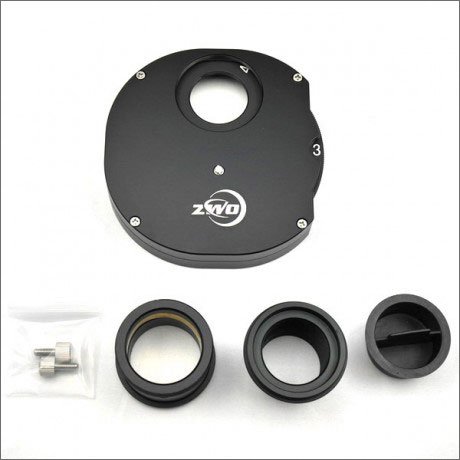
Filter Wheels: Filter wheels sit between the camera and the telescope to help you capture color images of astronomical objects with monochrome cameras. ZWO offers a range of filter wheels for all applications and budgets. At the simplest and most economical end, they offer a manual filter wheel that accepts five 1.25" filters. They have also released very popular 5, 7 and 8 position electronic filter wheels for 1.25", 31mmm, 36mm, and 2" filters. The larger 2" filter wheels are intended for use with the full-frame ASI6200-series cameras.
Adapters: ZWO now offers an ever-increasing range of simple yet necessary mechanical adapters for a variety of applications. These could be useful for attaching accessories with differing thread formats and getting the correct spacing between the camera and accessories such as focal reducers, barlows, and so forth.
Camera Kits: Camera kits, consisting of a camera, a filter wheel, and select filters are also offered for some popular camera models. Buying the kit saves you a little bit of money as compared to buying the individual items separately.
7. Summary
As this buyer's guide has shown, ZWO has a comprehensive (and growing) line of astronomy cameras to suit imagers with an interest in the planets, Moon and Sun, and the deep sky. With state of the art CMOS sensors, these multipurpose cameras are designed to suit a wide range of budgets and are easy to use, so it has been easier to get into astroimaging and start producing good results. ZWO is constantly innovating so new cameras and accessories are introduced often. As new products and accessories are introduced, this guide will be updated, so check back here regularly, or have a look at Agena's ZWO product page at this link.

About the Author
Brian Ventrudo is a writer, scientist, and astronomy educator. He received his first telescope at the age of 5 and completed his first university course in astronomy at the age of 12, eventually receiving a master's degree in the subject. He also holds a Ph.D. in engineering physics from McMaster University. During a twenty-year scientific career, he developed laser systems to detect molecules found in interstellar space and planetary atmospheres, and leveraged his expertise to create laser technology for optical communications networks. Since 2008, Brian has taught astronomy to tens of thousands of stargazers through his websites OneMinuteAstronomer.com and CosmicPursuits.com.

About the Author
Manish Panjwani has been an active amateur astronomer since before Halley's Comet last flew by our neighborhood. A former wireless communications consulting engineer and management consultant to various Fortune 500 companies, Manish started Agena AstroProducts in 2003. Since then, Agena has become one of the leading online retailers of telescopes and astronomical accessories worldwide. Besides observing from his heavily light polluted backyard in Los Angeles, Manish enjoys conducting astronomy outreach programs in local schools. Manish holds a Master's degree in Electrical Engineering from Virginia Tech and an MBA from the Kellogg School of Management at Northwestern University.