



William Optics Telescopes – A Buyer's Guide
1. About William Optics
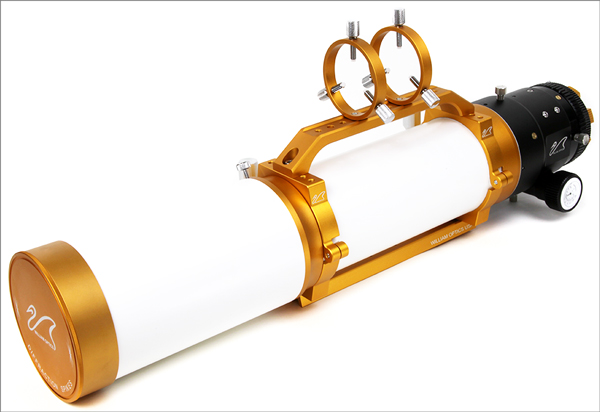
William Optics is a Taiwan-based manufacturer of telescopes and astronomical accessories. Founded by William Yang in 1996, the company concentrates on making high-quality and affordable refracting telescopes with a distinctive design and a robust build. William Optics refractors feature metal tubes and trim, ED (extra-low dispersion) glass in the objectives, and premium focusers for holding cameras and astrophotography accessories.
William Optics frequently introduces innovations and features into their telescopes, and they occasionally release entirely new product families. This buyer's guide summarizes the main characteristics of each current product line and serves as a single stop for information for prospective buyers of William Optics telescopes who wish to quickly understand how to choose a William Optics refractor for astronomical and terrestrial observation. As William Optics changes the features and specifications of their product lines, we will update this guide to keep it accurate and useful for the foreseeable future.
2. Overview of William Optics Telescopes
William Optics refractors are available in apertures from 51mm to 153mm and they come with doublet, triplet, and quadruplet apochromatic/ED objective lenses that are designed to suit most amateur astronomers from casual visual observers to serious astrophotographers. Some of the smaller instruments are also excellent for daytime terrestrial observing or photography. William Optics organizes its telescope product line into named series of refractors, each with distinctive characteristics. The current lines of William Optics telescopes include:
- (RC) Series apochromatic Petzval refractors
- Zenithstar (ZS) Series of ED/apochromatic doublet refractors
- Gran Turismo (GT) Series of apochromatic triplet refractors
- A limited series of Fluorostar (FLT) premium apochromatic triplet refractors
- Star Series of quadruplet imaging refractors
| Scope | Aperture (mm) | Focal Ratio | Focal Length | Objective | Focuser | Bahtinov Mask |
|---|---|---|---|---|---|---|
| RedCat 51 II | 51 | f/4.9 | 250 | Petzval | Helical | Yes |
| RedCat 71 | 71 | f/4.9 | 348 | Petzval | Helical | Yes |
| Zenithstar 61 II | 61 | f/5.9 | 360 | Doublet | 2" RP | Yes |
| Zenithstar 73 | 73 | f/5.9 | 430 | Doublet | 2.5" RP | Yes |
| Zenithstar 81 | 81 | f/6.9 | 559 | Doublet | 2.5" RP | Yes |
| GT71-II | 71 | f/5.9 | 420 | Triplet | 2.5" RP | Yes |
| GT81-IV | 81 | f/5.9 | 480 | Triplet | 2.5" RP | Yes |
| Fluorostar 91 | 91 | f/5.9 | 540 | Triplet | 3.3" RP | Yes |
| Fluorostar 120 | 120 | f/6.5 | 780 | Triplet | 3.3" RP | Yes |
| Fluorostar 132 | 132 | f/7 | 925 | Triplet | 3.3" RP | Yes |
Table 1 – A comparison of the main optical features of William Optics telescopes from the RedCat (RC), ZenithStar (ZS), Gran Turismo (GT), and Fluorostar (FLT) series.
| Scope | Mount Rings | Mount Rail | Carrying Handle |
Guide Rings | Dewshield Diameter (mm) |
Tube Diameter (mm) |
Retracted Length (mm) |
Weight (lbs) |
|---|---|---|---|---|---|---|---|---|
| RC51-II | Single | Vixen/Arca | No | No | TBD | TBD | 225 | 3.96 |
| ZS61 | Single | Vixen L-Base | No | No | TBD | TBD | 230 | 3.2 |
| ZS73 | Dual | Vixen/Arca | Yes | No | TBD | TBD | 390 | 5.5 |
| ZS81 | Dual | Vixen/Arca | Yes | No | TBD | TBD | 460 | 7.8 |
| ZS103* | Dual | Vixen | Yes | Yes | TBD | TBD | 615 | 9.7 |
| ZS126* | Dual | Losmandy | Yes | No | TBD | TBD | 790 | 21.8 |
| GT71-II | Dual | Vixen/Arca | Yes | No | TBD | TBD | 325 | 4.8 |
| GT81-III | Dual | Vixen/Arca | Yes | No | TBD | TBD | 390 | 8.7 |
| GT102* | Dual | Vixen | Yes | Yes | TBD | TBD | 678 | 14.0 |
| GT153* | Dual | Losmandy | Yes | No | TBD | TBD | 1100 | 29.5 |
| FLT156 | Triple | Losmandy | Yes | No | TBD | TBD | 1120 | 37.4 |
| FLT132-III | Dual | Losmandy | Yes | No | TBD | TBD | 780 | 19.8 |
| FLT91 | Dual | Vixen | Yes | No | TBD | TBD | 441 | 12.3 |
| WS71-II* | Dual | Vixen | No | Yes | TBD | TBD | 320 | 4.85 |
Table 2 – A comparison of the main mechanical features and accessories of William Optics telescopes from the RedCat (RC), ZenithStar (ZS), Gran Turismo (GT), Fluorostar (FLT), and Star (WS) series.
3. 'Cat' Series Petzval Refractors
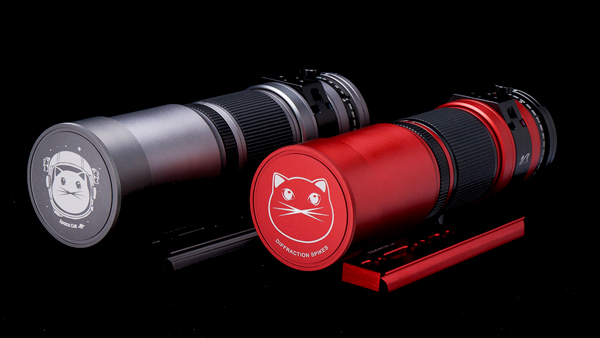
The William Optics RedCat series of telescopes uses a four-element Petzval lens system with high-quality synthetic fluorite FPL53 and FPL51 glass to achieve apochromatic performance over a wide and flat field, without the need for a field flattener or focal reducer. RedCats are currently available in an aperture of 51mm with a focal ratio of f/4.9, giving the telescope a focal length of 250mm.
The RedCat is intended for very wide field astronomical imaging: it has a field of nearly 10 degrees across a 43mm image circle that fills a full-frame camera sensor. The scope can also be used for terrestrial imaging. It can also be used for visual observation using a specially-made William Optics erecting diagonal (sold separately) that threads onto the focuser
While the optical and mechanical design of the RedCat series is quite sophisticated, these instruments are easy to use and suitable for intermediate to advanced observers. These scopes are not intended as a primary telescope for imaging or visual observing, but they make a good companion scope for those who already own longer focal length instruments.
The primary features of RedCat telescopes are:
- Apochromatic four-element objective lens in three groups with one FPL-53 glass element and one FPL-51 glass element to minimize chromatic aberration
- Dual-spec reversible mounting base for Vixen-style astronomy mounts or an Arca-Swiss mount used in photography tripod heads
- A helical focuser with engraved calibration markings and a tension adjustment to increase focusing drag or to lock the focuser in place; the focuser terminates in a male M48 thread for attaching a camera adapter or T-Ring
- To help frame and orient images, the scope includes a field rotator that is laser etched and fully rotatable by 360 degrees to a precision of one degree
- Just behind the field rotator is a slot to insert standard 2" astronomy filters with M48 threads
The RedCat is also quite compact, with a length of 225mm when fully retracted and with a weight of 3.24lbs.
In a sense, the RedCat 51 series is a hybrid between a telescope and a manual-focus camera lens. The color correction and image sharpness may exceed that of many camera lenses, which makes the RedCat ideal for terrestrial daylight photography and visual imaging of birds, wildlife, and landscapes. Owners of Sony mirrorless cameras can use autofocus with the RedCat with the addition of the optional TechArt Pro adapter than includes a built-in focusing motor.
The RedCat was first released in early 2019 in red with black trim and white with gold trim. In late 2019, a second generation was released with a 'Space Gray' color option with black trim. Additional upgraded features make the scopes easier to use. These features include:
- A tilt-adjustment mechanism on the rear to ensure that your camera sensor is squared with the optical axis
- A focusing index on the lens body, similar to that found on camera lenses
- A new mounting ring and longer dovetail rail
BEST FOR:
- Very wide-field astrophotography with cameras with APS-C and full-frame sensors
- Bird and wildlife photography
- Travel
LIMITATIONS:
- Short focal length renders small images of planets and smaller deep-sky objects
- Requires special diagonal to use visually
PRODUCT LINKS:
William Optics RedCat/SpaceCat 51mm Petzval refractors
4. ZenithStar Series Doublet 'Apo' Refractors
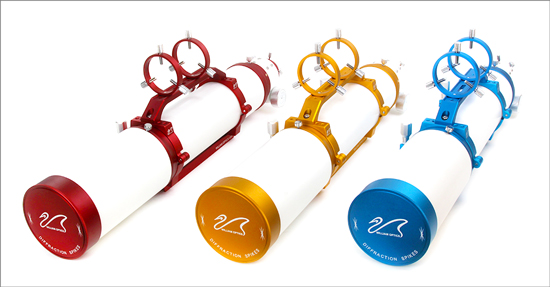
ZenithStar is an established series of apochromatic doublet telescopes by William Optics aimed at visual observers and astrophotographers. They are ideal instruments for newcomers to visual astronomy looking for a premium instrument. With an appropriate field flattener/focal reducer, they also serve as very good photographic instruments with many cameras including those with larger APS-C and full-frame sensors.
The primary features of ZenithStar telescopes are an apochromatic doublet objective lens with one FPL-53 glass element to minimize chromatic aberration, and an aluminum carrying handle matched to color trim of the rings and focuser. A set of rings (sold separately) can fit into the dovetail saddle on the handle
William Optics ZenithStar scopes are currently available in apertures of 61mm and 73mm (at f/5.9) and 81mm. Each model is available in three colors: red, blue, and gold. The ZS 103mm (at f/6.9) and ZS 126mm (at f/7.7) have been discontinued.
For visual use, no accessories other than a 1.25" or 2" diagonal and eyepiece are required, and these items are sold separately.
For casual imaging or EAA (electronically-assisted astronomy) with cameras with smaller sensors (those with a diagonal <10mm to 15mm approximately), a focal reducer or field flattener may not be required.
For more serious imaging with cameras with 1", micro 4/3, APS-C, or full-frame sensors, a field flattener or focal reducer is required to ensure sharp images across the entire field.
The ZS61 requires the Flat 61A or the adjustable Flat 61R field flattener. The ZS73 requires the Flat 73A or the adjustable Flat 73R field flattener. The William Optics Flat 6AIII adjustable field flattener/0.8x focal reducer works with the ZS81 and ZS103.
BEST FOR:
- Visual observation of deep sky and lunar/planetary (at longer focal lengths and larger apertures)
- Terrestrial observing and photography (with smaller apertures) using an erecting diagonal (sold separately)
- Astrophotography (with flattener reducer, sold separately)
LIMITATIONS:
- Slightly more residual color than triplet objectives
PRODUCT LINKS:
William Optics ZenithStar Doublet ED Refractors
5. Gran Turismo Series – Triplet Refractors
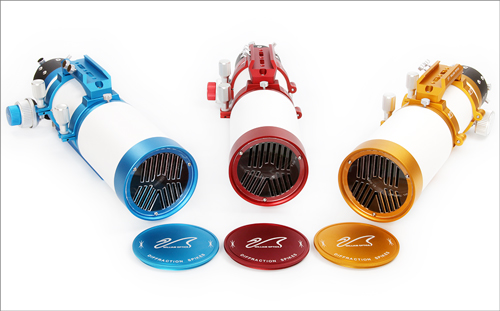
The William Optics Gran Turismo (GT) series uses apochromatic triplet objectives with an FPL-53 element to achieve a higher degree of color correction than the ZenithStar series. These scopes are intended for visual observers and astrophotographers who demand minimal residual color when imaging, especially when brighter objects are in the field of view. They are no more mechanically complex than ZenithStar scopes, so they are still suitable for beginners in visual astronomy looking for a premium instrument and willing to pay the premium for a triplet objective. With an appropriate field flattener/focal reducer, Gran Turismo scopes also serve as excellent photographic instruments with larger APS-C and full-frame cameras.
The Gran Turismo series is available in apertures of 71mm and 81mm (both f/5.9). Each aperture is available in a number of color trims. The GT 102mm (f/6.9) GT 153mm (f/7.8) have been discontinued.
The primary features of Gran Turismo telescopes are an apochromatic triplet objective lenses with one FPL-53 glass element to minimize chromatic aberration, and an aluminum carrying handle matched to color trim of the rings and focuser. A set of rings (sold separately) can fit into the dovetail saddle on the handle.
Telescopes in the Gran Turismo series also include a mounting plate and a dual-speed focuser.
For visual use, no accessories other than a 1.25" or 2" diagonal and eyepiece are required, and these items are sold separately.
For casual imaging or EAA (electronically-assisted astronomy) with cameras with smaller sensors (with a diagonal <10mm to 15mm approximately), a focal reducer or field flattener may not be required.
For more serious imaging with cameras with 1", micro 4/3, APS-C, or full-frame sensors, a field flattener or focal reducer is required to ensure sharp images across the entire field.
The GT71 and GT81 require the Flat 6AIII adjustable field flattener/0.8x focal reducer. The GT102 requires the William Optics Flattener 7A field flattener/0.8x focal reducer. The big GT153 requires William Optics Flattener 8 field flattener/0.72x focal reducer.
BEST FOR:
- Astrophotography (with flattener reducer, sold separately)
- Visual observation of deep sky and lunar/planetary (at longer focal lengths and larger apertures)
LIMITATIONS:
- Heavier and more expensive relative to doublet refractors
PRODUCT LINKS:
William Optics Gran Turismo (GT) Triplet ED Refractors
6. Fluorostar Refractors
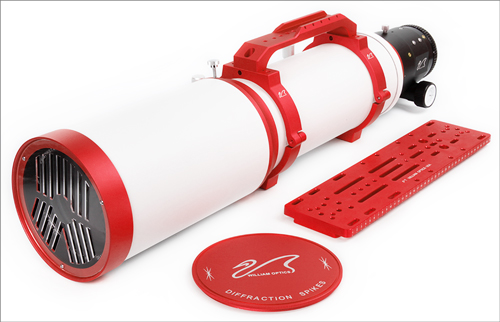
William Optics offers another model of apochromatic triplet refractor, the Fluorostar. It is similar to the Gran Turismo series, and at present it comes in apertures of 91mm at f/5.9, 132mm at f/7, and 156mm at f/7.8 These are premium instruments primarily aimed at astrophotographers, but they can also be used for visual observations. The Fluorostar refractors further reduce chromatic aberration relative to the Gran Turismo series. Because of its larger size, the FLT132 and FLT156 come with a heavier mounting plate, while the FLT91 comes with a Vixen-style mounting plate.
For astrophotography, the FLT91 refractor requires the William Optics FLAT6III-M92 field flattener/0.8x focal reducer or the FLAT 68III flattener.
The FLT132 refractor requires the William Optics Flattener 8 field flattener/0.72x focal reducer for astrophotography with larger-sensor cameras. The FLT132 is also offered with a FeatherTouch focuser upgrade.
BEST FOR:
- Astrophotography (with flattener reducer, sold separately)
- Visual observation of deep sky and lunar/planetary
LIMITATIONS:
- Heavier and more expensive relative to doublet refractors
PRODUCT LINKS:
- William Optics Fluorostar Triplet ED Refractors
7. Field Flatteners and Focal Reducers
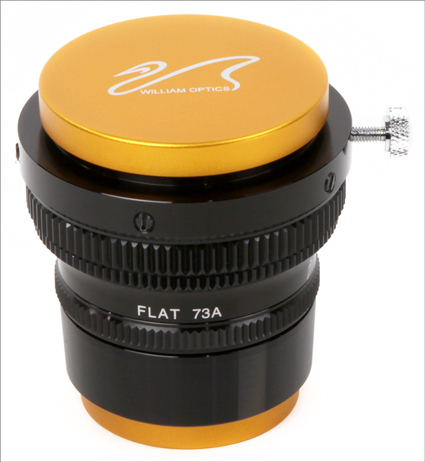
William Optics also offers a wide assortment of field flatteners and focal reducers designed to work optimally with their refracting telescopes. These optical accessories are used by astrophotographers to correct for the curved focal plane produced by the fast objective lens and enable a tight focus across the entire focal plane to the edge of the field of view. Some field flatteners also serve as a focal reducer to shorten the effective focal length (and reduce the focal ratio) of the telescope so that extended celestial objects can be imaged with shorter exposure times.
William Optics produces several models of focal reducers for their telescopes. Table 3 shows the properties of each focal reducer and summarizes which reducer works with which William Optics telescope. Some scopes, including the William Optics Star and RedCat series, do not require a focal reducer or field flattener for astrophotography.
| Item | Reduction Factor | Thread on Scope Side | Thread on Camera Side | Compatible Scopes | Adjustment Setting (mm) |
|---|---|---|---|---|---|
| P-6AIII | 0.8x | M63 | M48 | GT71 | 7.1 |
| GT81 | 5.1 | ||||
| ZS81 | 0.5 | ||||
| ZS103 | 3.2 | ||||
| P-6AIII-M92 | 0.8x | M92 | M48 | FLT91 | n/a |
| P-FLAT8 | 0.72x | M92 | M48 | GT153 | 5.4 |
| FLT132 | 8.4 | ||||
| 102GTS | 12.0 | ||||
| P-FLAT7A | 0.72x | M92 | M48 | FLT132 | 14.24 |
| FLT156 | 10.29 | ||||
| GT102 | 15.6 | ||||
| GT153 | 10.41 | ||||
| ZS126 | 12.76 | ||||
| P-FLAT61A | Flattener only | M54 | M48 | ZS61 | n/a |
| P-FLAT61R | 0.8x | M54 | M54 | ZS61 | n/a |
| P-FLAT73A | Flattener only | M63 | M48 | ZS73 | n/a |
| P-FLAT73R | 0.8x | M63 | M48 | ZS73 | n/a |
| GS61A | Flattener only | M54 | M48 | GS61 | n/a |
| P-FLAT68III | Flattener only | M92 | M48 | GT153 | 2.8 |
| ZS126 | 3.0 | ||||
| FLT132 | 7.7 | ||||
| 102GTS | 13.6 | ||||
| FLT91 | TBD |
Table 3 – Characteristics and compatibility of William Optics field flatteners/focal reducers.
As Table 3 shows, some William Optics field flatteners are fixed devices for particular telescopes like the ZenithStar 61 and ZenithStar 73. Others flatteners or flattener/focal reducers are adjustable to work with several William Optics scopes. Each of these scopes has a different focal plane position with respect to the back of the optical tube, so the length of the flattener can be set by the user to ensure the combined back focus of the system is close to 55mm for astrophotography. Table 3 includes the suggested settings for each flattener with their compatible scopes.
These flattener/focal reducers are constructed with multiple optical elements. The more expensive premium devices also incorporate low dispersion Ohara glass to minimize additional chromatic aberration.
8. Accessories
Finders
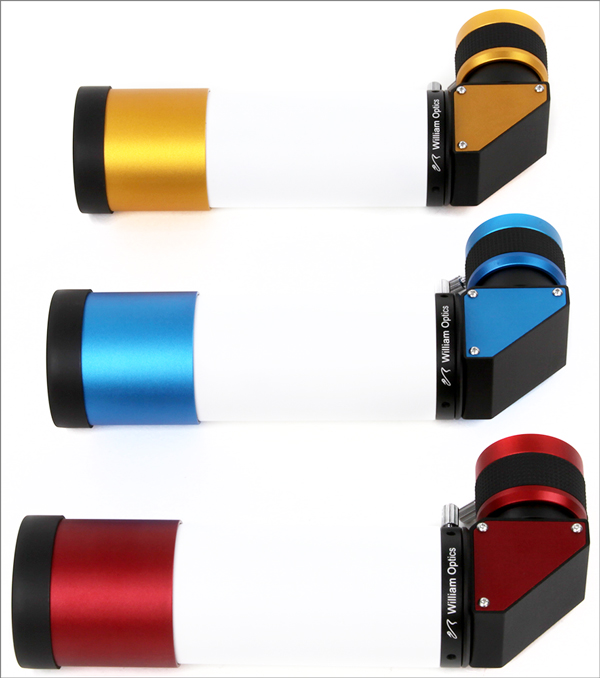
William Optics has offered a number of premium quality finder scopes that match the style of their telescopes. They currently offer a red-dot finder and a 50mm RACI (right-angle correct image) finder scope with several color trims to match William Optics telescopes
The William Optics red-dot finder fits most William Optics scopes, as well as other telescopes, and includes a Vixen-style mounting base.
The William Optics 50mm RACI finder does not include an eyepiece, but it can be used with a 1.25" eyepiece with or without a reticle. The f/4 objective lens has a focal length of 200mm, so a 20mm eyepiece gives a magnification of 10x while a 24mm eyepiece gives a magnification of 8.3x. The finder includes a helical focuser that will bring several (but not all) 1.25" eyepieces to focus. It may take a bit of trial and error to find an eyepiece that will work. A reticle eyepiece, which is useful to help center a star in the field. The Agena Astro 24mm reticle eyepiece can be used with this 50mm RACI finder.
William Optics also makes clamping rings for their magnifying finders that fit most current William Optics Telescopes.
PRODUCT LINKS:
William Optics Finder Scopes
Guide Scopes
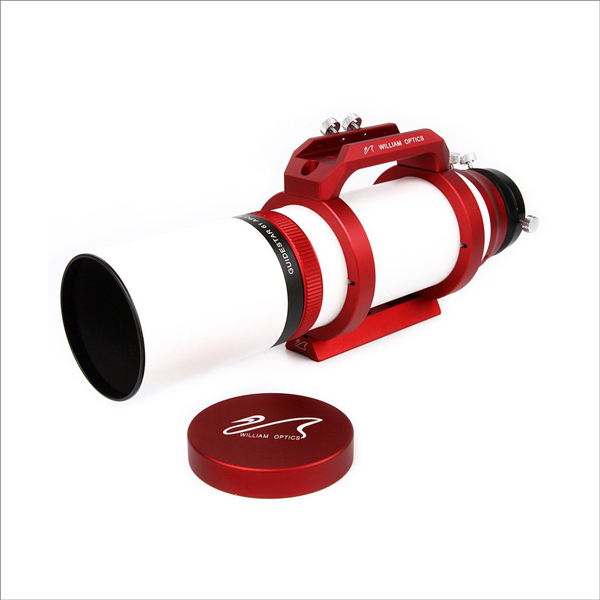
Many William Optics telescopes are used for astrophotography, and the company offers their own lines of guide scopes that can be mounted on their refractors.
Their largest guide scope, the GuideStar61 (GS61) series, is based on the ZenithStar 61mm apochromatic refractors but with a simpler focuser and lighter-weight housing to keep the overall weight low. In the GuideStar series, the conventional Z61 focuser has been replaced by a rotatable 2" drawtube that you can slide in or out manually over a range of 60mm for coarse focusing. Fine focusing is accomplished by rotating the dewshield and locking it in place as is done on many finderscopes. The dewshield can be adjusted over a distance of 25mm.
The bottom of the GS61 features a narrow Vixen/Synta-style finder dovetail rail (32mm wide x 120mm long). This is designed to fit into the Saddle/handlebar found on William Optics scopes or in other compatible finder bases. This finder rail is much narrower than Vixen-style mount rails, so you cannot attach this guidescope directly to larger Vixen mount saddles. The top features a Vixen-style handle/saddlebar. To attach your guide camera directly to the guidescope, it must have a 2" nosepiece.
Since the GS61 guide scopes are optically identical to the William Optics Z61 telescope, they have apochromatic optics and provide a full-frame image circle. That means the GS61 can be used as a primary imaging scope, and the use of the FLAT-GS61 field flattener (sold separately), which is made specifically for this telescope, is highly recommended. Since the GS61 terminates in a male M48 thread, a camera-specific 48mm wide T ring is also required (sold separately).
UniGuide Guide Scopes
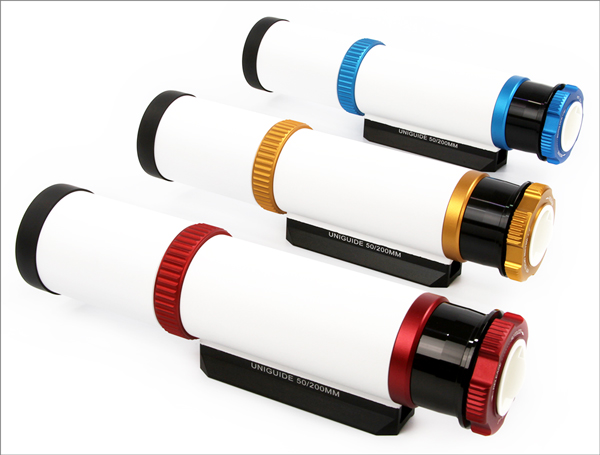
The William Optics UniGuide Scope series features a 50mm f/4 objective with the William Optics RotoLock to hold the guide camera. This scope features a black anodized Vixen/Synta-style rail bolted to the bottom of the finder tube for direct insertion into compatible handles on new William Optics telescopes. The scope is not intended for use with conventional guidescope rings or finder rings as the mounting rail cannot be removed.
A version of the above guide scope is also available without the mounting rail for those who wish to use the scope with guidescope rings.
Both series of guide scopes have only 6.2mm of back-focus available, so they can only be used with 1.25" cylinder-type or "Mini" cameras from QHY, ZWO, SBIG, and so forth. It's important to check your camera or autoguider's back-focus requirements to ensure compatibility before using this scope. Neither of these scopes can be used as a finder with a reticle eyepiece, as they do not have sufficient back-focus (in-focus) travel. For focusing, the RotoLock adapter rides on an M48 threaded barrel, allowing it to be screwed in or out to obtain focus. The lock ring is included.
PRODUCT LINKS:
William Optics UniGuide 50mm Guide Scopes
William Optics UniStar 61mm Guide Scopes
Diagonals
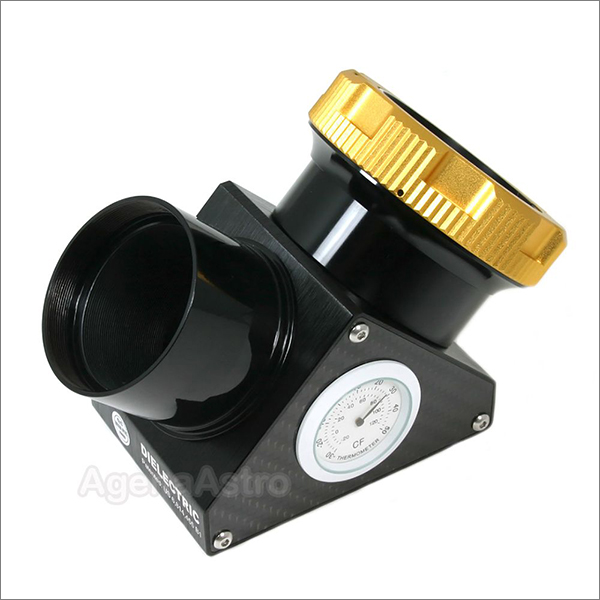
William Optics also offers a wide assortment of 1.25" and 2" mirror or prism diagonals to complement their refractors and for use with other telescope for visual observation. Their premium diagonals include a Dura Bright coating for high reflectivity and a RotoLock collar to easily fasten the diagonal to the telescope. The company also offers erecting prism diagonals for terrestrial observation, and specialty diagonals intended for use only with specific William Optics telescopes like the RedCat/SpaceCat and Star 71 refractors. See the current line of William Optics diagonals at this link.
PRODUCT LINK:
William Optics Diagonals and Accessories
9. Summary
This guide described and summarized the features and specifications of the telescope and accessories available from William Optics. Since William Optics makes very frequent changes to their telescope and accessory lineup, we suggest readers visit our product pages for information on the latest and most current product configurations.

About the Author
Brian Ventrudo is a writer, scientist, and astronomy educator. He received his first telescope at the age of 5 and completed his first university course in astronomy at the age of 12, eventually receiving a master's degree in the subject. He also holds a Ph.D. in engineering physics from McMaster University. During a twenty-year scientific career, he developed laser systems to detect molecules found in interstellar space and planetary atmospheres, and leveraged his expertise to create laser technology for optical communications networks. Since 2008, Brian has taught astronomy to tens of thousands of stargazers through his websites OneMinuteAstronomer.com and CosmicPursuits.com.

About the Author
Manish Panjwani has been an active amateur astronomer since before Halley's Comet last flew by our neighborhood. A former wireless communications consulting engineer and management consultant to various Fortune 500 companies, Manish started Agena AstroProducts in 2003. Since then, Agena has become one of the leading online retailers of telescopes and astronomical accessories worldwide. Besides observing from his heavily light polluted backyard in Los Angeles, Manish enjoys conducting astronomy outreach programs in local schools. Manish holds a Master's degree in Electrical Engineering from Virginia Tech and an MBA from the Kellogg School of Management at Northwestern University.